
太极拳对1176名成年人血浆同型半胱氨酸的影响:一项基于倾向评分匹配的研究。
The effect of Tai Chi on plasma homocysteine in 1176 adults: a propensity score matching-based study.
作者信息
Gu Yingchun, Bai Juncai, Li Yang, Han Ling, Wang Dongwei
机构信息
Department of Cardiac Rehabilitation, Zhengzhou Central Hospital Affiliated to Zhengzhou University, Zhengzhou, 450000, China.
出版信息
BMC Cardiovasc Disord. 2025 Jan 29;25(1):61. doi: 10.1186/s12872-025-04519-9.
BACKGROUND
Tai Chi is a low-impact form of exercise that involves a series of slow movements that flow together. Increased plasma homocysteine(Hcy) levels are associated with an increased risk of cardiovascular diseases and may be reduced by exercise. This study aimed to compare plasma Hcy levels and the risk of hyperhomocysteinemia in 1,176 adults with and without Tai Chi exercises.
METHODS
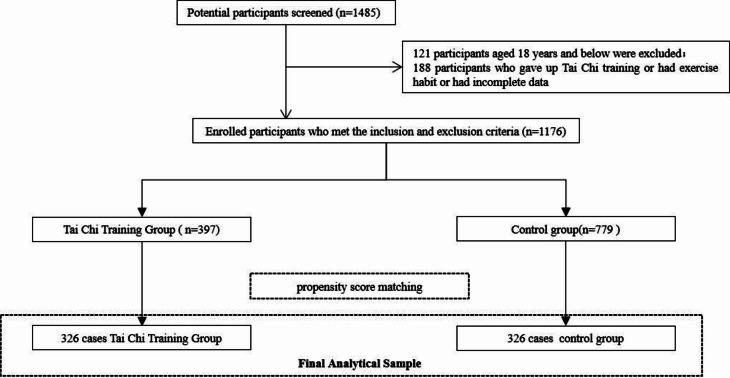
This study included 1176 participants from Chenjiagou who adhered to Tai Chi exercise (Tai Chi group, n = 397) and physical examination participants (control group, n = 779). In the Tai Chi group, the type of exercise was 24 simplified forms of Tai Chi, at least 3 times/week for 30-60 min/ time. The median duration of practice for Tai Chi group was 26.5 (11,41) years. Participants in the control group had no regular exercise habits. Baseline data and blood samples were collected from both the groups. Plasma Hcy in the two groups was determined by using the enzyme-linked immunosorbent assay (ELISA) Kit for Hcy. The primary outcome was the difference in Hyc levels between the two groups and the secondary outcome was the effect of Tai Chi on the risk of hyperhomocysteinemia. Propensity score matching(PSM) and other statistical methods were used to balance confounding bias matching and to analyze the effect of Tai Chi on plasma Hcy levels.
RESULTS
In total, 326 pairs of participants were successfully matched between the Tai Chi group and control group. After matching, the plasma Hcy level of the Tai Chi group was 12.30(10.38, 18.16) umol/L, and that of the control group was 14.69(10.63, 20.29) umol/L, and there was a statistical difference between the two groups (P = 0.008). The prevalence of hyperhomocysteinemia (P<0.001) was significantly lower in the Tai Chi group. Univariate analysis showed that the risk of hyperhomocysteinemia in the control group was 2.37 times higher than that in Tai Chi group. After adjusting for confounding factors, the risk of hyperhomocysteinemia in the control group was 3.67 times higher than that in Tai Chi group.
CONCLUSIONS
Tai Chi exercise may be associated with lower homocysteine levels and is a promising aerobic exercise for Hcy control.
TRIAL REGISTRATION NUMBER
ChiCTRl900023059 (Chinese Clinical Trial Registry). The registration date: 2019.5.9.
背景
太极拳是一种低强度的运动形式,由一系列连贯的缓慢动作组成。血浆同型半胱氨酸(Hcy)水平升高与心血管疾病风险增加相关,而运动可能降低该水平。本研究旨在比较1176名有或没有进行太极拳锻炼的成年人的血浆Hcy水平及高同型半胱氨酸血症风险。
方法
本研究纳入了来自陈家沟坚持太极拳锻炼的1176名参与者(太极拳组,n = 397)和参加体检的参与者(对照组,n = 779)。在太极拳组中,运动类型为24式简化太极拳,每周至少3次,每次30 - 60分钟。太极拳组的练习中位时长为26.5(11,41)年。对照组参与者没有规律的运动习惯。两组均收集了基线数据和血样。使用Hcy酶联免疫吸附测定(ELISA)试剂盒测定两组的血浆Hcy。主要结局是两组间Hyc水平的差异,次要结局是太极拳对高同型半胱氨酸血症风险的影响。采用倾向得分匹配(PSM)等统计方法平衡混杂偏倚匹配,并分析太极拳对血浆Hcy水平的影响。
结果
太极拳组和对照组共成功匹配326对参与者。匹配后,太极拳组的血浆Hcy水平为12.30(10.38, 18.16)μmol/L,对照组为14.69(10.63, 20.29)μmol/L,两组间存在统计学差异(P = 0.008)。太极拳组高同型半胱氨酸血症的患病率显著更低(P < 0.001)。单因素分析显示,对照组高同型半胱氨酸血症的风险比太极拳组高2.37倍。校正混杂因素后,对照组高同型半胱氨酸血症的风险比太极拳组高3.67倍。
结论
太极拳锻炼可能与较低的同型半胱氨酸水平相关,是一种有前景的用于控制Hcy的有氧运动。
试验注册号
ChiCTRl900023059(中国临床试验注册中心)。注册日期:2019年5月9日。

 Zotero 插件