
安徽省大学生近十年身体素质的长期变化趋势。
Secular trends of physical fitness for college students in Anhui Province over the past decade.
作者信息
Sun Jianzhong, Liang Hui, Wang Lei, Chen Zhongju, Bi Cunjian, Zhang Feng
机构信息
School of Physical Education, Chizhou University, Chizhou, 247000, China.
Sports for Health Promotion Center, Chizhou University, Chizhou, 247000, China.
出版信息
BMC Public Health. 2025 Jan 28;25(1):357. doi: 10.1186/s12889-025-21613-x.
BACKGROUND
Since the beginning of the 21st century, China's economy has experienced rapid growth, resulting in a steady improvement in its citizens' living standards. However, alongside the emergence of modern civilization-related health issues, the overall physical fitness of the population has been declining. In the final year of 2019, a global COVID-19 pandemic emerged and persisted for three years, causing a significant diminution in human physical well-being. This article aims to delve into the changes in the physical fitness of college students over the past decade and anticipates future trends.
METHODS
A total of 58,472 university students aged 16-23 from 16 prefecture-level cities in Anhui province were recruited for this study. Total ten physical fitness indicators were tested: body height, body weight, vital capacity, standing long jump, sit-and-reach, 50-m dash, 1000 m run and pull-up (for boys), and 800 m run and sit-ups (for girls).The data were analyzed using one-way ANOVA, LSD tests, and Pearson's correlations.
RESULTS
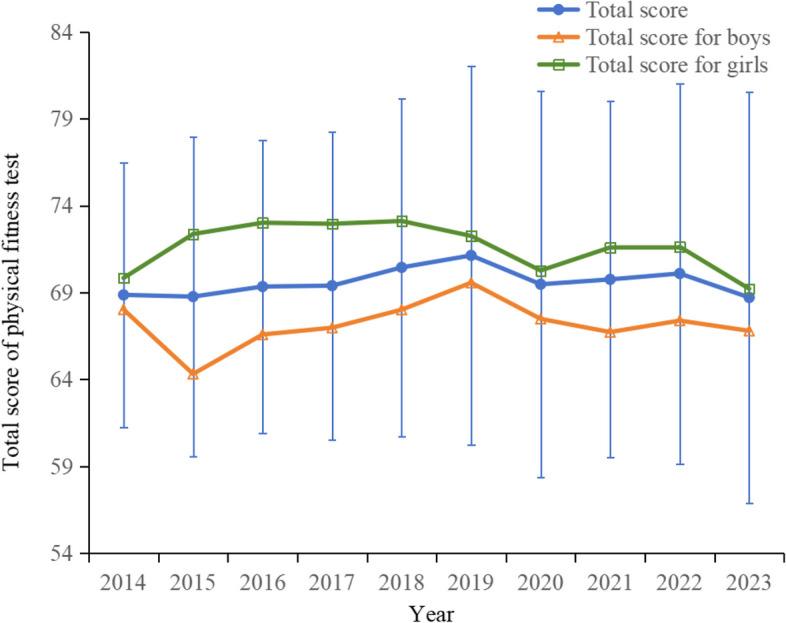
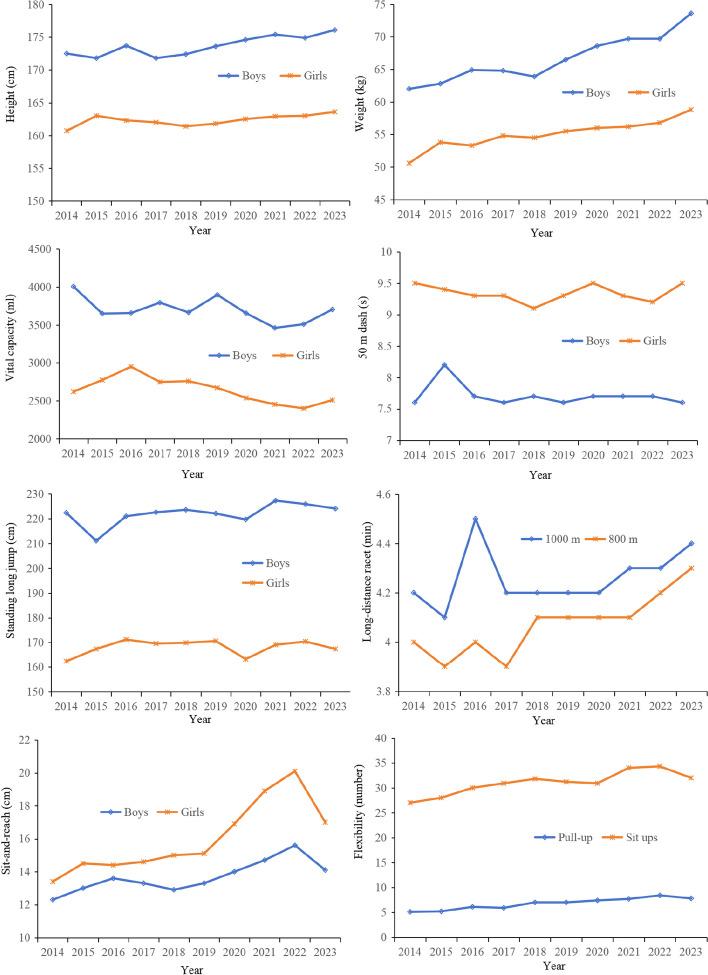
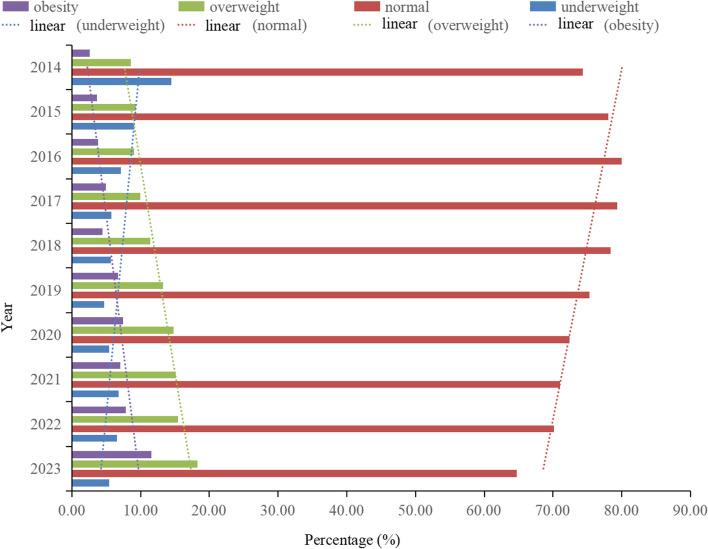
The overall physical fitness scores of college students ranged from 68.71 (2023) to 71.13 (2019) during the last decade, with girls consistently demonstrating superior performance in physical tests. There was a statistically significant difference in physical fitness scores between the periods of 2015-2022 and 2023 (p < 0.05). When dividing the total physical fitness scores into four levels, a noteworthy downward trend was observed in the pass grade, while the other three grades exhibited an increasing trend year by year. Compared to the year of 2019, there has been a substantial decline in the physical fitness levels of college students, along with a notable uptick of "failed" candidates, in the year of 2020.In terms of individual physical fitness, boys outperformed girls in all physical testing items except for sit-and-reach, and significant differences were observed in most years for both boys and girls. Additionally, a consistent downward trend was observed in the proportion of underweight and normal weight students, while the proportion of overweight (increased by 2.1 times) and obese (increased by 4.4 times) students showed a marked upward trend from 2014 to 2023.
CONCLUSIONS
It is imperative to allocate special focus to the profound ramifications of the three-year COVIE-19 pandemic on the physical well-being of college students. In 2024, it is anticipated that the proportion of overweight and obese college students will increase, along with a continued increase in body height and vital capacity. However, there will be a notable increase in the time taken to complete the 50-meter dash and the 1000-meter/800-meter run. Conversely, a decline is forecasted for the performance in standing long jump, sit-and-reach, and pull-ups/sit-ups exercises, with an accelerating rate of deterioration. It is crucial to promptly identify the underlying reasons for the deteriorating physical fitness among college students, particularly in relation to obesity, and to implement effective measures promptly to address this issue.
背景
自21世纪初以来,中国经济快速增长,公民生活水平稳步提高。然而,随着与现代文明相关的健康问题出现,人口总体身体素质一直在下降。2019年末,全球新冠疫情爆发并持续了三年,导致人类身体健康显著下降。本文旨在探讨过去十年大学生身体素质的变化,并预测未来趋势。
方法
本研究招募了安徽省16个地级市的58472名16 - 23岁的大学生。共测试了十项身体素质指标:身高、体重、肺活量、立定跳远、坐位体前屈、50米短跑、1000米跑(男生)和引体向上(男生),800米跑(女生)和仰卧起坐(女生)。数据采用单因素方差分析、LSD检验和Pearson相关性分析。
结果
在过去十年中,大学生的总体身体素质得分在68.71(2023年)至71.13(2019年)之间,女生在体能测试中始终表现优异。2015 - 2022年和2023年期间的身体素质得分存在统计学显著差异(p < 0.05)。将总体身体素质得分分为四个等级时,及格等级出现了明显的下降趋势,而其他三个等级逐年呈上升趋势。与2019年相比,2020年大学生的身体素质水平大幅下降,“不及格”人数显著增加。在个体身体素质方面,除坐位体前屈外,男生在所有体能测试项目中均优于女生,且大多数年份男生和女生之间均存在显著差异。此外,体重过轻和正常体重学生的比例呈持续下降趋势,而超重(增加了2.1倍)和肥胖(增加了4.4倍)学生的比例在2014年至2023年期间呈显著上升趋势。
结论
必须特别关注新冠疫情三年对大学生身体健康的深远影响。预计2024年超重和肥胖大学生的比例将增加,身高和肺活量也将持续增加。然而,完成50米短跑和1000米/800米跑所需的时间将显著增加。相反,预计立定跳远、坐位体前屈和引体向上/仰卧起坐的成绩将下降,且下降速度加快。及时找出大学生身体素质下降的根本原因,特别是与肥胖相关的原因,并迅速采取有效措施解决这一问题至关重要。


 Zotero 插件