
根据AGREE II对喉炎和咽炎护理临床指南的质量评估
Quality assessment of clinical guidelines in the care of laryngitis and pharyngitis according to AGREE II.
作者信息
Carvalho Lucas Mateus Rodrigues, Barbosa Ana Paula de Oliveira, Laismann Nara Amanda, Barros Débora Santos Lula, Lima Rodrigo Fonseca, Santana Rafael Santos
机构信息
Departamento de Farmácia, Universidade de Brasília - UnB - Brasília (DF), Brasil.
出版信息
Codas. 2025 Jan 27;37(1):e20240016. doi: 10.1590/2317-1782/e20240016en. eCollection 2025.
PURPOSE
The study aimed to identify and assess the methodological quality of essential clinical guidelines for the management of laryngitis and pharyngitis.
METHODS
A systematic search of clinical guidelines for the management of laryngitis and pharyngitis was performed in three databases. Methodological quality was assessed according to AGREE II, in which each item in its domains was scored by four independent evaluators. To determine the agreement, a weighted Kappa square statistic calculation was performed.
RESULTS
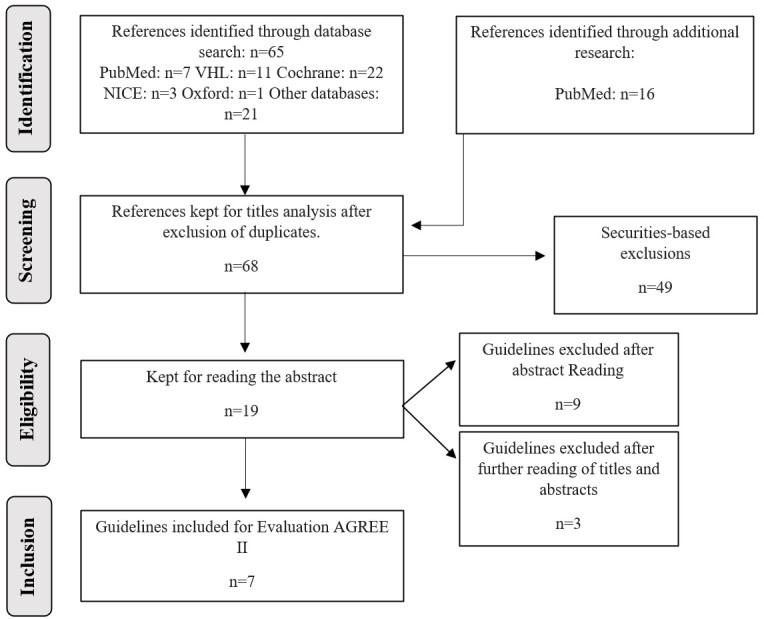
81 studies were found in the bibliographic sources consulted and all were evaluated. Considering the exclusion criteria, seven guidelines were selected for final evaluation by AGREE II. The squared weighted Kappa coefficient calculated after the first round of evaluation by AGREE II was 0.85, within an almost perfect agreement rate. The domains "stakeholder engagement", "applicability", and "editorial independence" had the lowest mean scores and the highest standard deviation indices. They had, respectively, a mean score of (63.7%) with a standard deviation of (17%), a mean score of (65.7%) with a standard deviation of (22%), and a mean score of (35%) with a standard deviation of (23%). The use of penicillin, erythromycin, ampicillin, amoxicillin, azithromycin and clarithromycin were recommended in (75%) of all guidelines that presented pharmacological measures. As a non-pharmacological measure, oral rehydration and gargling were recommended by two guidelines.
CONCLUSION
The statistical results indicate that all guidelines were considered as recommended. However, no uniformity was observed in the recommendations of these seven guidelines with regard to non-pharmacological and pharmacological treatment.
目的
本研究旨在识别和评估喉炎和咽炎管理基本临床指南的方法学质量。
方法
在三个数据库中对喉炎和咽炎管理的临床指南进行系统检索。根据AGREE II评估方法学质量,其领域中的每个项目由四名独立评估者评分。为确定一致性,进行加权Kappa平方统计计算。
结果
在所查阅的文献来源中发现81项研究并全部进行评估。考虑排除标准后,选择七项指南进行AGREE II最终评估。AGREE II第一轮评估后计算的加权Kappa平方系数为0.85,一致性几乎完美。“利益相关者参与”“适用性”和“编辑独立性”领域的平均得分最低,标准差指数最高。它们的平均得分分别为(63.7%),标准差为(17%);平均得分(65.7%),标准差为(22%);平均得分(35%),标准差为(23%)。在所有提出药理学措施的指南中,(75%)推荐使用青霉素、红霉素、氨苄青霉素、阿莫西林、阿奇霉素和克拉霉素。作为非药理学措施,两项指南推荐口服补液和漱口。
结论
统计结果表明所有指南均被视为推荐。然而,这七项指南在非药理学和药理学治疗建议方面未观察到一致性。
 Zotero 插件