
四个非洲国家成年人的肥胖表型与血脂异常:一项H3Africa AWI-Gen研究
Obesity phenotypes and dyslipidemia in adults from four African countries: An H3Africa AWI-Gen study.
作者信息
Nonterah Engelbert A, Agongo Godfred, Crowther Nigel J, Mohamed Shukri F, Micklesfield Lisa K, Boua Palwendé Romuald, Wade Alisha N, Choma Solomon S R, Sorgho Hermann, Kissiangani Isaac, Asiki Gershim, Ansah Patrick, Oduro Abraham R, Norris Shane A, Tollman Stephen M, Raal Frederick J, Alberts Marianne, Ramsay Michele
机构信息
Navrongo Health Research Centre, Ghana Health Service, Navrongo, Ghana.
Julius Centre for Health Sciences and Primary Care, University Medical Centre Utrecht, Utrecht University, Utrecht, The Netherlands.
出版信息
PLoS One. 2025 Jan 30;20(1):e0316527. doi: 10.1371/journal.pone.0316527. eCollection 2025.
INTRODUCTION
The contribution of obesity phenotypes to dyslipidaemia in middle-aged adults from four sub-Saharan African (SSA) countries at different stages of the epidemiological transition has not been reported. We characterized lipid levels and investigated their relation with the growing burden of obesity in SSA countries.
METHODS
A cross-sectional study was conducted in Burkina Faso, Ghana, Kenya and South Africa. Participants were middle aged adults, 40-60 years old residing in the study sites for the past 10 years. Age-standardized prevalence and adjusted mean cholesterol, LDL-C, HDL-C, triglycerides and non-HDL-C were estimated using Poisson regression analyses and association of body mass index (BMI), waist circumference (WC) and waist-to-hip ratio (WTHR) with abnormal lipid fractions modeled using a random effects meta-analysis. Obesity phenotypes are defined as BMI ≥ 30 kg/m2, increased WC and increased waist-to-hip ratio.
RESULTS
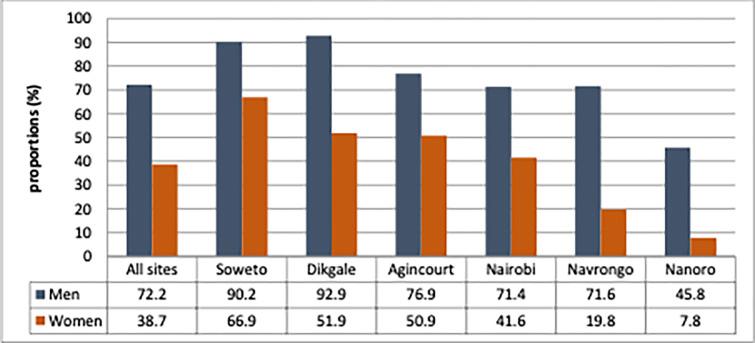
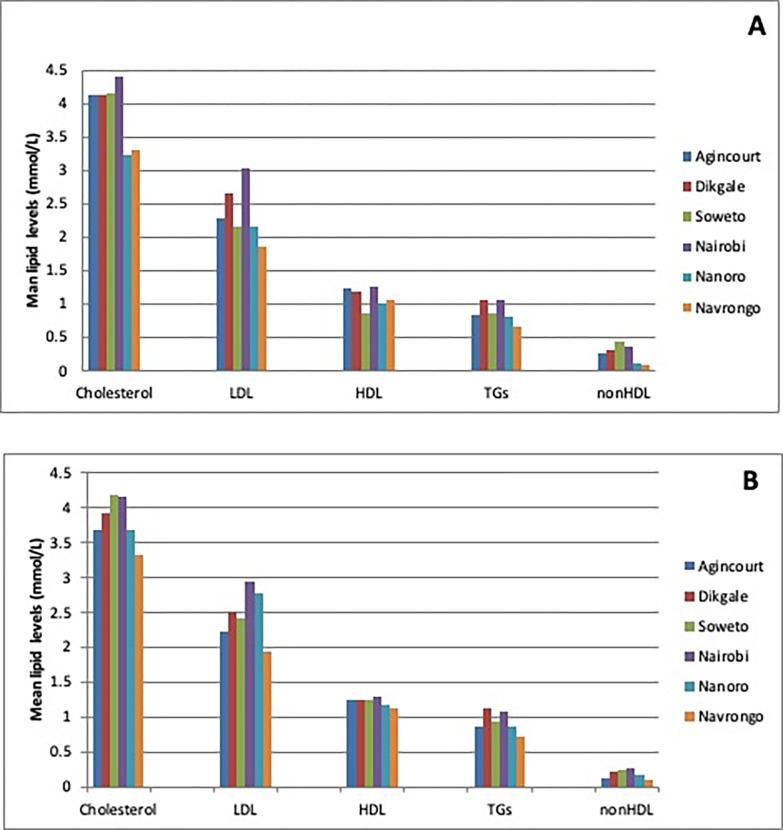
A sample of 10,700 participants, with 54.7% being women was studied. Southern and Eastern African sites recorded higher age-standardized prevalence of five lipid fractions then West African sites. Men had higher LDL-C (19% vs 8%) and lower HDL-C (35% vs 24%) while women had higher total cholesterol (15% vs 19%), triglycerides (9% vs 10%) and non-HDL-cholesterol (20% vs 26%). All lipid fractions were significantly associated with three obesity phenotypes. Approximately 72% of participants in the sample needed screening for dyslipidaemia with more men than women requiring screening.
CONCLUSION
Obesity in all forms may drive a dyslipidaemia epidemic in SSA with men and transitioned societies at a higher risk. Targeted interventions to control the epidemic should focus on health promoting and improved access to screening services.
引言
尚未有关于撒哈拉以南非洲(SSA)四个国家处于流行病学转变不同阶段的中年成年人肥胖表型对血脂异常影响的报道。我们对SSA国家的血脂水平进行了特征描述,并研究了它们与日益加重的肥胖负担之间的关系。
方法
在布基纳法索、加纳、肯尼亚和南非进行了一项横断面研究。参与者为40至60岁的中年成年人,过去10年一直居住在研究地点。使用泊松回归分析估计年龄标准化患病率以及调整后的平均胆固醇、低密度脂蛋白胆固醇(LDL-C)、高密度脂蛋白胆固醇(HDL-C)、甘油三酯和非高密度脂蛋白胆固醇,并使用随机效应荟萃分析对体重指数(BMI)、腰围(WC)和腰臀比(WTHR)与异常血脂成分之间的关联进行建模。肥胖表型定义为BMI≥30kg/m²、腰围增加和腰臀比增加。
结果
对10700名参与者进行了研究,其中54.7%为女性。南部和东部非洲地区的五个血脂成分的年龄标准化患病率高于西非地区。男性的LDL-C较高(19%对8%),HDL-C较低(35%对24%),而女性的总胆固醇较高(15%对19%)、甘油三酯较高(9%对10%)和非高密度脂蛋白胆固醇较高(20%对26%)。所有血脂成分均与三种肥胖表型显著相关。样本中约72%的参与者需要进行血脂异常筛查,需要筛查的男性多于女性。
结论
各种形式的肥胖可能在SSA引发血脂异常流行,男性和处于转变阶段的社会面临的风险更高。控制这一流行的针对性干预措施应侧重于促进健康和改善筛查服务的可及性。
 Zotero 插件