
利用链霉素聚酮合酶酰基转移酶固有的底物选择性来进行类似物的突变生物合成。
Exploiting the inherent promiscuity of the acyl transferase of the stambomycin polyketide synthase for the mutasynthesis of analogues.
作者信息
Su Li, Souaibou Yaouba, Hôtel Laurence, Jacob Christophe, Grün Peter, Shi Yan-Ni, Chateau Alicia, Pinel Sophie, Bode Helge B, Aigle Bertrand, Weissman Kira J
机构信息
Université de Lorraine, CNRS, IMoPA F-54000 Nancy France
Université de Lorraine, INRAE, DynAMic F-54000 Nancy France
出版信息
Chem Sci. 2025 Jan 22;16(12):5076-5088. doi: 10.1039/d4sc06976e. eCollection 2025 Mar 19.
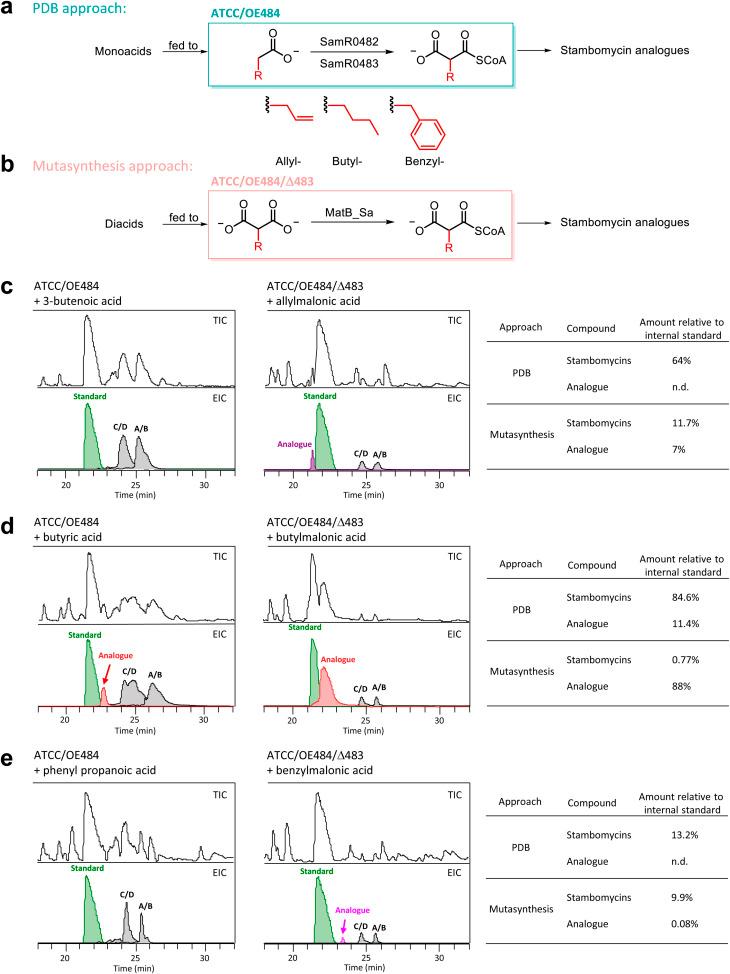
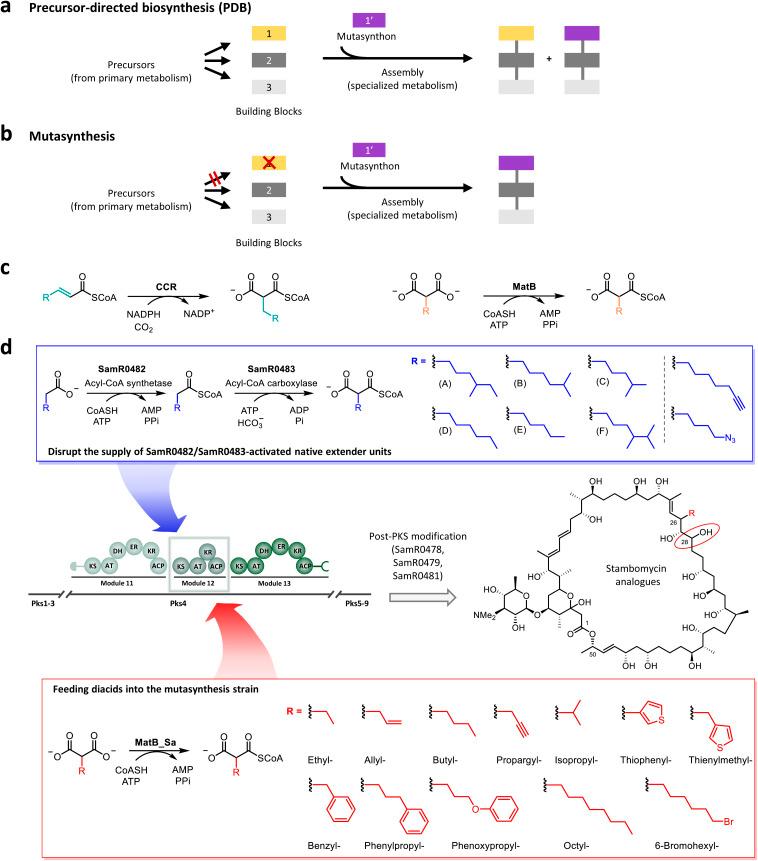
The polyketide specialized metabolites of bacteria are attractive targets for generating analogues, with the goal of improving their pharmaceutical properties. Here, we aimed to produce C-26 derivatives of the giant anti-cancer stambomycin macrolides using a mutasynthesis approach, as this position has been shown previously to directly impact bioactivity. For this, we leveraged the intrinsically broad specificity of the acyl transferase domain (AT) of the modular polyketide synthase (PKS), which is responsible for the alkyl branching functionality at this position. Feeding of a panel of synthetic and commercially available dicarboxylic acid 'mutasynthons' to an engineered strain of (Sa) deficient in synthesis of the native α-carboxyacyl-CoA extender units, resulted in six new series of stambomycin derivatives as judged by LC-HRMS and NMR. Notably, the highest product yields were observed for substrates which were only poorly accepted when AT was transplanted into a different PKS module, suggesting a critical role for domain context in the overall functioning of PKS proteins. We also demonstrate the superiority of this mutasynthesis approach - both in terms of absolute titers and yields relative to the parental compounds - in comparison to the alternative precursor-directed strategy in which monoacid building blocks are supplied to the wild type strain. We further identify a malonyl-CoA synthetase, MatB_Sa, with specificity distinct from previously described promiscuous enzymes, making it a useful addition to a mutasynthesis toolbox for generating atypical, CoA activated extender units. Finally, we show that two of the obtained (deoxy)-butyl-stambomycins exhibit antibacterial and antiproliferative activities similar to the parental stambomycins, while an unexpected butyl-demethyl congener is less potent. Overall, this works confirms the interest of biosynthetic pathways which combine a dedicated route to extender unit synthesis and a broad specificity AT domain for producing bioactive derivatives of fully-elaborated complex polyketides.
细菌的聚酮类特殊代谢产物是生成类似物的有吸引力的目标,目的是改善它们的药学性质。在此,我们旨在使用突变合成方法生产巨型抗癌斯坦博霉素大环内酯的C-26衍生物,因为先前已表明该位置直接影响生物活性。为此,我们利用了模块化聚酮合酶(PKS)的酰基转移酶结构域(AT)固有的广泛特异性,该结构域负责该位置的烷基支化功能。将一组合成的和市售的二羧酸“突变合成子”喂入缺乏天然α-羧基酰基辅酶A延伸单元合成能力的工程化(Sa)菌株中,通过液相色谱-高分辨质谱(LC-HRMS)和核磁共振(NMR)判断,得到了六个新系列的斯坦博霉素衍生物。值得注意的是,当AT被移植到不同的PKS模块中时,对底物接受度较差的情况下却观察到了最高的产物产量,这表明结构域背景在PKS蛋白的整体功能中起关键作用。我们还证明了这种突变合成方法的优越性——无论是在绝对滴度还是相对于亲本化合物的产率方面——与向野生型菌株供应单酸构建块的替代前体导向策略相比。我们进一步鉴定了一种丙二酰辅酶A合成酶MatB_Sa,其特异性与先前描述的混杂酶不同,使其成为生成非典型、辅酶A活化延伸单元的突变合成工具箱中的有用补充。最后,我们表明获得的两种(脱氧)丁基斯坦博霉素表现出与亲本斯坦博霉素相似的抗菌和抗增殖活性,而一种意外的丁基去甲基同系物活性较弱。总体而言,这项工作证实了生物合成途径的价值,该途径结合了专门的延伸单元合成途径和具有广泛特异性的AT结构域,用于生产完全合成的复杂聚酮类生物活性衍生物。

 Zotero 插件