
支气管肺泡灌洗液的单细胞图谱揭示脓毒症免疫抑制期间的特定中性粒细胞
Single-Cell Landscape of Bronchoalveolar Lavage Fluid Identifies Specific Neutrophils during Septic Immunosuppression.
作者信息
Shen Rong, Jiang Yi, Liu Guanglong, Gao Shenjia, Sun Hao, Wu Xinyi, Gu Jiahui, Wu Han, Mo Ke, Niu Xing, Ben-Ami Ronen, Shang Wanjing, Zhang Jie, Wang Jun, Miao Changhong, Wang Zhizhang, Chen Wankun
机构信息
Department of Pathology, Nanfang Hospital, School of Basic Medical Sciences, Southern Medical University, Guangzhou, Guangdong, 510515, China.
Guangdong Province Key Laboratory of Molecular Tumor Pathology, Guangzhou, Guangdong, 510515, China.
出版信息
Adv Sci (Weinh). 2025 Mar;12(11):e2406218. doi: 10.1002/advs.202406218. Epub 2025 Jan 30.
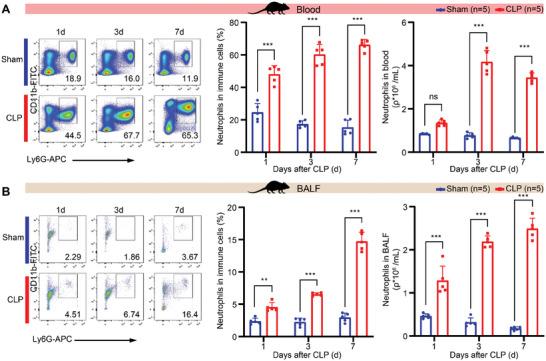
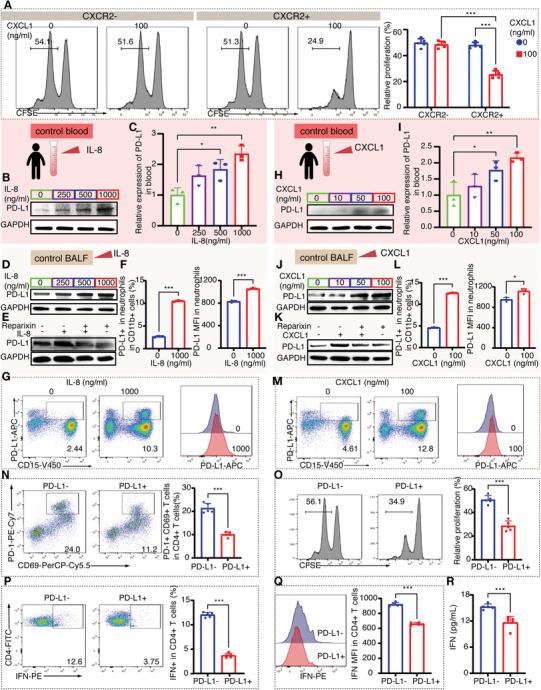
Sepsis-induced immunosuppression is related to increased susceptibility to secondary infections and death. Lung is the most vulnerable target organ in sepsis, but the understanding of the pulmonary immunosuppression state is still limited. Here, single-cell RNA sequencing of bronchoalveolar lavage fluid (BALF) is performed to map the landscape of immune cells, revealing a neutrophil-driven immunosuppressive program in the lungs of patients with immunosuppressive sepsis. Although immunosuppressive genes are upregulated in different immune cells, only neutrophils dramatically increase in the BALF of patients in immunosuppressive phase of sepsis. Five neutrophil subpopulations in BALF are identified, among which CXCR2 and CD274 (PD-L1 coding gene)IL1RN neutrophil subpopulations increased significantly during septic immunosuppression. Interestingly, a developmental trajectory from CXCR2 to CD274IL1RN neutrophil subpopulation is disclosed. Moreover, the therapeutic effect of CXCR2 blockade is observed on the survival of septic mice, along with a decreased number of PD-L1 neutrophils. Taken together, the CXCR2 neutrophil subpopulation is discovered as a contributor to immunosuppression in sepsis and identified it as a potential therapeutic target in sepsis treatment.
脓毒症诱导的免疫抑制与继发感染易感性增加及死亡相关。肺是脓毒症中最易受损的靶器官,但对肺部免疫抑制状态的了解仍有限。在此,对支气管肺泡灌洗液(BALF)进行单细胞RNA测序以描绘免疫细胞图谱,揭示了免疫抑制性脓毒症患者肺部由中性粒细胞驱动的免疫抑制程序。尽管免疫抑制基因在不同免疫细胞中上调,但在脓毒症免疫抑制期患者的BALF中只有中性粒细胞显著增加。在BALF中鉴定出五个中性粒细胞亚群,其中CXCR2和CD274(PD-L1编码基因)IL1RN中性粒细胞亚群在脓毒症免疫抑制期间显著增加。有趣的是,揭示了从CXCR2到CD274IL1RN中性粒细胞亚群的发育轨迹。此外,观察到CXCR2阻断对脓毒症小鼠存活有治疗作用,同时PD-L1阳性中性粒细胞数量减少。综上所述,发现CXCR2中性粒细胞亚群是脓毒症免疫抑制的一个促成因素,并将其确定为脓毒症治疗的潜在靶点。




 Zotero 插件