
减少麻醉气体使用的全国性方法:荷兰麻醉脱碳方法。
A nationwide approach to reduction in anaesthetic gas use: the Dutch Approach to decarbonising anaesthesia.
作者信息
Kampman Jasper M, van Bree Egid M, Gielen Lieke, Sperna Weiland Nicolaas H
机构信息
Department of Anaesthesiology, Amsterdam UMC, University of Amsterdam, Amsterdam, the Netherlands; Centre for Sustainable Healthcare, Amsterdam UMC, Amsterdam, the Netherlands.
Centre for Sustainable Healthcare, Amsterdam UMC, Amsterdam, the Netherlands; Department of Surgery, Maastricht University, Maastricht, the Netherlands.
出版信息
Br J Anaesth. 2025 Apr;134(4):1146-1152. doi: 10.1016/j.bja.2024.11.049. Epub 2025 Jan 30.
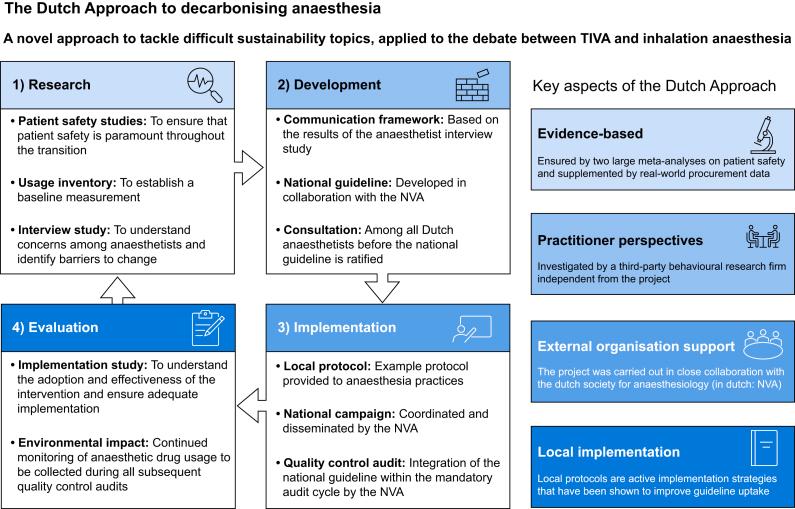
Anaesthetic gases account for ∼3% of the carbon footprint of the entire healthcare sector and up to 63% of the emissions originating from surgical care. Transitioning to predominant use of total intravenous anaesthesia (TIVA) has been proven a safe and effective strategy to reduce this footprint, yet its adoption has been slow in most countries. Interventions at the national level have been limited to regulatory action (e.g. banning of desflurane) and publication of nonbinding recommendations and best practices. We describe a new approach that we used to drive sustainable change and apply it to the debate between TIVA and inhalation anaesthesia at the national level. The Dutch Approach is founded on a bottom-up, self-regulatory model grounded in evidence-based practices. Patient safety studies, a national inventory of anaesthetic drug use, and in-depth interviews with anaesthetists were combined in developing a national guideline. Meeting the two main concerns among anaesthetists, patient safety and professional autonomy, the guideline requires all Dutch anaesthetic practices to adopt a local protocol whose main message is 'TIVA when possible, inhalation anaesthesia when necessary'. Central to the approach was the integration within the national quinquennial quality control audits. Adoption and implementation will be monitored and evaluated in an ongoing research project.
麻醉气体占整个医疗保健行业碳足迹的约3%,占外科护理产生排放量的63%。事实证明,过渡到主要使用全静脉麻醉(TIVA)是减少这一碳足迹的安全有效策略,但在大多数国家,其采用速度一直很慢。国家层面的干预措施仅限于监管行动(如禁止使用地氟烷)以及发布无约束力的建议和最佳实践。我们描述了一种用于推动可持续变革的新方法,并将其应用于国家层面关于TIVA与吸入麻醉的辩论中。荷兰方法基于一种自下而上的自我监管模式,该模式以循证实践为基础。患者安全研究、全国麻醉药物使用清单以及对麻醉师的深入访谈相结合,制定了一项国家指南。该指南满足了麻醉师的两个主要关切,即患者安全和专业自主权,要求荷兰所有麻醉机构采用当地协议,其主要内容是“尽可能采用TIVA,必要时采用吸入麻醉”。该方法的核心是将其纳入国家每五年一次的质量控制审计中。将在一个正在进行的研究项目中对采用和实施情况进行监测和评估。
 Zotero 插件