
利用替代原料“转基因甘蔗”为实验室和商业酵母菌株精心设计经济高效的发酵培养基
Resourceful and economical designing of fermentation medium for lab and commercial strains of yeast from alternative feedstock: 'transgenic oilcane'.
作者信息
Maitra Shraddha, Dien Bruce, Eilts Kristen, Kuanyshev Nurzhan, Cortes-Pena Yoel R, Jin Yong-Su, Guest Jeremy S, Singh Vijay
机构信息
Department of Agricultural and Biological Engineering, University of Illinois Urbana-Champaign, Urbana, IL, 61801, USA.
U.S. Department of Energy Center for Advanced Bioenergy and Bioproducts Innovation, University of Illinois Urbana-Champaign, Urbana, IL, 61801, USA.
出版信息
Biotechnol Biofuels Bioprod. 2025 Jan 31;18(1):14. doi: 10.1186/s13068-025-02606-9.
BACKGROUND
Sugarcane plant engineered to accumulate lipids in its vegetative tissue is being developed as a new bioenergy crop. The new crop would be a source of juice, oil, and cellulosic sugars. However, limited tolerance of industrially recognized yeasts towards inhibitors generated during the processing of lignocellulosic biomass to produce fermentable sugars is a major challenge in developing scalable processes for second-generation drop-in fuel production. To this end, hydrolysates generated from engineered sugarcane-'oilcane' bagasse contain added phenolics and fatty acids that further restrict the growth of fermenting microorganisms and necessitate nutrient supplementation and/or detoxification of hydrolysate which makes the fermentation process expensive. Herein, we propose a resourceful and economical approach for growing lab and commercial strains of S. cerevisiae on unrefined cellulosic sugars aerobically and fermentatively.
RESULTS
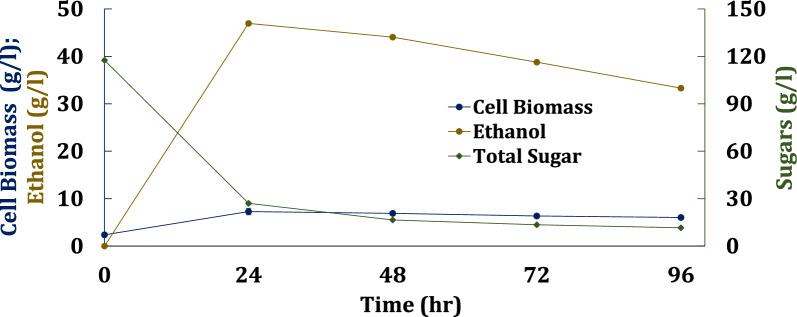
An equal ratio of hydrolysate and juice was found optimum for growth and fermentation by lab and commercial strains of Saccharomyces cerevisiae engineered for xylose fermentation. The industrial strain grew and fermented efficiently under low aeration conditions having an ethanol titer, yield, specific and volumetric productivities of 46.96 ± 0.19 g/l, 0.51 ± 0.00 g/g, 0.27 ± 0.02 g/g.h and 1.95 ± 0.01 g/l.h, respectively, while the lab strain grew better under higher aeration conditions having the ethanol titer, yield, specific and volumetric productivities of 24.93 ± 0.09, 0.27 ± 0.00 g/g, 0.17 ± 0.00 g/g.h and 1.04 ± 0.00 g/l.h, respectively. Acclimation of cultures in a blended medium significantly improved the performance of the yeast strains.
CONCLUSIONS
The addition of transgenic oilcane juice, which is inedible and rich in amino acids, to the hydrolysate averted the need for expensive nutrient supplementation and detoxification steps of hydrolysate. The approach provides an economical solution to reduce the cost of fermentation at an industrial scale for second-generation drop-in fuel production.
背景
经过基因工程改造,能够在营养组织中积累脂质的甘蔗正被开发成为一种新型生物能源作物。这种新作物将成为果汁、油脂和纤维素糖的来源。然而,工业上认可的酵母对木质纤维素生物质加工生产可发酵糖过程中产生的抑制剂耐受性有限,这是开发第二代替代燃料规模化生产工艺的一个主要挑战。为此,由经过基因工程改造的甘蔗——“油甘蔗”的蔗渣产生的水解产物含有额外的酚类物质和脂肪酸,这进一步限制了发酵微生物的生长,并且需要对水解产物进行营养补充和/或解毒处理,这使得发酵过程成本高昂。在此,我们提出一种巧妙且经济的方法,用于在有氧和发酵条件下,在未精制的纤维素糖上培养实验室和商业菌株的酿酒酵母。
结果
对于经过木糖发酵改造的酿酒酵母实验室菌株和商业菌株,发现水解产物与果汁的等比例混合对其生长和发酵最为适宜。工业菌株在低通气条件下能够高效生长和发酵,乙醇浓度、产率、比生产率和体积生产率分别为46.96±0.19 g/l、0.51±0.00 g/g、0.27±0.02 g/g·h和1.95±0.01 g/l·h,而实验室菌株在较高通气条件下生长得更好,乙醇浓度、产率、比生产率和体积生产率分别为24.93±0.09、0.27±0.00 g/g、0.17±0.00 g/g·h和1.04±0.00 g/l·h。在混合培养基中对培养物进行驯化显著提高了酵母菌株的性能。
结论
向水解产物中添加不可食用且富含氨基酸的转基因油甘蔗汁,避免了对水解产物进行昂贵的营养补充和解毒步骤的需要。该方法为降低第二代替代燃料工业规模发酵成本提供了一种经济的解决方案。


 Zotero 插件