
成年女性中苯酚和对羟基苯甲酸酯暴露与患乳腺癌风险之间的关联:一项横断面研究。
Associations between phenol and paraben exposure and the risk of developing breast cancer in adult women: a cross-sectional study.
作者信息
Xiong Yao, Li Zhiyu, Xiong Xiong, Luo Zixuan, Zhong Kaixin, Hu Jiawei, Sun Shengrong, Chen Chuang
机构信息
Department of Breast and Thyroid Surgery, Renmin Hospital of Wuhan University, No 238 Jiefang Road, Wuchang District, Wuhan, 430060, Hubei, People's Republic of China.
Department of Information, Electronic and Bioengineering, Politecnico Di Milano., Piazza Leonardo da Vinci, 32, 20133, Milano, MI, Italy.
出版信息
Sci Rep. 2025 Feb 3;15(1):4038. doi: 10.1038/s41598-025-88765-z.
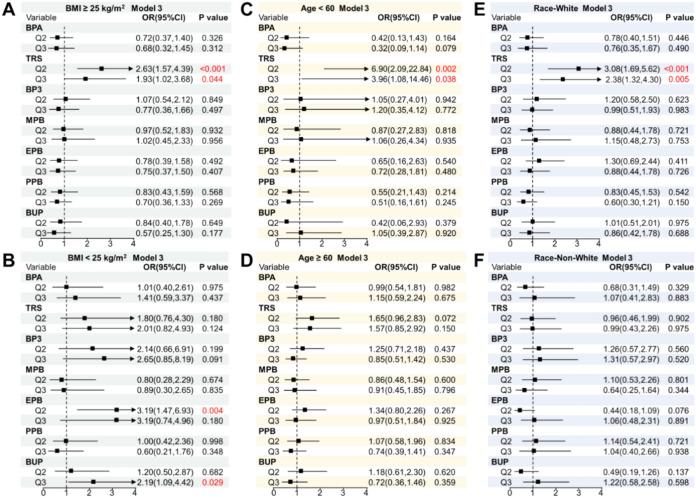
Increasing evidence suggests that endocrine-disrupting chemicals (EDCs) have adverse effects on breast cancer (BC). The aim of this study was to assess the association between exposure to prevalent EDCs-phenols and parabens-and the risk of developing BC. Data on urinary bisphenol A (BPA), triclosan (TRS), benzophenone-3 (BP3), methyl paraben (MPB), ethyl paraben (EPB), propyl paraben (PPB), and butyl paraben (BUP) were obtained from the 2005-2014 National Health and Nutrition Examination Survey. A total of 4455 subjects were included in this cross-sectional study. The results from the weighted multivariable regression models indicated that exposure to elevated concentrations of TRS increased the risk of developing BC by 2.33 (Q2: 95% CI = 1.45-3.75, p < 0.001) and 1.94 times (Q3: 95% CI = 1.21-3.09, p = 0.006), respectively. The nonlinear association between TRS concentrations and the risk of developing BC was statistically significant (P nonlinear = 0.007), with the restricted cubic splines (RCS) curve exhibiting an inverted U shape. The association between TRS concentrations and the risk of developing BC was more pronounced among overweight individuals (BMI ≥ 25 kg/m), those aged < 60 years, and white individuals. Weighted quantile sum (WQS) and Bayesian Kernel Machine Regression (BKMR) analysis revealed no significant overall association between mixtures of urinary phenol and paraben metabolites and BC risk. However, TRS exposure was the most influential, with higher TRS concentrations (both continuous and categorical) significantly associated with an increased BC risk, particularly in overweight individuals (BMI ≥ 25 kg/m), those aged < 60 years, and white individuals.
越来越多的证据表明,内分泌干扰化学物质(EDCs)对乳腺癌(BC)有不良影响。本研究的目的是评估暴露于常见的EDCs——酚类和对羟基苯甲酸酯类——与患BC风险之间的关联。尿双酚A(BPA)、三氯生(TRS)、二苯甲酮-3(BP3)、对羟基苯甲酸甲酯(MPB)、对羟基苯甲酸乙酯(EPB)、对羟基苯甲酸丙酯(PPB)和对羟基苯甲酸丁酯(BUP)的数据来自2005 - 2014年国家健康和营养检查调查。本横断面研究共纳入4455名受试者。加权多变量回归模型的结果表明,暴露于浓度升高的TRS会使患BC的风险分别增加2.33倍(Q2:95%CI = 1.45 - 3.75,p < 0.001)和1.94倍(Q3:95%CI = 1.21 - 3.09,p = 0.006)。TRS浓度与患BC风险之间的非线性关联具有统计学意义(P非线性 = 0.007),限制立方样条(RCS)曲线呈倒U形。TRS浓度与患BC风险之间的关联在超重个体(BMI≥25 kg/m)、年龄<60岁的个体和白人个体中更为明显。加权分位数和(WQS)以及贝叶斯核机器回归(BKMR)分析显示,尿酚和对羟基苯甲酸酯代谢物混合物与BC风险之间没有显著的总体关联。然而,TRS暴露的影响最大,较高的TRS浓度(连续和分类)与BC风险增加显著相关,尤其是在超重个体(BMI≥25 kg/m)、年龄<60岁的个体和白人个体中。


 Zotero 插件