
利用脐带血库的数据构建潜在的HLA单倍体纯合诱导多能干细胞单倍体库。
Constructing a potential HLA haplo-homozygous induced pluripotent stem cell haplobank using data from an umbilical cord blood bank.
作者信息
He Ji, He Yanmin, Zhan Qigang, Wu Zhipan, Sheng Qi, Zhang Wei, Zhu Faming
机构信息
Blood Center of Zhejiang Province, Hangzhou, Zhejiang, People's Republic of China.
Umbilical Cord Blood Bank of Zhejiang Province, Hangzhou, Zhejiang, People's Republic of China.
出版信息
Stem Cell Res Ther. 2025 Feb 4;16(1):42. doi: 10.1186/s13287-025-04159-y.
BACKGROUND
Induced pluripotent stem cells (iPSCs) can differentiate into any type of cell and have potential uses in regenerative medicine for the treatment of many diseases. However, reducing immune rejection is a key problem in the application of iPSCs that can be solved by the development of haplobanks containing specially selected iPSC lines.
METHODS
To study the feasibility of constructing an HLA (human leukocyte antigen)-matched induced pluripotent stem cell haplobank in China, 5421 umbilical cord blood samples were randomly collected from the Umbilical Cord Blood Bank of Zhejiang Province, China. The HLA-A, HLA-B, HLA-C, HLA-DRB1, and HLA-DQB1 loci were genotyped using next-generation sequencing. Using HLA genotype data at the high-resolution level, the number of HLA homozygous donors needed to cover a certain percentage of the Chinese population and the feasibility of constructing a high-matching iPSC haplobank were estimated.
RESULTS
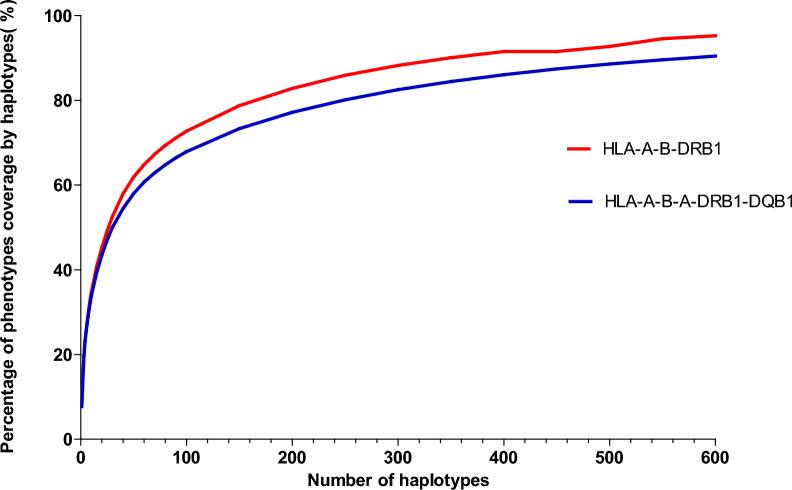
Thirteen HLA-A, -B, and -DRB1 and 11 HLA-A, -B, -C, -DRB1, and -DQB1 haplotype homozygotes were observed among the stored umbilical CB units which were as HLA zero-mismatched iPSC donors cumulatively matched 37.01% and 32.99% of 5421 potential patients respectively. The analysis showed that 100 distinct HLA-A, -B, and -DRB1 and HLA-A, -B, -C, -DRB1, and -DQB1 homozygous haplotypes would cover 72.74% and 67.87% of Chinese populations, respectively, and 600 HLA-A, -B, -C, -DRB1, and -DQB1 homozygous haplotypes would cover more than 90% of Chinese populations. PCA (principal component analysis) of published HLA data from different populations revealed that the frequency of these haplotypes in Asian populations is different from those in European populations.
CONCLUSION
The results suggested that at least some HLA-homozygous iPSC lines developed from Chinese individuals will not only be useful for covering the Chinese population but will also cover other Asian populations. A high-matching iPSC haplobank generated from umbilical CB units may be an economical and effective option in an allogeneic model of iPSC therapy.
背景
诱导多能干细胞(iPSC)可分化为任何类型的细胞,在再生医学治疗多种疾病方面具有潜在用途。然而,减少免疫排斥是iPSC应用中的一个关键问题,可通过建立包含经过特殊选择的iPSC系的单倍型库来解决。
方法
为研究在中国构建HLA(人类白细胞抗原)匹配的诱导多能干细胞单倍型库的可行性,从中国浙江省脐带血库随机采集了5421份脐带血样本。使用下一代测序对HLA - A、HLA - B、HLA - C、HLA - DRB1和HLA - DQB1基因座进行基因分型。利用高分辨率水平的HLA基因型数据,估计覆盖一定比例中国人群所需的HLA纯合供体数量以及构建高匹配iPSC单倍型库的可行性。
结果
在所储存的脐血样本中观察到13种HLA - A、- B和 - DRB1以及11种HLA - A、- B、- C、- DRB1和 - DQB1单倍型纯合子,它们作为HLA零错配iPSC供体分别累计匹配了5421名潜在患者中的37.01%和32.99%。分析表明,100种不同的HLA - A、- B和 - DRB1以及HLA - A、- B、- C、- DRB1和 - DQB1纯合单倍型将分别覆盖72.74%和67.87%的中国人群,600种HLA - A、- B、- C、- DRB1和 - DQB1纯合单倍型将覆盖超过90%的中国人群。对来自不同人群的已发表HLA数据进行主成分分析(PCA)显示,这些单倍型在亚洲人群中的频率与欧洲人群不同。
结论
结果表明,至少一些由中国个体产生的HLA纯合iPSC系不仅对覆盖中国人群有用,而且还将覆盖其他亚洲人群。由脐血样本产生的高匹配iPSC单倍型库可能是iPSC治疗同种异体模型中的一种经济有效的选择。


 Zotero 插件