
饮食和体育活动干预对肥胖儿童肥胖程度的不同影响。
Differential effects of dietary and physical activity interventions on adiposity of children with obesity.
作者信息
Tangtongsoong Anekchoke, Visuthranukul Chonnikant, Chongpison Yuda, Chomtho Sirinuch
机构信息
Department of Pediatrics, King Chulalongkorn Memorial Hospital, The Thai Red Cross Society, Bangkok, Thailand.
Center of Excellence in Pediatric Nutrition, Division of Nutrition, Department of Pediatrics, Faculty of Medicine, Chulalongkorn University, Bangkok, Thailand.
出版信息
Clin Exp Pediatr. 2025 May;68(5):370-378. doi: 10.3345/cep.2024.01347. Epub 2025 Feb 3.
BACKGROUND
Managing obesity in children remains challenging. In addition to body mass index (BMI), incorporating body composition into evaluations of postobesity interventions would help assess changes in adiposity.
PURPOSE
This study aimed to identify the relationship between dietary intake, physical activity, and changes in BMI z scores and adiposity among children with obesity.
METHODS
Children aged 7-15 years with obesity received monthly dietary and physical activity instructions for 6 months. Three-day dietary records and physical activity questionnaires were collected at 0, 3, and 6 months. Body composition was measured using bioelectrical impedance analysis. These relationships were analyzed using uni- and multivariate linear regression analyses.
RESULTS
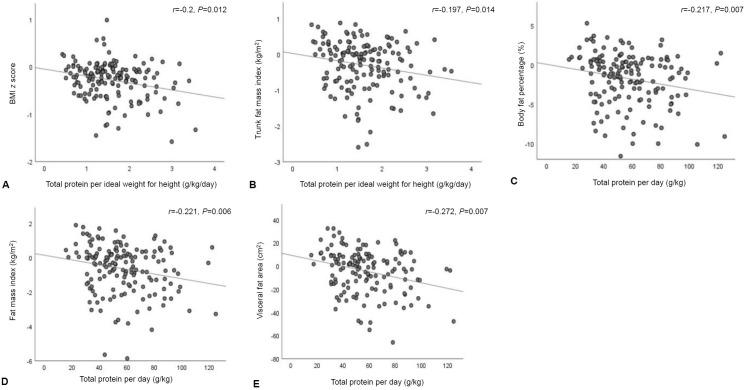
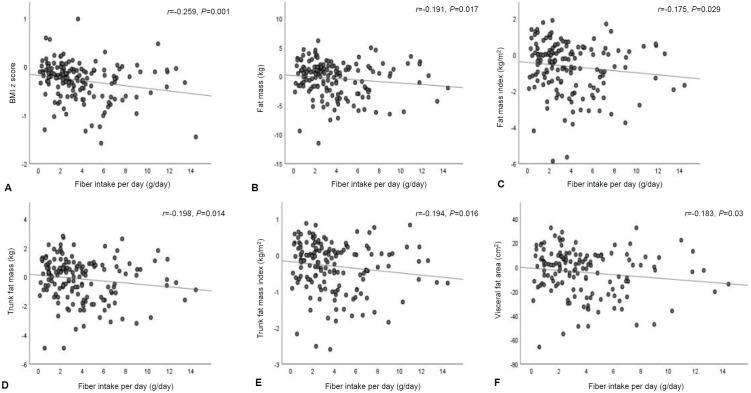
A total of 155 children with obesity completed the 6-month study. A higher total protein intake per ideal weight for height was significantly correlated with a decrease in BMI z score and trunk fat mass index (trunk fat mass [FM] in kg/height in m2). Mean dietary fiber intake was negatively correlated with BMI z score, FM, FM index (FMI, FM in kg/height in m2), and visceral fat area (VFA) at 6 months. Each 1 g/kg/day increase in protein intake and additional 1 g/day of dietary fiber intake led to a 0.191 kg/m2 (95% confidence interval [CI], -0.309 to -0.072) and 0.028 kg/m2 (-0.05 to -0.005) reduction in BMI z score. Each 1 g/day increase in protein intake led to a reduction of 0.009 kg/m² in trunk FMI (-0.016 to -0.002) and 0.21 cm² in VFA (-0.418 to -0.002). The outcomes observed at 6 months were consistent with the overall 6-month findings, reinforcing the efficacy of the intervention.
CONCLUSION
Our study showed beneficial effects of high dietary protein and fiber intakes on BMI z scores and adiposity of children with obesity. Fine-tuning dietary interventions that emphasize appropriate protein and fiber intakes may be more practical for managing childhood obesity.
背景
儿童肥胖管理仍然具有挑战性。除了体重指数(BMI)外,将身体成分纳入肥胖症后干预评估有助于评估肥胖程度的变化。
目的
本研究旨在确定肥胖儿童的饮食摄入、身体活动与BMI z评分及肥胖程度变化之间的关系。
方法
7至15岁的肥胖儿童接受为期6个月的每月饮食和身体活动指导。在第0、3和6个月收集为期三天的饮食记录和身体活动问卷。使用生物电阻抗分析测量身体成分。使用单变量和多变量线性回归分析这些关系。
结果
共有155名肥胖儿童完成了为期6个月的研究。每身高理想体重中较高的总蛋白质摄入量与BMI z评分和躯干脂肪质量指数(躯干脂肪质量[FM],单位为kg/身高的平方米)的降低显著相关。平均膳食纤维摄入量与第6个月时的BMI z评分、FM、FM指数(FMI,单位为kg/身高的平方米)和内脏脂肪面积(VFA)呈负相关。蛋白质摄入量每增加1 g/kg/天以及膳食纤维摄入量额外增加1 g/天,分别导致BMI z评分降低0.191 kg/m²(95%置信区间[CI],-0.309至-0.072)和0.028 kg/m²(-0.05至-0.005)。蛋白质摄入量每增加1 g/天,导致躯干FMI降低0.009 kg/m²(-0.016至-0.002),VFA降低0.21 cm²(-0.418至-0.002)。在第6个月观察到的结果与整个6个月的研究结果一致,强化了干预措施的有效性。
结论
我们的研究表明,高蛋白质和膳食纤维摄入量对肥胖儿童的BMI z评分和肥胖程度有有益影响。微调强调适当蛋白质和膳食纤维摄入量的饮食干预措施可能对管理儿童肥胖更为实用。

 Zotero 插件