
通路依赖性脑刺激反应表明中风后运动处理的完整性。
Pathway-dependent brain stimulation responses indicate motion processing integrity after stroke.
作者信息
Bevilacqua Michele, Windel Fabienne, Beanato Elena, Menoud Pauline, Zandvliet Sarah, Ramdass Nicola, Fleury Lisa, Hervé Julie, Huxlin Krystel R, Hummel Friedhelm C, Raffin Estelle
机构信息
Defitech Chair of Clinical Neuroengineering, Neuro-X Institute (INX), École Polytechnique Fédérale de Lausanne (EPFL), Geneva 1202, Switzerland.
Defitech Chair of Clinical Neuroengineering, INX, EPFL Valais, Clinique Romande de Réadaptation, Sion 1951, Switzerland.
出版信息
Brain. 2025 Jul 7;148(7):2361-2372. doi: 10.1093/brain/awaf043.
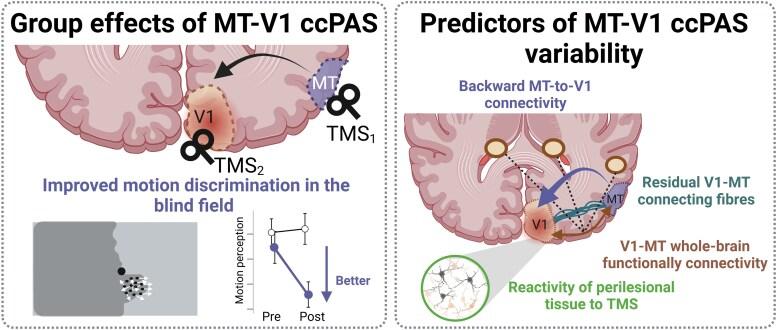
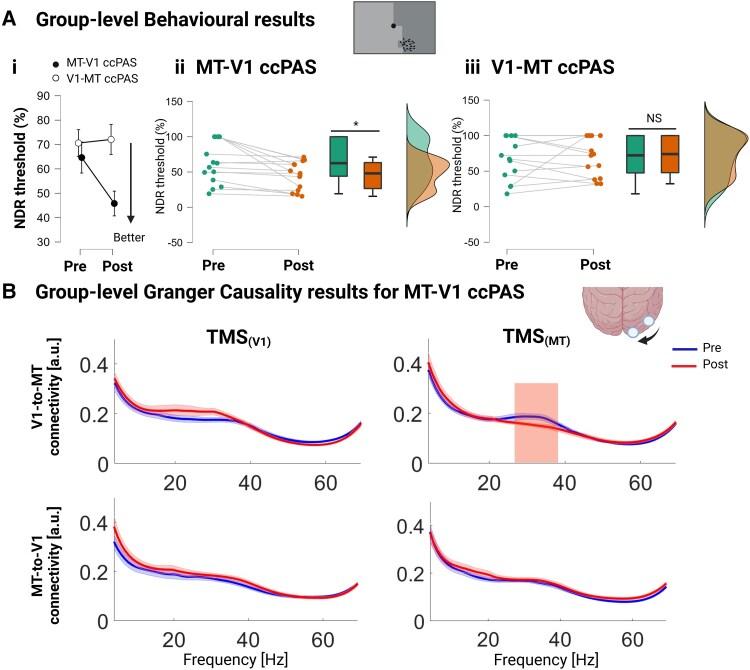
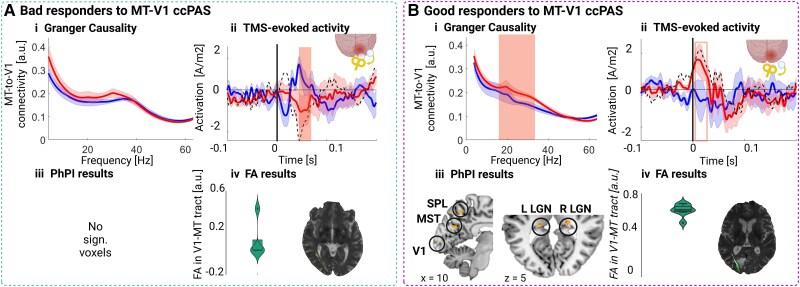
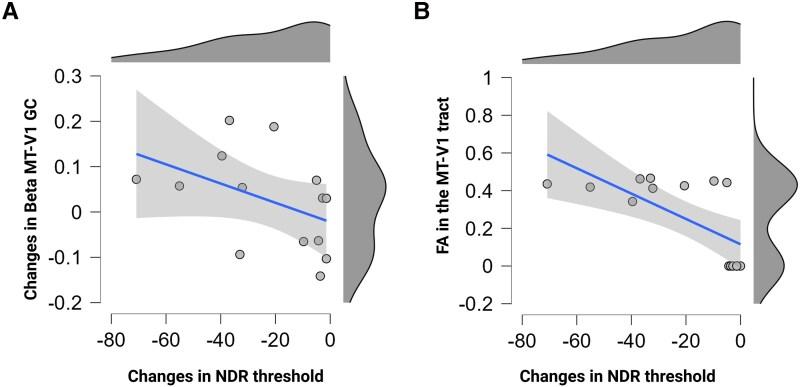
Homonymous hemianopia (HH), a common visual impairment resulting from occipital lobe lesions, affects a significant number of stroke survivors. Intensive perceptual training can foster recovery, possibly by enhancing surviving visual pathways. This study employed cortico-cortical paired associative stimulation (ccPAS) to induce associative plasticity within the residual and bidirectional primary visual cortex (V1)-middle temporal area (MT) pathways in stroke patients. We used ccPAS, which is thought to tap into Hebbian-like spike-timing dependent plasticity, over a motion processing pathway in stroke patients to transiently improve visual motion discrimination in their blind field. Sixteen stroke patients participated in this double-blind, crossover study comparing the effects of bidirectional ccPAS (V1-to-MT or MT-to-V1) on motion discrimination and EEG-Granger Causality. Additionally, we explored potential multimodal sources of inter-individual variability. Results showed that MT-to-V1 ccPAS enhanced motion direction discrimination, but the expected electrophysiological increase in top-down MT-to-V1 inputs was observed only in patients who showed improvement in motion discrimination. Good responders to MT-V1 ccPAS also demonstrated improved functional coupling between the cortical motion pathway and other relevant areas in the visual network, as well as more preserved ipsilesional V1-MT structural integrity. These findings indicate that targeted ccPAS can effectively engage functionally relevant residual visual pathways in stroke-affected brains, potentially offering new avenues for patient stratification and visual recovery strategies.
同向性偏盲(HH)是一种由枕叶病变导致的常见视力障碍,影响着大量中风幸存者。强化感知训练可能通过增强尚存的视觉通路促进恢复。本研究采用皮质 - 皮质配对联想刺激(ccPAS),在中风患者残余且双向的初级视觉皮层(V1)- 颞中区(MT)通路中诱导联想可塑性。我们在中风患者的运动处理通路上使用被认为利用类赫布型脉冲时间依赖可塑性的ccPAS,以短暂改善其盲视野中的视觉运动辨别能力。16名中风患者参与了这项双盲交叉研究,比较双向ccPAS(V1到MT或MT到V1)对运动辨别和脑电图格兰杰因果关系的影响。此外,我们探索了个体间变异性的潜在多模态来源。结果显示,MT到V1的ccPAS增强了运动方向辨别能力,但仅在运动辨别能力有所改善的患者中观察到预期的自上而下MT到V1输入的电生理增加。对MT - V1 ccPAS反应良好的患者还表现出皮质运动通路与视觉网络中其他相关区域之间功能耦合的改善,以及同侧V1 - MT结构完整性的更多保留。这些发现表明,靶向ccPAS可以有效地激活中风影响大脑中功能相关的残余视觉通路,可能为患者分层和视觉恢复策略提供新途径。

 Zotero 插件