
基于磁共振成像的全脑弹性成像和体积测量以预测脑龄。
MRI-based whole-brain elastography and volumetric measurements to predict brain age.
作者信息
Claros-Olivares Claudio Cesar, Clements Rebecca G, McIlvain Grace, Johnson Curtis L, Brockmeier Austin J
机构信息
Department of Electrical & Computer Engineering, University of Delaware, Newark, DE 19716, United States.
Department of Biomedical Engineering, University of Delaware, Newark, DE 19713, United States.
出版信息
Biol Methods Protoc. 2024 Nov 20;10(1):bpae086. doi: 10.1093/biomethods/bpae086. eCollection 2025.
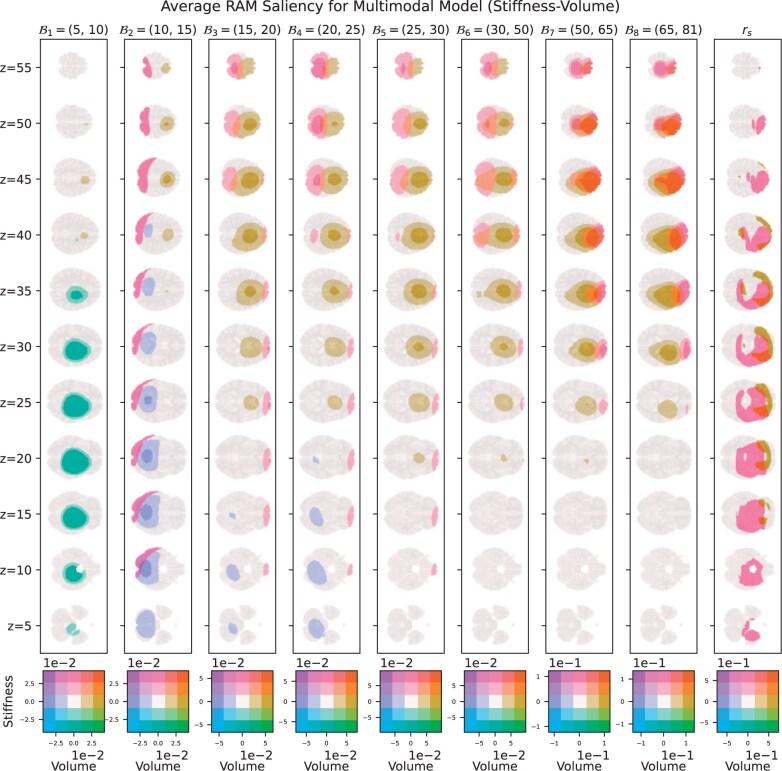
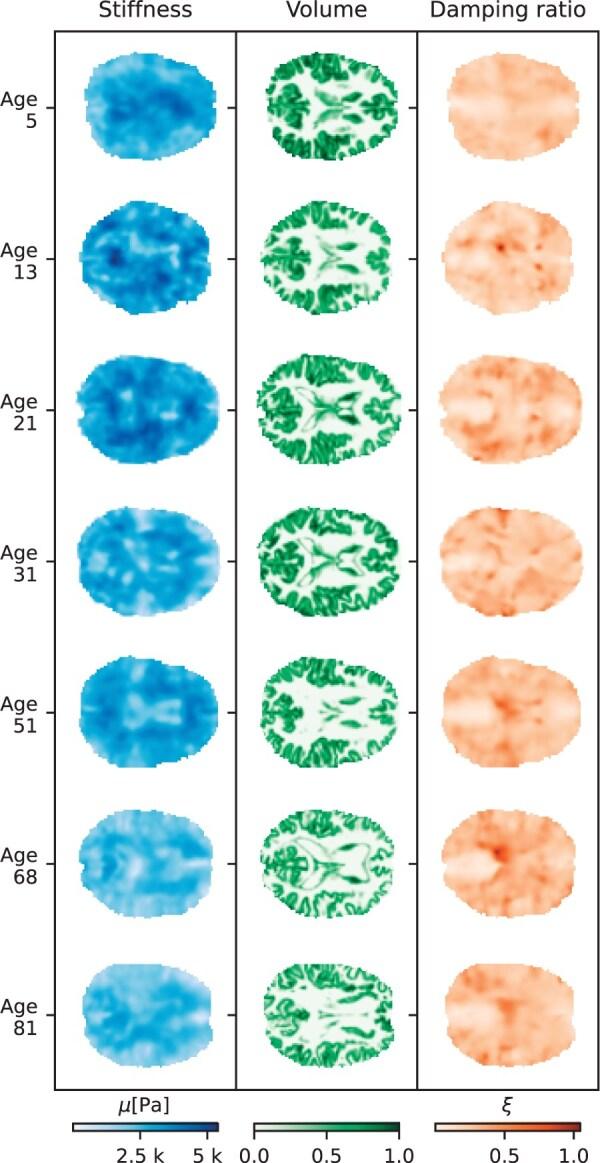
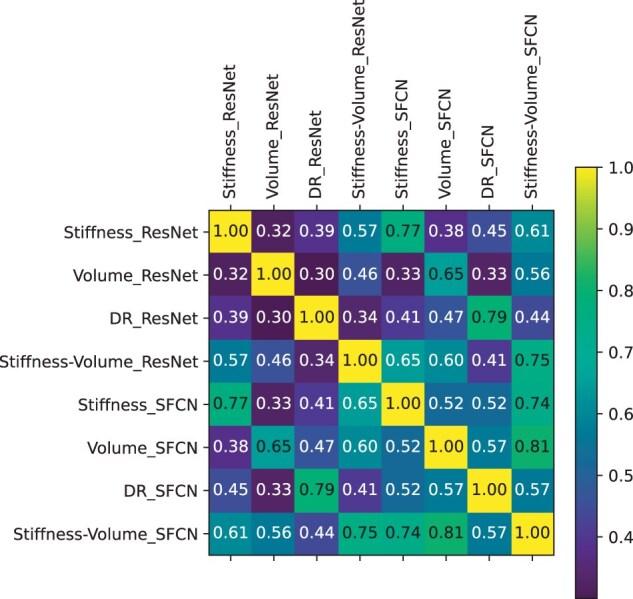
Brain age, as a correlate of an individual's chronological age obtained from structural and functional neuroimaging data, enables assessing developmental or neurodegenerative pathology relative to the overall population. Accurately inferring brain age from brain magnetic resonance imaging (MRI) data requires imaging methods sensitive to tissue health and sophisticated statistical models to identify the underlying age-related brain changes. Magnetic resonance elastography (MRE) is a specialized MRI technique which has emerged as a reliable, non-invasive method to measure the brain's mechanical properties, such as the viscoelastic shear stiffness and damping ratio. These mechanical properties have been shown to change across the life span, reflect neurodegenerative diseases, and are associated with individual differences in cognitive function. Here, we aim to develop a machine learning framework to accurately predict a healthy individual's chronological age from maps of brain mechanical properties. This framework can later be applied to understand neurostructural deviations from normal in individuals with neurodevelopmental or neurodegenerative conditions. Using 3D convolutional networks as deep learning models and more traditional statistical models, we relate chronological age as a function of multiple modalities of whole-brain measurements: stiffness, damping ratio, and volume. Evaluations on held-out subjects show that combining stiffness and volume in a multimodal approach achieves the most accurate predictions. Interpretation of the different models highlights important regions that are distinct between the modalities. The results demonstrate the complementary value of MRE measurements in brain age models, which, in future studies, could improve model sensitivity to brain integrity differences in individuals with neuropathology.
脑龄作为从结构和功能神经影像数据中获取的与个体实际年龄相关的指标,能够评估相对于总体人群的发育或神经退行性病变。从脑磁共振成像(MRI)数据准确推断脑龄需要对组织健康敏感的成像方法以及复杂的统计模型,以识别与年龄相关的潜在脑变化。磁共振弹性成像(MRE)是一种专门的MRI技术,已成为一种可靠的、非侵入性的方法来测量大脑的力学特性,如粘弹性剪切刚度和阻尼比。这些力学特性已被证明在整个生命周期中会发生变化,反映神经退行性疾病,并且与认知功能的个体差异有关。在此,我们旨在开发一个机器学习框架,从脑力学特性图中准确预测健康个体的实际年龄。该框架随后可用于理解神经发育或神经退行性疾病患者与正常情况相比的神经结构偏差。使用3D卷积网络作为深度学习模型以及更传统的统计模型,我们将实际年龄作为全脑测量的多种模态的函数进行关联:刚度、阻尼比和体积。对留出的受试者的评估表明,在多模态方法中结合刚度和体积可实现最准确的预测。对不同模型的解释突出了各模态之间不同的重要区域。结果证明了MRE测量在脑龄模型中的互补价值,在未来的研究中,这可能会提高模型对神经病理学个体脑完整性差异的敏感性。

 Zotero 插件