
对钙调蛋白的N叶和C叶在兰尼碱受体1(RyR1)通道调节中作用的动力学见解。
Kinetics insight into the roles of the N- and C-lobes of calmodulin in RyR1 channel regulation.
作者信息
Zhang Jingyan, Treinen Levy M, Mast Skylar J, McCarthy Megan R, Svensson Bengt, Thomas David D, Cornea Razvan L
机构信息
Department of Biochemistry, Molecular Biology, and Biophysics, University of Minnesota, Minneapolis, USA.
Department of Biochemistry, Molecular Biology, and Biophysics, University of Minnesota, Minneapolis, USA.
出版信息
J Biol Chem. 2025 Mar;301(3):108258. doi: 10.1016/j.jbc.2025.108258. Epub 2025 Feb 2.
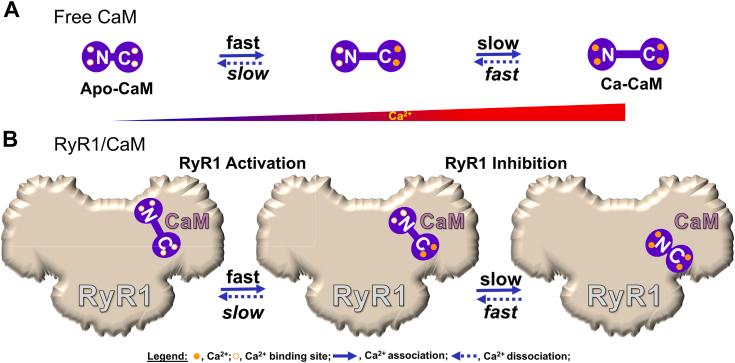
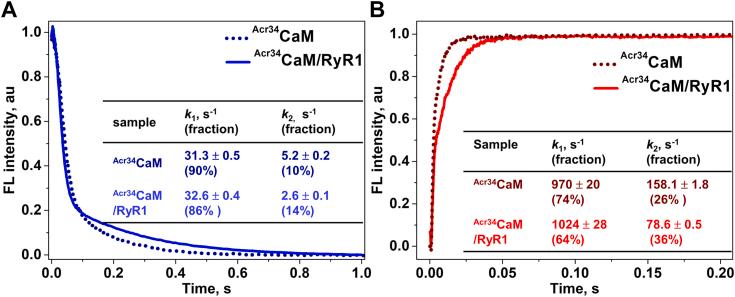
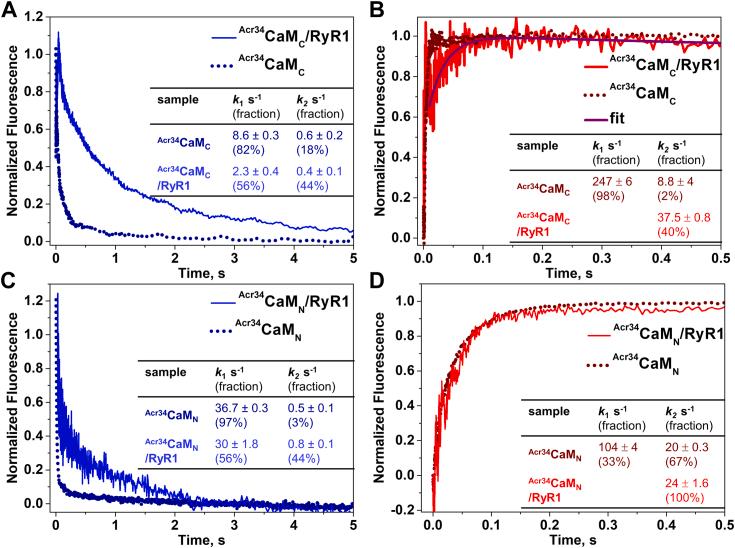
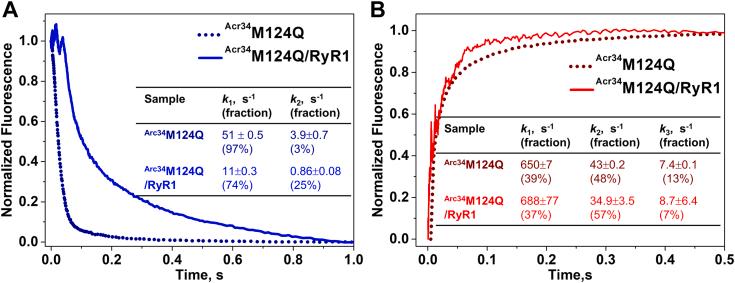
Calmodulin (CaM) activates the skeletal muscle Ca release channel (ryanodine receptor, RyR1) at nanomolar Ca and inhibits it at micromolar Ca. CaM conversion from RyR1 activator to inhibitor is due to structural changes induced by Ca binding at CaM's two lobes. However, it remains unclear which lobe provides the switch for this conversion. Here, we attached the environment-sensitive fluorophore acrylodan (Acr) at either lobe of intact CaM or lobe-specific Ca-sensitive CaM mutants, and monitored the effects of Ca binding via the fluorescence change of free or RyR1-bound CaM. Using steady state measurements, we found that Ca binding to free CaM causes a dramatic structural change in the N-lobe, but only a slight effect on the C-lobe of the Ca-sensitive lobe-specific mutants, in addition to the previously known higher Ca affinity at the C-lobe versus the N-lobe. Using stopped-flow measurements, we found ∼30x faster Ca dissociation from the N- versus C-lobe, and ∼20x slower Ca association to the N-lobe versus C-lobe. These Ca binding properties hold for the CaM/RyR1 complex, and Ca affinity is enhanced at the CaM C-lobe but decreased at the N-lobe by RyR1 binding. We propose that fast Ca-binding at the C-lobe of CaM initiates its inhibition to RyR1 at high [Ca], while slow Ca binding to the N-lobe is necessary for timely enhancement of the inhibitory effect. The dysregulation of RyR1 by M124Q-CaM may be explained by the lower Ca affinity versus WT-CaM, as suggested by both steady-state and transient kinetics results.
钙调蛋白(CaM)在纳摩尔钙浓度下激活骨骼肌钙释放通道(兰尼碱受体,RyR1),而在微摩尔钙浓度下抑制该通道。CaM从RyR1激活剂转变为抑制剂是由于钙结合到CaM的两个叶上所诱导的结构变化。然而,尚不清楚哪个叶为这种转变提供了开关。在这里,我们将环境敏感荧光团丙烯罗丹(Acr)连接到完整CaM的任一叶或叶特异性钙敏感CaM突变体上,并通过游离或与RyR1结合的CaM的荧光变化监测钙结合的影响。通过稳态测量,我们发现钙与游离CaM结合会导致N叶发生显著的结构变化,但对钙敏感叶特异性突变体的C叶只有轻微影响,此外,之前已知C叶相对于N叶具有更高的钙亲和力。通过停流测量,我们发现钙从N叶解离的速度比从C叶快约30倍,而钙与N叶结合的速度比与C叶结合慢约20倍。这些钙结合特性适用于CaM/RyR1复合物,并且通过RyR1结合,CaM C叶的钙亲和力增强而N叶的钙亲和力降低。我们提出,在高[Ca]浓度下,CaM的C叶快速结合钙启动其对RyR1的抑制作用,而钙缓慢结合到N叶对于及时增强抑制作用是必要的。如稳态和瞬态动力学结果所表明的,M124Q-CaM对RyR1的调节异常可能是由于其相对于野生型CaM的钙亲和力较低所致。



 Zotero 插件