
青少年维生素D缺乏、肥胖指数与胰岛素抵抗之间的关联:来自2011 - 2018年美国国家健康与营养检查调查(NHANES)的中介分析
Associations between hypovitaminosis D, adiposity indices and insulin resistance in adolescents: mediation analyses from NHANES 2011-2018.
作者信息
Deng Yaping, Luo Yingting, Shen Yilei, Zhao Yong, Cao Wei, Cao Jie, Xu Lijuan, Kong Lin
机构信息
Department of Clinical Nutrition, Children's Hospital of Chongqing Medical University, National Clinical Research Center for Child Health and Disorders, Ministry of Education Key Laboratory of Child Development and Disorders, Chongqing Key Laboratory of Pediatrics, Chongqing, China.
School of Mathematics, Sichuan University, Chengdu, China.
出版信息
Nutr Diabetes. 2025 Feb 4;15(1):2. doi: 10.1038/s41387-025-00358-x.
BACKGROUND
As all kown, both hypovitaminosis D and insulin resistance (IR) have been linked to adiposity. However, the extent of adiposity's mediating influence on the hypovitaminosis D-IR relationship among adolescents remains to be elucidated. Additionally, the intricate effects of obesity and blood lipid profiles on IR are not yet fully understood.
METHODS
We conducted a comprehensive analysis of NHANES data from 2011 to 2018, examining the correlation between adiposity indices such as Body Mass Index (BMI), Fat Mass Index (FMI, defined as the ratio of fat mass to height squared), hypovitaminosis D, and IR. We employed the XGBoost algorithm to identify key factors significantly influencing IR, thereby deepening our insight into the link between adiposity and insulin resistance. Furthermore, we applied mediation analysis to precisely assess the mediating role of adiposity indices in the relationship between hypovitaminosis D and IR.
RESULTS
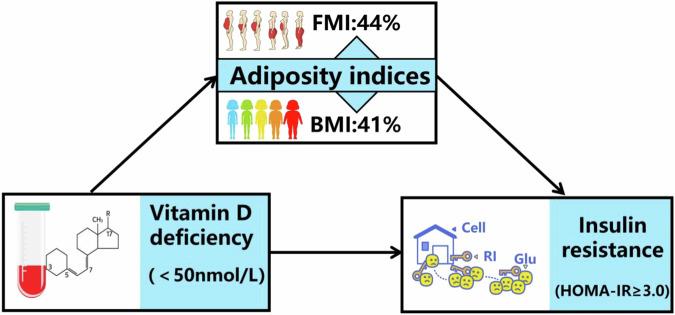
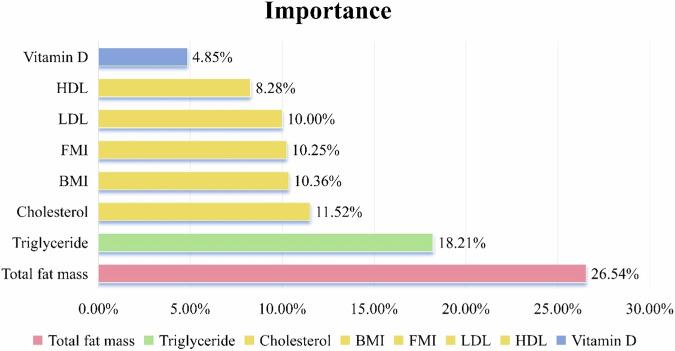
Our study revealing significant correlations between adiposity indices, hypovitaminosis D, and IR after variable adjustment. Notably, subgroup analysis indicated a pronounced hypovitaminosis D -adiposity association in female adolescents, which was not observed in males. The XGBoost algorithm pinpointed obesity and blood lipid indicators significantly affecting IR, with total fat mass, triglyceride, cholesterol, BMI, and FMI ranked by descending importance. Mediation analysis disclosed that adiposity indices mediate a substantial portion of the hypovitaminosis D -IR relationship, with FMI (43.84%, p < 0.001) and BMI (40.87%, p < 0.001) showing significant mediating effects.
CONCLUSION
The study confirmed significant correlations between adiposity indices, hypovitaminosis D, and IR in adolescents, with gender-specific differences in the hypovitaminosis D -adiposity link. Cholesterol was found to have a more substantial influence on IR than BMI and FMI. Furthermore, FMI was identified as a more potent mediator of the hypovitaminosis D-IR relationship compared to BMI, highlighting its importance in the pathophysiology of insulin resistance in adolescents.
背景
众所周知,维生素D缺乏和胰岛素抵抗(IR)均与肥胖有关。然而,肥胖对青少年维生素D缺乏与胰岛素抵抗关系的中介影响程度仍有待阐明。此外,肥胖和血脂谱对胰岛素抵抗的复杂影响尚未完全了解。
方法
我们对2011年至2018年的美国国家健康与营养检查调查(NHANES)数据进行了全面分析,研究了肥胖指数如体重指数(BMI)、脂肪量指数(FMI,定义为脂肪量与身高平方的比值)、维生素D缺乏和胰岛素抵抗之间的相关性。我们采用XGBoost算法来识别显著影响胰岛素抵抗的关键因素,从而加深我们对肥胖与胰岛素抵抗之间联系的理解。此外,我们应用中介分析来精确评估肥胖指数在维生素D缺乏与胰岛素抵抗关系中的中介作用。
结果
我们的研究表明,在变量调整后,肥胖指数、维生素D缺乏和胰岛素抵抗之间存在显著相关性。值得注意的是,亚组分析表明,女性青少年中维生素D缺乏与肥胖之间存在明显关联,而男性中未观察到这种关联。XGBoost算法确定肥胖和血脂指标对胰岛素抵抗有显著影响,按重要性降序排列的是总脂肪量、甘油三酯、胆固醇、BMI和FMI。中介分析显示,肥胖指数介导了维生素D缺乏与胰岛素抵抗关系的很大一部分,FMI(43.84%,p<0.001)和BMI(40.87%,p<0.001)显示出显著的中介作用。
结论
该研究证实了青少年肥胖指数、维生素D缺乏和胰岛素抵抗之间存在显著相关性,维生素D缺乏与肥胖之间存在性别差异。发现胆固醇对胰岛素抵抗的影响比BMI和FMI更大。此外,与BMI相比,FMI被确定为维生素D缺乏与胰岛素抵抗关系中更有效的中介因素,突出了其在青少年胰岛素抵抗病理生理学中的重要性。
 Zotero 插件