
比较宫腔内注射单个核细胞与富血小板血浆对复发性植入失败女性妊娠率的影响:一项随机对照试验。
Comparing intra-uterine injection of mononuclear cells and platelet-rich plasma on the pregnancy rate of women with recurrent implantation failure: An RCT.
作者信息
Fazaeli Hoda, Sheikholeslami Azar, Ebrahimi Zahra, Kalhor Naser, Naserpour Leila
机构信息
Department of Cell Biology and Regenerative Medicine, Academic Center for Education, Culture, and Research (ACECR), Qom Branch, Qom, Iran.
Department of Reproductive Biology, Academic Center for Education, Culture, and Research (ACECR), Qom Branch, Qom, Iran.
出版信息
Int J Reprod Biomed. 2024 Dec 2;22(10):801-810. doi: 10.18502/ijrm.v22i10.17668. eCollection 2024 Oct.
BACKGROUND
Recurrent implantation failure (RIF) can be explained mainly by improper crosstalk between the embryo and endometrium. The T-helper1/T-helper2 profile balance influences effective embryo implantation. Endometrial immunomodulation via intrauterine injection of activated peripheral blood mononuclear cells (PBMCs) or autologous platelet-rich plasma (PRP) is a potentially efficient treatment option.
OBJECTIVE
This study aims to examine the biochemical and clinical pregnancies resulting from the intrauterine administering of activated PBMCs and PRP in RIF women.
MATERIALS AND METHODS
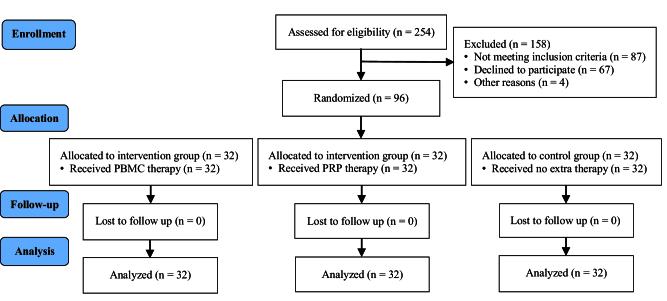
This randomized clinical trial study was done in the Rooya Infertility Treatment Center, Qom, Iran from November 2022 to April 2024. 96 women with at least 2 RIFs were randomized into control, PBMC, and PRP groups. Briefly, 3 ml of blood sample was collected and PBMCs were isolated using Ficoll separation solution, and cultured for 72 hr. PRP was separated from 10 ml of peripheral blood through centrifugation. 2 days before embryo transfer PBMCs or PRP were transferred into the endometrial cavity.
RESULTS
Except for the duration of infertility, which was higher in the PBMC group, all other baseline characteristics were not statistically different. Moreover, a significantly higher rate of biochemical pregnancy was observed in the PRP (10/32) and PBMC (12/32) groups compared to the control (3/32) (p = 0.027), while the rate of clinical pregnancy was only significantly higher in the PBMC group (10/32) than in the control group (2/32) (p = 0.038).
CONCLUSION
Neither PBMC nor PRP interventions exhibited a substantial advantage over one another regarding biochemical and clinical pregnancy rates.
背景
反复种植失败(RIF)主要可归因于胚胎与子宫内膜之间的串扰不当。辅助性T细胞1/辅助性T细胞2谱平衡影响胚胎的有效着床。通过子宫内注射活化的外周血单个核细胞(PBMC)或自体富血小板血浆(PRP)进行子宫内膜免疫调节是一种潜在有效的治疗选择。
目的
本研究旨在探讨子宫内给予活化PBMC和PRP对RIF女性生化妊娠和临床妊娠的影响。
材料与方法
本随机临床试验于2022年11月至2024年4月在伊朗库姆的鲁亚不孕治疗中心进行。96名至少有2次RIF的女性被随机分为对照组、PBMC组和PRP组。简要来说,采集3ml血液样本,使用Ficoll分离液分离PBMC,并培养72小时。通过离心从10ml外周血中分离PRP。在胚胎移植前2天将PBMC或PRP注入子宫内膜腔。
结果
除PBMC组的不孕持续时间较长外,所有其他基线特征在统计学上无差异。此外,与对照组(3/32)相比,PRP组(10/32)和PBMC组(12/32)的生化妊娠率显著更高(p = 0.027),而临床妊娠率仅PBMC组(10/32)显著高于对照组(2/32)(p = 0.038)。
结论
在生化妊娠率和临床妊娠率方面,PBMC和PRP干预均未显示出相对于彼此的显著优势。
 Zotero 插件