
加强糖尿病护理中的健康公平性和患者参与度:技术辅助连续血糖监测试点实施项目
Enhancing Health Equity and Patient Engagement in Diabetes Care: Technology-Aided Continuous Glucose Monitoring Pilot Implementation Project.
作者信息
Thakur Madhur, Maurer Eric W, Tran Kim Ngan, Tholkes Anthony, Rajamani Sripriya, Dwivedi Roli
机构信息
Institute for Health Informatics, Medical School, University of Minnesota, Minneapolis, MN, United States.
Community-University Health Care Center, Office of Academic Clinical Affairs, University of Minnesota, Minneapolis, MN, United States.
出版信息
JMIR Diabetes. 2025 Feb 5;10:e68324. doi: 10.2196/68324.
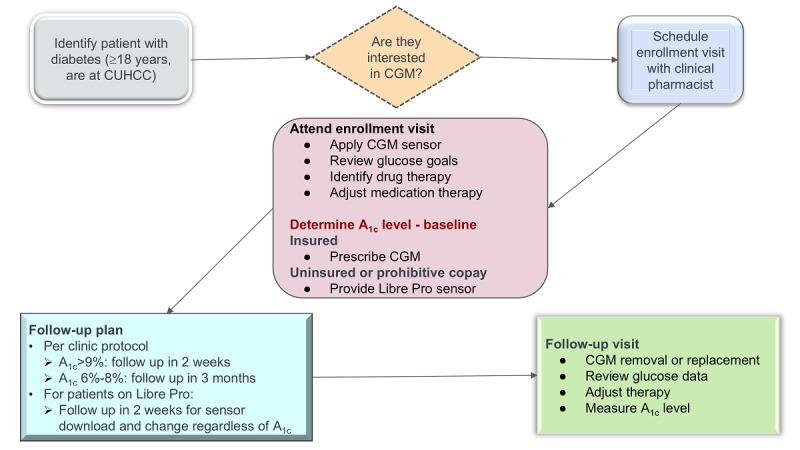
Federally Qualified Health Centers (FQHCs) provide service to medically underserved areas and communities, providing care to over 32 million patients annually. The burden of diabetes is increasing, but often, the vulnerable communities served by FQHCs lag in the management of the disease due to limited resources and related social determinants of health. With the increasing adoption of technologies in health care delivery, digital tools for continuous glucose monitoring (CGM) are being used to improve disease management and increase patient engagement. In this viewpoint, we share insights on the implementation of a CGM program at an FQHC, the Community-University Health Care Center (CUHCC) in Minneapolis, Minnesota. Our intent is to improve diabetes management through better monitoring of glucose and to ensure that the CGM program enables our organization's overarching digital strategy. Given the resource limitations of our population, we provided Libre Pro devices to uninsured patients through grants to improve health care equity. We used an interdisciplinary approach involving pharmacists, nurses, and clinicians and used hemoglobin A1c (HbA1c) levels as a measure of diabetes management. We assessed the CGM program and noted key aspects to guide future implementation and scalability. We recruited 148 participants with a mean age of 54 years; 39.8% (59/148) self-identified their race as non-White, 9.5% (14/148) self-identified their ethnicity as Hispanic or Latino, and one-third (53/148, 35.8%) were uninsured. Participants had diverse language preferences, with Spanish (54/148, 36.5%), English (52/148, 35.1%), Somali (21/148, 14.2%), and other languages (21/148, 14.2%). Their clinical characteristics included an average BMI of 29.91 kg/m2 and a mean baseline HbA1c level of 9.73%. Results indicate that the CGM program reduced HbA1c levels significantly from baseline to first follow-up (P<.001) and second follow-up (P<.001), but no significant difference between the first and second follow-up (P=.94). We share key lessons learned on cultural and language barriers, the digital divide, technical issues, and interoperability needs. These key lessons are generalizable for improving implementation at FQHCs and refining digital strategies for future scalability.
联邦合格医疗中心(FQHCs)为医疗服务不足的地区和社区提供服务,每年为超过3200万患者提供护理。糖尿病的负担正在增加,但通常,FQHCs服务的弱势群体由于资源有限和相关的健康社会决定因素,在疾病管理方面滞后。随着医疗保健服务中技术应用的增加,持续葡萄糖监测(CGM)的数字工具正被用于改善疾病管理并提高患者参与度。在这一观点中,我们分享了在明尼苏达州明尼阿波利斯的一家FQHC——社区大学医疗中心(CUHCC)实施CGM项目的见解。我们的目的是通过更好地监测血糖来改善糖尿病管理,并确保CGM项目符合我们组织的总体数字战略。鉴于我们服务人群的资源限制,我们通过拨款为未参保患者提供了Libre Pro设备,以改善医疗保健公平性。我们采用了一种跨学科方法,涉及药剂师、护士和临床医生,并将糖化血红蛋白(HbA1c)水平作为糖尿病管理的一项指标。我们评估了CGM项目,并指出了指导未来实施和扩大规模的关键方面。我们招募了148名参与者,平均年龄为54岁;39.8%(59/148)的人自我认定为非白人,9.5%(14/148)的人自我认定为西班牙裔或拉丁裔,三分之一(53/148,35.8%)未参保。参与者有不同的语言偏好,其中西班牙语(54/148,36.5%)、英语(52/148,35.1%)、索马里语(21/148,14.2%)和其他语言(21/148,14.2%)。他们的临床特征包括平均体重指数为29.91kg/m²,平均基线HbA1c水平为9.73%。结果表明,CGM项目从基线到首次随访(P<.001)和第二次随访(P<.001)时HbA1c水平显著降低,但首次和第二次随访之间无显著差异(P=.94)。我们分享了在文化和语言障碍、数字鸿沟、技术问题以及互操作性需求方面吸取的关键经验教训。这些关键经验教训可用于改进FQHCs的实施,并完善未来扩大规模的数字战略。
 Zotero 插件