
用于植入大型视网膜前刺激器的3D打印大阵列端口系统的设计、制造及手术测试
Design, Fabrication, and Surgical Testing of the 3D-Printed Large-Array Port-System for the Implantation of Large Epiretinal Stimulators.
作者信息
Balcewicz Frederic Kuba, Baumgarten Sabine, Schaffrath Kim, Wang Jiayun, Johnen Sandra, Walter Peter, Lohmann Tibor
机构信息
Department of Ophthalmology, RWTH Aachen University, Aachen, Germany.
出版信息
Transl Vis Sci Technol. 2025 Feb 3;14(2):8. doi: 10.1167/tvst.14.2.8.
PURPOSE
In the treatment of blindness causing retinal dystrophies, that is, retinitis pigmentosa (RP), retinal implants showed promising results. Recently, larger devices restoring a greater visual field were introduced. With larger size, implantation surgery became more difficult. In this study, a novel implantation device was developed, fabricated, and tested in implantation surgeries. The goal was to demonstrate a reproducible, safe, and, in comparison, superior implantation method.
METHODS
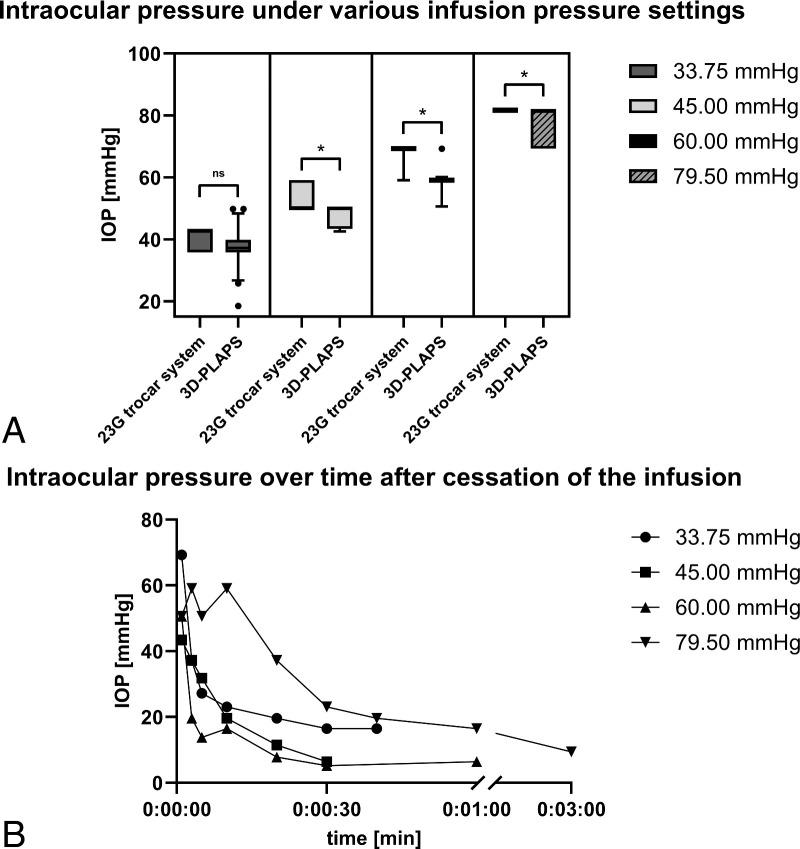
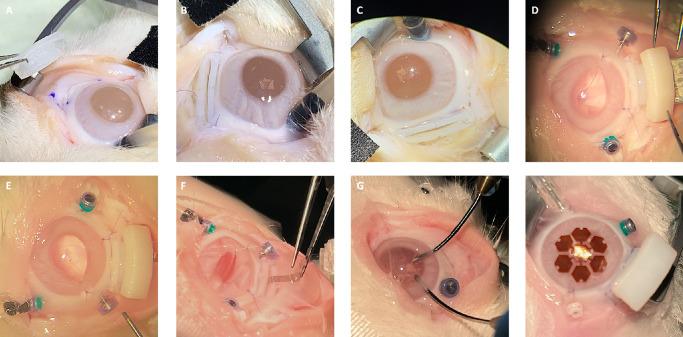
The novel implantation device 3D-Printed Large-Array Port-System (3D-PLAPS) was designed using computer-aided design software. Anatomic dimensions of rabbit, pig, and human eyes were collected from anatomic and histological data sources. The 3D-PLAPS were 3D-printed. In cadaveric porcine and rabbit eyes, 3D-PLAPS was used to implant large epiretinal stimulators developed by this group. A standardized surgical procedure was established. Intraocular pressure (IOP) was measured.
RESULTS
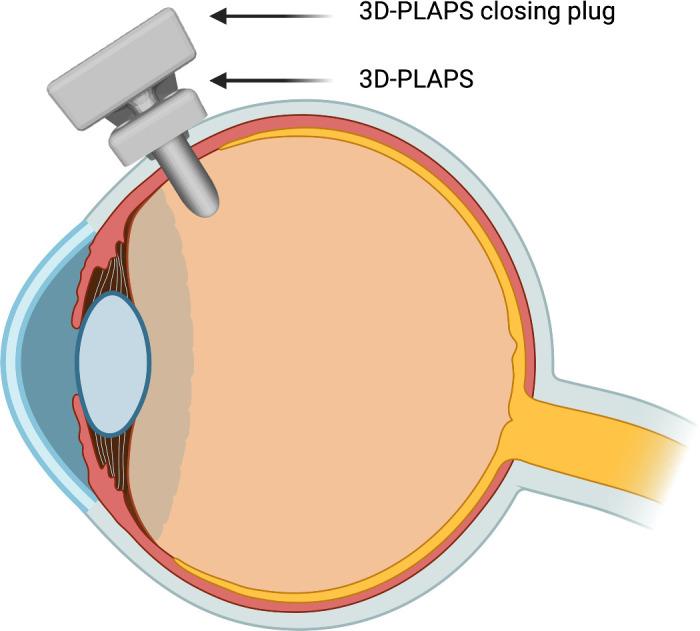
The 3D-PLAPS implantation device was designed with a length of 8.4 mm and adapted to the curvature of normal sighted human eyes with a diameter of 24.0 mm. The elliptical aperture is 7.0 mm in length and 1.0 mm in width at its widest points. Marginal apertures for scleral fixation were added. A closing plug was introduced. Design and dimensions were adapted for rabbit eyes. During surgery, the 3D-PLAPS improved ocular stability, sealed the incision, and withstood an elevated IOP. It was suitable for foldable stimulators with a diameter of up to 14.0 mm.
CONCLUSIONS
The 3D-PLAPS implantation device showed feasibility in implantation of large epiretinal stimulators and possibly also facilitates repositioning of stimulating arrays in acute experiments without the necessity for additional surgical steps.
TRANSLATIONAL RELEVANCE
The 3D printing and CAD software are used to applied surgery for large epiretinal stimulators.
目的
在治疗导致视网膜营养不良的失明疾病,即色素性视网膜炎(RP)方面,视网膜植入物显示出了有前景的结果。最近,更大尺寸、能恢复更大视野的装置被引入。随着尺寸增大,植入手术变得更加困难。在本研究中,开发、制造了一种新型植入装置,并在植入手术中进行了测试。目标是证明一种可重复、安全且相比之下更优的植入方法。
方法
使用计算机辅助设计软件设计新型植入装置3D打印大阵列端口系统(3D-PLAPS)。从解剖学和组织学数据源收集兔、猪和人眼的解剖尺寸。对3D-PLAPS进行3D打印。在猪和兔的尸体眼上,使用3D-PLAPS植入该团队开发的大型视网膜上刺激器。建立了标准化手术程序。测量眼内压(IOP)。
结果
3D-PLAPS植入装置设计长度为8.4毫米,适应正常视力人眼直径为24.0毫米的曲率。椭圆形孔径在最宽处长度为7.0毫米,宽度为1.0毫米。增加了用于巩膜固定的边缘孔。引入了封闭塞。设计和尺寸适用于兔眼。手术过程中,3D-PLAPS提高了眼球稳定性,封闭了切口,并能承受升高的眼压。它适用于直径达14.0毫米的可折叠刺激器。
结论
3D-PLAPS植入装置在植入大型视网膜上刺激器方面显示出可行性,并且在急性实验中可能还便于刺激阵列的重新定位,而无需额外的手术步骤。
转化相关性
3D打印和CAD软件用于大型视网膜上刺激器的应用手术。
 Zotero 插件