
基于1999年至2018年美国国家健康与营养检查调查横断面研究的营养摄入与骨关节炎之间的关联。
Associations between nutrient intake and osteoarthritis based on NHANES 1999 to 2018 cross sectional study.
作者信息
Lv Xiaofeng, Deng Xinmin, Lai Rui, Liu Shanshan, Zou Zihao, Dai Xuechun, Luo Yalan, Luo Jian, Li Ying
机构信息
School of Acupuncture and Tuina, Chengdu University of Traditional Chinese Medicine, Chengdu, 610075, China.
School of Clinical Medicine, Chengdu University of Traditional Chinese Medicine, Chengdu, 610075, Sichuan, China.
出版信息
Sci Rep. 2025 Feb 6;15(1):4445. doi: 10.1038/s41598-025-88847-y.
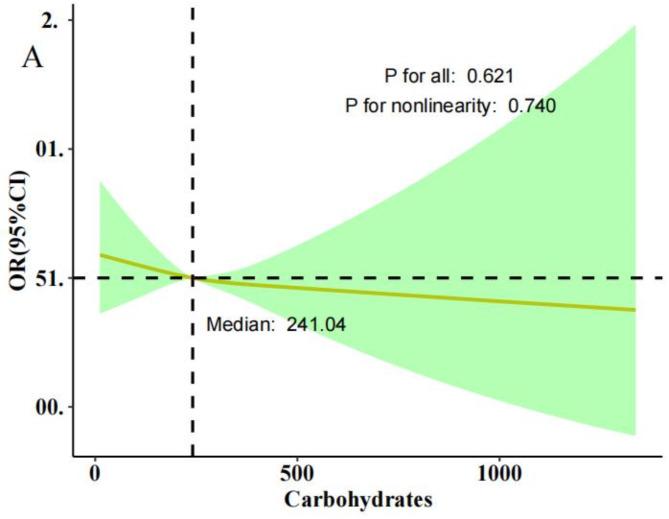
The relationship between nutrient intake and osteoarthritis (OA) remains unclear. This study utilized data from the National Health and Nutrition Examination Survey (NHANES) in a multi-cycle retrospective cohort study to explore the associations between the intake of six nutrients-carbohydrates, dietary fiber, protein, fat, folate, niacin and OA. This study performed a cross-sectional analysis using NHANES data from 1999 to 2018 to investigate the relationship between the intake of six nutrients and OA. Univariate and multivariate weighted logistic regression models, along with restricted cubic splines (RCS), were applied to assess the associations between nutrient intake and OA. A total of 32,484 participants were included in the study, of whom 1864 were diagnosed with OA, resulting in a prevalence rate of 5.74%. Multivariate weighted logistic regression consistently demonstrated that dietary fiber, folic acid, and nicotinic acid intake were negatively associated with the presence of OA, while protein intake exhibited a J-shaped relationship with OA, and carbohydrate or fat intake showed no significant association with OA. Compared with participants in the lowest quartile (Q1), those in the highest quartile (Q4) of dietary fiber, folic acid, and nicotinic acid intake had 27%, 28%, and 33% lower odds of having OA, respectively, after adjusting for potential confounding factors. RCS analysis revealed that dietary fiber and nicotinic acid intake had a nonlinear relationship with the presence of OA, folic acid intake had a linear relationship with OA, and protein intake followed a J-shaped curve with OA. These results suggest that higher intake of dietary fiber, folic acid, and nicotinic acid is associated with a reduced likelihood of OA, while protein intake follows a J-shaped curve, with moderate intake offering the greatest protection. These findings highlight the importance of balancing protein intake and optimizing the consumption of other nutrients for the prevention and management of OA. Further research is needed to confirm these findings and clarify the underlying mechanisms.
营养摄入与骨关节炎(OA)之间的关系仍不明确。本研究在一项多周期回顾性队列研究中利用了美国国家健康与营养检查调查(NHANES)的数据,以探讨六种营养素(碳水化合物、膳食纤维、蛋白质、脂肪、叶酸、烟酸)的摄入量与骨关节炎之间的关联。本研究使用1999年至2018年的NHANES数据进行横断面分析,以调查六种营养素的摄入量与骨关节炎之间的关系。应用单变量和多变量加权逻辑回归模型以及受限立方样条(RCS)来评估营养摄入与骨关节炎之间的关联。该研究共纳入32484名参与者,其中1864人被诊断患有骨关节炎,患病率为5.74%。多变量加权逻辑回归一致表明,膳食纤维、叶酸和烟酸的摄入量与骨关节炎的存在呈负相关,而蛋白质摄入量与骨关节炎呈J形关系,碳水化合物或脂肪摄入量与骨关节炎无显著关联。在调整潜在混杂因素后,与膳食纤维、叶酸和烟酸摄入量处于最低四分位数(Q1)的参与者相比,处于最高四分位数(Q4)的参与者患骨关节炎的几率分别降低了27%、28%和33%。RCS分析显示,膳食纤维和烟酸摄入量与骨关节炎的存在呈非线性关系,叶酸摄入量与骨关节炎呈线性关系,蛋白质摄入量与骨关节炎呈J形曲线。这些结果表明,较高的膳食纤维、叶酸和烟酸摄入量与较低的骨关节炎发生可能性相关,而蛋白质摄入量呈J形曲线,中等摄入量提供最大保护。这些发现突出了平衡蛋白质摄入量和优化其他营养素摄入对骨关节炎预防和管理的重要性。需要进一步的研究来证实这些发现并阐明潜在机制。

 Zotero 插件