
埃塞俄比亚年轻女孩对人乳头瘤病毒疫苗接种的犹豫态度:接种的影响因素和障碍
Human papillomavirus vaccination hesitancy among young girls in Ethiopia: factors and barriers to uptake.
作者信息
Sendekie Ashenafi Kibret, Abate Biruk Beletew, Adamu Betelhem Anteneh, Tefera Aschalew Mulatu, Mekonnen Kaleab Temelket, Ashagrie Melkam Alemu, Tadesse Yabibal Berie, Dagnaw Abera Dessie, Melaku Mequannent Sharew, Bizuneh Gizachew Kassahun
机构信息
Department of Clinical Pharmacy, School of Pharmacy, College of Medicine and Health Sciences, University of Gondar, Gondar, Ethiopia.
School of Pharmacy, Curtin Medical School, Faculty of Health Sciences, Curtin University, Bentley, WA, Australia.
出版信息
Front Public Health. 2025 Jan 23;13:1507832. doi: 10.3389/fpubh.2025.1507832. eCollection 2025.
BACKGROUND
Human papillomavirus (HPV) vaccinations protect against HPV infections. The infection might lead to vaginal cancer, vulvar cancer, genital warts, cervical intraepithelial neoplasia lesions, and cervical cancer. This study assessed hesitancy of HPV vaccination, associated factors, and barriers to vaccination among youth girls in Ethiopia.
METHODS
An institutional-based cross-sectional study was conducted among female undergraduate students at the University of Gondar, College of Medicine and Health Sciences, between July and August 2022. The data was collected using a self-administered questionnaire. A simple random sampling method was used to recruit participants. The data were entered and analyzed with SPSS version 26. Descriptive statistics were used to describe the participants' demographic characteristics. Logistic regression was performed to identify the significant factors associated with acceptance of the HPV vaccine. A -value <0.05 was considered statistically significant.
RESULTS
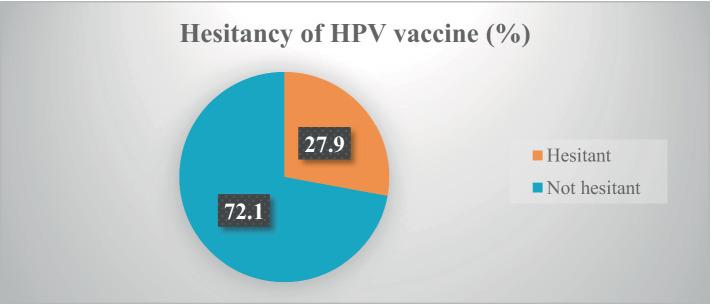
The study included 423 participants with a mean age of 22.5 ± 6.7 years. Only more than one-third (35.2, 95% CI: 27.2-44.1) received the HPV vaccine. Currently, more than one-fourth (27.9, 95% Cl: 21.4-33.8) of participants are hesitant to receive the HPV vaccine. Higher monthly income (AOR = 1.52, 95% CI: 1.08-6.34), good knowledge of the HPV vaccine (AOR = 2.12, 95% CI: 1.12-4.87), and a positive attitude towards the vaccine (AOR = 3.03, 95% CI: 1.63-9.56) were significantly associated with acceptance of HPV vaccination. Safety concerns (63.1%), misinformation (42.8%), and parental concerns (42.3%) about the HPV vaccine were among the top perceived reported barriers to receiving the HPV vaccine.
CONCLUSION
This result showed that more than a quarter number of youth girls are still hesitant to receive HPV vaccinations. To increase vaccination acceptance, interventions should focus on awareness-raising programs about HPV infection and vaccines and addressing safety and parental concerns.
背景
人乳头瘤病毒(HPV)疫苗可预防HPV感染。该感染可能导致阴道癌、外阴癌、尖锐湿疣、宫颈上皮内瘤变病变和宫颈癌。本研究评估了埃塞俄比亚年轻女孩对HPV疫苗接种的犹豫态度、相关因素及接种障碍。
方法
2022年7月至8月间,在贡德尔大学医学与健康科学学院对本科女生开展了一项基于机构的横断面研究。数据通过自填式问卷收集。采用简单随机抽样方法招募参与者。数据录入SPSS 26版进行分析。描述性统计用于描述参与者的人口统计学特征。进行逻辑回归以确定与接受HPV疫苗相关的显著因素。P值<0.05被认为具有统计学意义。
结果
该研究纳入了423名参与者,平均年龄为22.5±6.7岁。只有三分之一以上(35.2%,95%置信区间:27.2 - 44.1%)接种了HPV疫苗。目前,超过四分之一(27.9%,95%置信区间:21.4 - 33.8%)的参与者对接种HPV疫苗犹豫不决。较高的月收入(比值比[AOR]=1.52,95%置信区间:1.08 - 6.34)、对HPV疫苗的良好认知(AOR = 2.12,95%置信区间:1.12 - 4.87)以及对疫苗的积极态度(AOR = 3.03,95%置信区间:1.63 - 9.56)与接受HPV疫苗接种显著相关。对HPV疫苗的安全担忧(63.1%)、错误信息(42.8%)和父母的担忧(42.3%)是报告的接受HPV疫苗接种的主要障碍。
结论
该结果表明,超过四分之一的年轻女孩对接种HPV疫苗仍犹豫不决。为提高疫苗接种率,干预措施应侧重于开展关于HPV感染和疫苗的提高认识项目,并解决安全和父母担忧的问题。
 Zotero 插件