
识别撒哈拉以南非洲地区育龄妇女中体重过轻、超重和肥胖的高危人群细分。
Identifying high-risk population segments for underweight, overweight, and obesity among reproductive-age women in sub-Saharan Africa.
作者信息
Tareke Amare Abera, Mohammed Anissa, Muche Amare, Ali Yeshimebet
机构信息
Department of Biomedical Sciences, School of Medicine, Wollo University, Dessie, Ethiopia.
Department of Epidemiology and Biostatistics, School of Public Health, Wollo University, Dessie, Ethiopia.
出版信息
Front Public Health. 2025 Jan 23;12:1467747. doi: 10.3389/fpubh.2024.1467747. eCollection 2024.
BACKGROUND
Despite significant progress in addressing underweight in developing countries, the recent rise in the number of overweight and obese individuals has confirmed that the double burden of malnutrition will remain a crucial problem in the foreseeable future. Some countries that previously succeeded in reducing underweight rates are now experiencing a resurgence. Initiatives in sub-Saharan African (SSA) countries aimed at reducing malnutrition often lack robust evidence. This study aimed to identify risk groups for malnutrition among women of reproductive age in SSA countries and prioritize intervention areas.
METHODS
This analysis utilized data from 247,911 reproductive-age women across recent demographic and health surveys conducted in 33 SSA countries. Nutritional status was assessed using body mass index (BMI). We computed the pooled prevalence of different forms of malnutrition using the random effects inverse variance method. We evaluated the factors associated with different forms of malnutrition using multilevel multinomial regression. We reported the adjusted odds ratios and 95% confidence intervals (CIs).
RESULTS
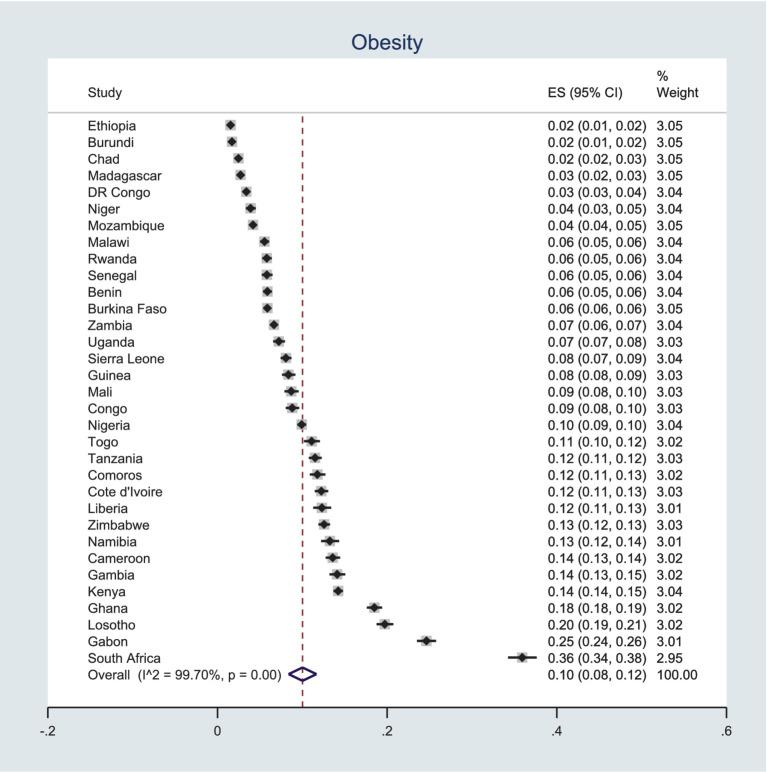
The pooled prevalence of underweight, overweight, and obesity among SSA women was 11% (95% CI: 9-12%), 18% (95% CI: 16-20%), and 10% (95% CI: 8-12%), respectively. Significant factors influencing malnutrition included women's age, highest educational level, wealth index, current breastfeeding status, contraceptive use, parity, media exposure, marital status, place of residence, and regional location within SSA. Factors such as education, wealth, age, contraceptive use, parity, and marital status were risk factors for overweight and obesity but were protective against underweight. Employment was protective against all three malnutrition forms.
CONCLUSION
Increased age, wealth index, not-breastfeeding status during the survey, contraceptive use, higher parity, marital status, urban residency, and living in southern or central Africa are associated with higher odds of increased BMI and lower odds of underweight. In designing interventions for overweight and obesity, emphasis should be given to the wealthy, reproductive-age women in later age, urban residents, and multiparous. Whereas the poorest and youngest is priority intervention segments for underweight.
背景
尽管发展中国家在解决体重不足问题上取得了重大进展,但近期超重和肥胖个体数量的增加证实,营养不良的双重负担在可预见的未来仍将是一个关键问题。一些此前成功降低体重不足率的国家现在正经历反弹。撒哈拉以南非洲(SSA)国家旨在减少营养不良的举措往往缺乏有力证据。本研究旨在确定SSA国家育龄妇女中的营养不良风险群体,并确定优先干预领域。
方法
本分析利用了在33个SSA国家近期进行的人口与健康调查中247,911名育龄妇女的数据。使用体重指数(BMI)评估营养状况。我们采用随机效应逆方差法计算不同形式营养不良的合并患病率。我们使用多水平多项回归评估与不同形式营养不良相关的因素。我们报告了调整后的比值比和95%置信区间(CI)。
结果
SSA妇女中体重不足、超重和肥胖的合并患病率分别为11%(95%CI:9 - 12%)、18%(95%CI:16 - 20%)和10%(95%CI:8 - 12%)。影响营养不良的重要因素包括妇女的年龄、最高教育水平、财富指数、当前母乳喂养状况、避孕措施使用情况、产次、媒体接触情况、婚姻状况、居住地点以及在SSA内的区域位置。教育、财富、年龄、避孕措施使用、产次和婚姻状况等因素是超重和肥胖的风险因素,但对体重不足有保护作用。就业对所有三种营养不良形式都有保护作用。
结论
年龄增加、财富指数、调查期间未进行母乳喂养、避孕措施使用、产次较高、婚姻状况、城市居住以及生活在非洲南部或中部与BMI升高的较高几率和体重不足的较低几率相关。在设计超重和肥胖干预措施时,应重点关注富裕的、年龄较大的育龄妇女、城市居民和经产妇。而最贫困和最年轻的人群是体重不足的优先干预对象。


 Zotero 插件