
叶酸可缓解因同型半胱氨酸代谢受损而导致的皮肤炎症和纤维化。
Folate alleviated skin inflammation and fibrosis resulting from impaired homocysteine metabolism.
作者信息
Huang Jiefeng, Lu Wuyan, Zhao Shenli, Cai Zixin, Li Linxiao, Hu Zihao, Jiang Yu, Deng Jinyi, Tang Yiming, Shi Chenzhang, Wang Chen, Liu Guangpeng, Li Shuaijun
机构信息
Department of Plastic Surgery, Shanghai Tenth People's Hospital, Tongji University School of Medicine, Shanghai, 200072, China.
The First Affiliated Hospital of Wannan Medical College, Yijishan Hospital of Wannan Medical College, Anhui, 241001, China.
出版信息
Redox Biol. 2025 Mar;80:103501. doi: 10.1016/j.redox.2025.103501. Epub 2025 Jan 21.
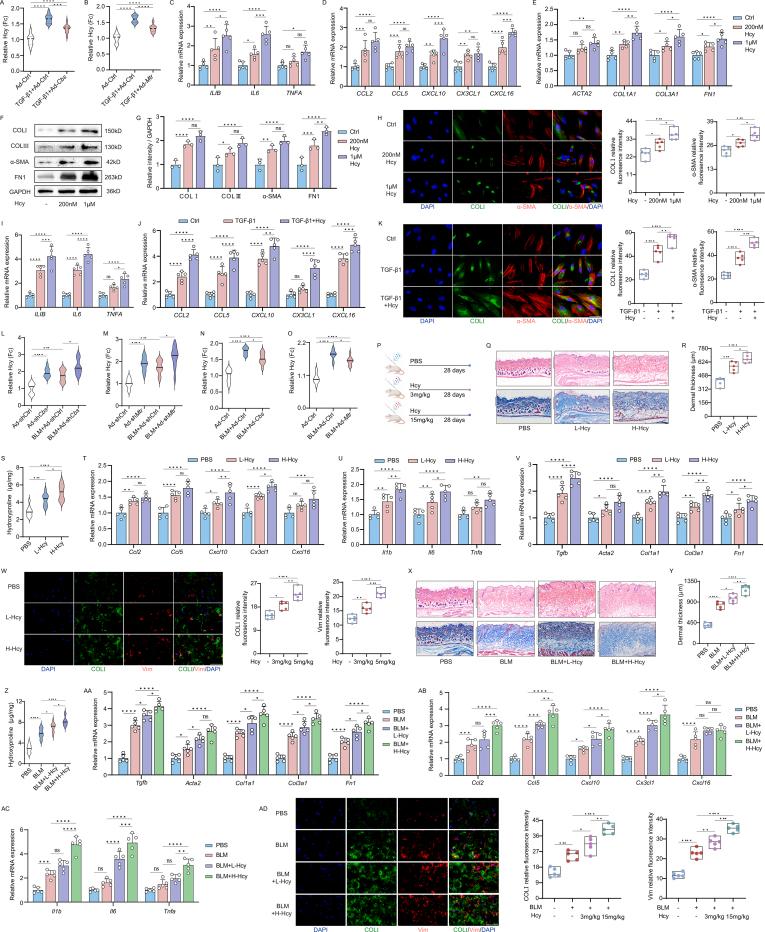
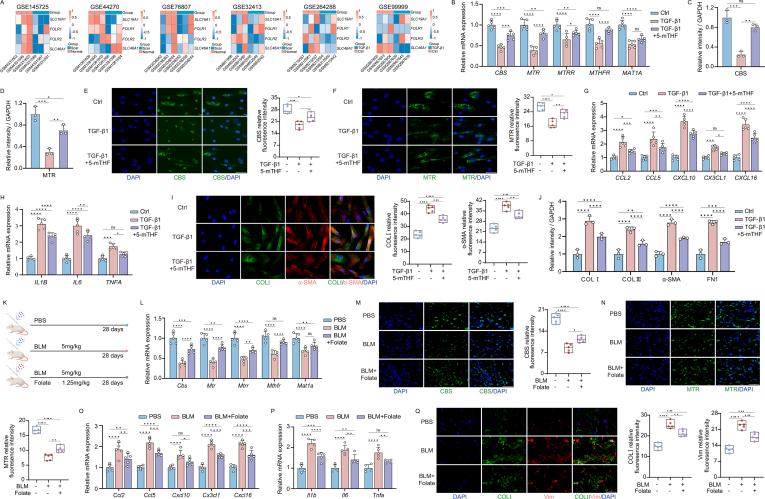
Skin fibrosis, characterized by uncontrolled secretion of extracellular matrix (ECM) proteins such as collagen, can lead to excessive scarring and compromised tissue function. Despite the widespread occurrence of fibrotic diseases, effective therapies are lacking. Recent clinical studies have demonstrated a positive correlation between serum homocysteine (Hcy) levels and the severity of systemic sclerosis. However, it remains unclear whether Hcy accumulation plays a pathogenic role in skin fibrosis. Here, we report that Hcy metabolism in fibroblasts plays a crucial role in regulating the pathogenesis of skin fibrosis. Fibrotic skin fibroblasts exhibited elevated levels of Hcy due to the downregulation of catabolism genes CBS and MTR. Experimental skin fibrosis was induced and exacerbated in mouse skin fibroblasts and tissues through adenoviral knockdown of Cbs or Mtr, whereas overexpression of these catabolic genes mitigated the pathogenesis. Furthermore, exogenous Hcy supplementation induced and aggravated the expression of inflammatory and fibrotic genes, promoting both spontaneous and BLM-induced skin fibrosis. Notably, folate administration enhanced Hcy catabolism and ameliorated skin inflammation and fibrosis by inhibiting JAK2/STAT3 signaling pathway. Collectively, these results indicate that skin fibrosis is associated with Hcy metabolic disorders and suggest that targeting Hcy metabolism or supplementing folate may provide a novel strategy for skin fibrosis.
皮肤纤维化的特征是细胞外基质(ECM)蛋白如胶原蛋白的分泌不受控制,可导致过度瘢痕形成和组织功能受损。尽管纤维化疾病普遍存在,但缺乏有效的治疗方法。最近的临床研究表明,血清同型半胱氨酸(Hcy)水平与系统性硬化症的严重程度呈正相关。然而,Hcy积累是否在皮肤纤维化中起致病作用仍不清楚。在此,我们报告成纤维细胞中的Hcy代谢在调节皮肤纤维化的发病机制中起关键作用。由于分解代谢基因CBS和MTR的下调,纤维化皮肤成纤维细胞中Hcy水平升高。通过腺病毒敲低Cbs或Mtr,在小鼠皮肤成纤维细胞和组织中诱导并加剧了实验性皮肤纤维化,而这些分解代谢基因的过表达减轻了发病机制。此外,外源性补充Hcy诱导并加重了炎症和纤维化基因的表达,促进了自发性和博来霉素诱导的皮肤纤维化。值得注意的是,叶酸给药通过抑制JAK2/STAT3信号通路增强了Hcy分解代谢,并改善了皮肤炎症和纤维化。总体而言,这些结果表明皮肤纤维化与Hcy代谢紊乱有关,并表明靶向Hcy代谢或补充叶酸可能为皮肤纤维化提供一种新的策略。

 Zotero 插件