
调强放疗后鼻咽癌患者残留颈部淋巴结中推量剂量的预后价值:一项回顾性研究
The prognostic value of boost dose in residual cervical lymph nodes in nasopharyngeal carcinoma patients after intensity-modulated radiotherapy: a retrospective study.
作者信息
Xu Mengting, Wang Liuling, Ding Jianming, Xu Yiying, Fei Zhaodong
机构信息
Department of Radiation Oncology, Clinical Oncology School of Fujian Medical University, Fujian Cancer Hospital, Fuma Road, Fuzhou, 350014, Fujian, People's Republic of China.
出版信息
BMC Cancer. 2025 Feb 7;25(1):222. doi: 10.1186/s12885-025-13665-4.
BACKGROUND
The administration of a boost dose to residual cervical lymph nodes (RCLN) following radiotherapy for nasopharyngeal carcinoma (NPC) remains a controversial contentious issue. This study explored the prognosis of NPC patients with such residuals and evaluated the impact of an intensity-modulated radiotherapy (IMRT) boost on outcome.
METHODS
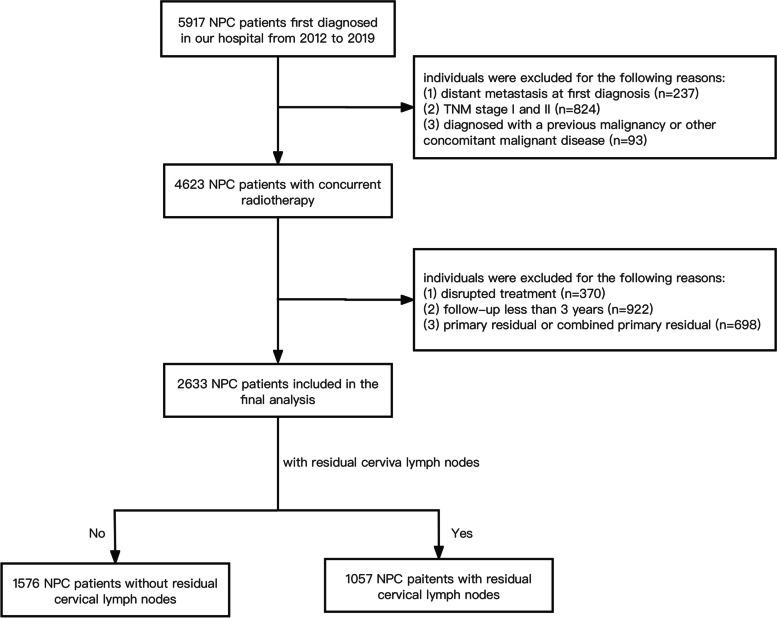
Two thousand six hundred thirty-three NPC patients following radical IMRT were retrospectively conducted. Clinical data of 1057 NPC patients with RCLN after radical IMRT were analyzed and 199 patients received boost radiation. To balance possible confounders between groups, propensity score matching (PSM) was carried out (ratio: 1:2). Risk classification was according to postradiotherapy Epstein-Barr virus (EBV) DNA and N category.
RESULTS
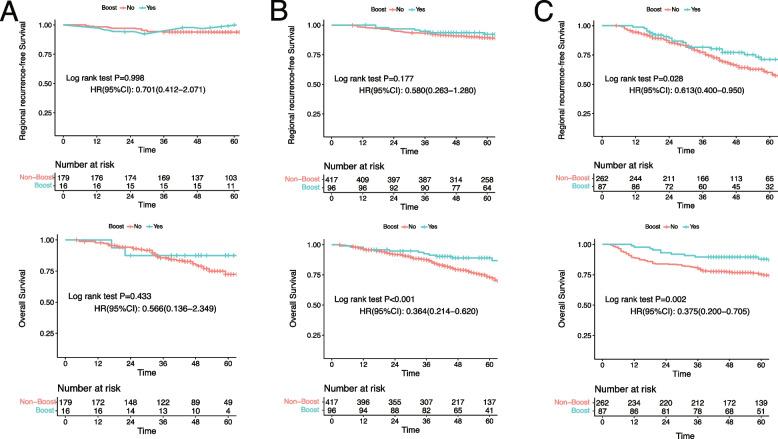
Patients with positive RCLN findings exhibited considerably lower 3-year relapse-free survival (RRFS), overall survival (OS), progression-free survival (PFS), and distant metastasis-free survival (DMFS) rates compared to those with negative findings (98.0% vs. 92.8%; 93.5% vs. 85.0%; 87.0% vs. 68.4%; 92.8% vs. 81.9%, all P < 0.001). Multivariate analysis indicated that N category and postradiotherapy EBV DNA levels as high-risk factors for RCLN. In the matched cohort, the boost radiation group showed improved 3-year OS (89.4% vs. 80.0%, P < 0.001), RRFS (95.0% vs. 89.8%, P = 0.019), PFS (73.8% vs. 63.7%, P = 0.004), and DMFS (85.2% vs. 74.2%, P = 0.001). Multivariate analysis confirmed boost radiation as a critical protective prognostic factor.
CONCLUSION
For NPC patients with RCLN, adding a boost dosage following radical IMRT results in desirable tumor control and a positive clinical outcome. Individuals with detectable EBV DNA and N2-3 category may benefit from the boost radiation.
背景
鼻咽癌(NPC)放疗后对残留颈部淋巴结(RCLN)给予加强剂量治疗仍是一个有争议的问题。本研究探讨了有此类残留的NPC患者的预后,并评估了调强放疗(IMRT)加强治疗对结局的影响。
方法
回顾性分析了2633例行根治性IMRT的NPC患者。分析了1057例根治性IMRT后有RCLN的NPC患者的临床资料,其中199例接受了加强放疗。为平衡组间可能的混杂因素,进行了倾向评分匹配(PSM)(比例:1:2)。风险分类根据放疗后 Epstein-Barr病毒(EBV)DNA和N分期。
结果
RCLN检查结果为阳性的患者与检查结果为阴性的患者相比,3年无复发生存率(RRFS)、总生存率(OS)、无进展生存率(PFS)和无远处转移生存率(DMFS)显著更低(98.0%对92.8%;93.5%对85.0%;87.0%对68.4%;92.8%对81.9%,均P<0.001)。多因素分析表明,N分期和放疗后EBV DNA水平是RCLN的高危因素。在匹配队列中,加强放疗组的3年OS(89.4%对80.0%,P<0.001)、RRFS(95.0%对89.8%,P = 0.019)、PFS(73.8%对63.7%,P = 0.004)和DMFS(85.2%对74.2%,P = 0.001)有所改善。多因素分析证实加强放疗是一个关键的保护性预后因素。
结论
对于有RCLN的NPC患者,根治性IMRT后增加加强剂量可实现理想的肿瘤控制并带来良好的临床结局。可检测到EBV DNA且N分期为2-3期的患者可能从加强放疗中获益。


 Zotero 插件