
纳米颗粒:应对植物环境胁迫的一种有前景的工具。
Nanoparticles: a promising tool against environmental stress in plants.
作者信息
Zhou Xu, El-Sappah Ahmed H, Khaskhoussi Amani, Huang Qiulan, Atif Amr M, Elhamid Mohamed A Abd, Ihtisham Muhammad, El-Maati Mohamed F Abo, Soaud Salma A, Tahri Walid
机构信息
International Faculty of Applied Technology, Yibin University, Yibin, Sichuan, China.
College of Agriculture, Forestry, and Food Engineering, Yibin University, Yibin, Sichuan, China.
出版信息
Front Plant Sci. 2025 Jan 27;15:1509047. doi: 10.3389/fpls.2024.1509047. eCollection 2024.
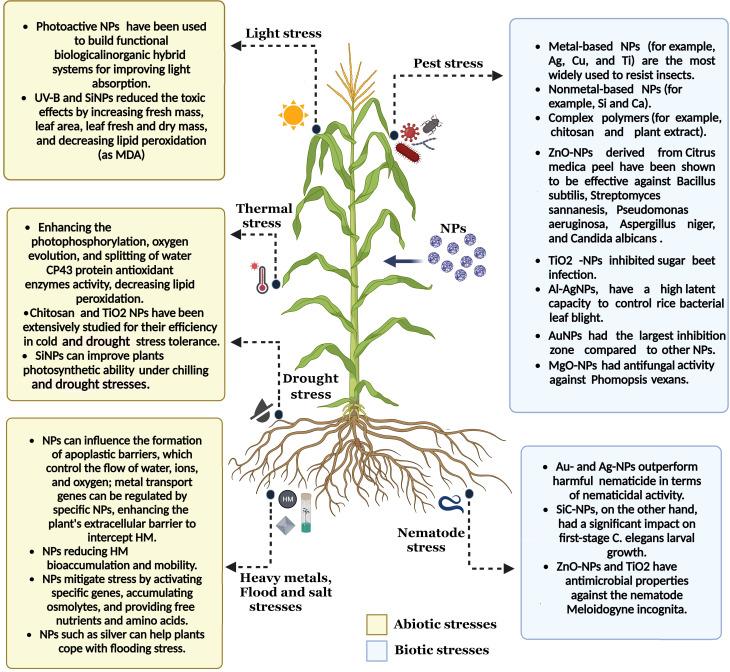
With a focus on plant tolerance to environmental challenges, nanotechnology has emerged as a potent instrument for assisting crops and boosting agricultural production in the face of a growing worldwide population. Nanoparticles (NPs) and plant systems may interact molecularly to change stress response, growth, and development. NPs may feed nutrients to plants, prevent plant diseases and pathogens, and detect and monitor trace components in soil by absorbing their signals. More excellent knowledge of the processes of NPs that help plants survive various stressors would aid in creating more long-term strategies to combat these challenges. Despite the many studies on NPs' use in agriculture, we reviewed the various types of NPs and their anticipated molecular and metabolic effects upon entering plant cells. In addition, we discussed different applications of NPs against all environmental stresses. Lastly, we introduced agricultural NPs' risks, difficulties, and prospects.
随着对植物耐受环境挑战的关注,纳米技术已成为一种有力工具,可在全球人口不断增长的情况下帮助作物生长并提高农业产量。纳米颗粒(NPs)与植物系统可能会发生分子相互作用,从而改变应激反应、生长和发育。纳米颗粒可以为植物提供养分,预防植物疾病和病原体,并通过吸收信号来检测和监测土壤中的微量成分。更深入了解有助于植物抵御各种压力源的纳米颗粒过程,将有助于制定更长期的策略来应对这些挑战。尽管对纳米颗粒在农业中的应用进行了大量研究,但我们仍综述了不同类型的纳米颗粒及其进入植物细胞后预期的分子和代谢效应。此外,我们还讨论了纳米颗粒针对所有环境压力的不同应用。最后,我们介绍了农用纳米颗粒的风险、困难和前景。

 Zotero 插件