
用于预防和管理癌症治疗相关心血管毒性的钠-葡萄糖协同转运蛋白2抑制剂:潜在机制与临床见解综述
SGLT2 inhibitors for prevention and management of cancer treatment-related cardiovascular toxicity: a review of potential mechanisms and clinical insights.
作者信息
Simela Carl, Walker J Malcolm, Ghosh Arjun K, Chen Daniel H
机构信息
University College London Hospital, London, UK.
Hatter Cardiovascular Institute, University College London, London, UK.
出版信息
Cardiooncology. 2025 Feb 11;11(1):15. doi: 10.1186/s40959-024-00284-4.
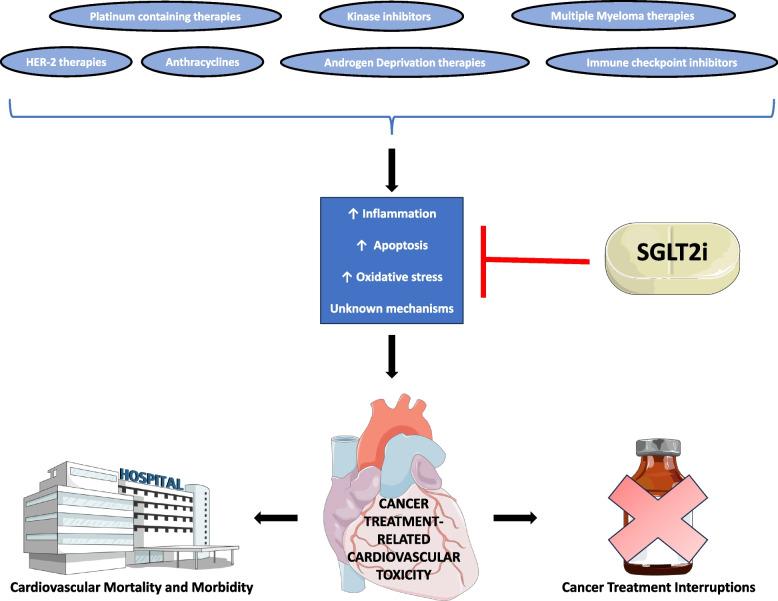
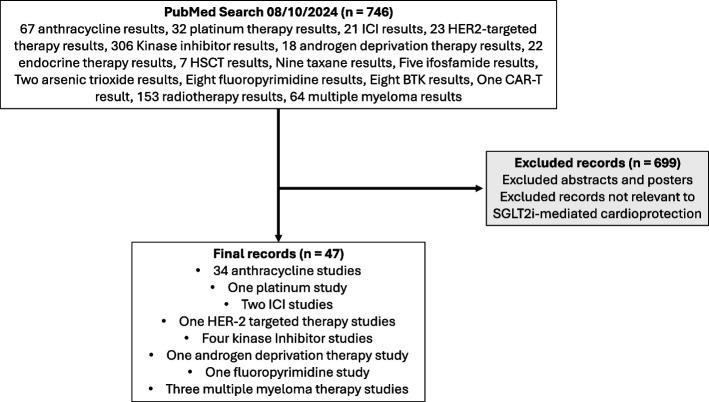
More evidence-based strategies are needed for preventing and managing cancer treatment-related cardiovascular toxicity (CTR-CVT). Owing to the growing body of evidence supporting their cardioprotective role in several cardiac injury scenarios, sodium-glucose cotransporter 2 inhibitors (SGLT2i) may be beneficial for preventing and treating CTR-CVT. In October 2024, a search was conducted of the PubMed database to review full studies investigating the cardioprotective role of SGLT2i against CTR-CVT. We identified 44 full published/pre-print studies and 3 ongoing randomised controlled trial across eight types of cancer treatment (anthracyclines, platinum-containing therapy, immune checkpoint inhibitors, HER2-targeted therapies, kinase inhibitors, androgen deprivation therapies, multiple myeloma therapies and 5-fluorouracil). Most studies used animal models and focussed on primary prevention. 43 of the 44 studies found some cardioprotective effect of SGLT2i against CTR-CVT, which in some cases included preventing ejection fraction decline and aberrations in cardiac electrophysiological parameters. Some studies also observed beneficial effects on mortality. A central triad of anti-inflammatory, anti-oxidative and anti-apoptotic mechanisms likely underlie SGLT2i-mediated cardioprotection against CTR-CVT. Overall, this growing body of research suggests that SGLT2i may be a promising candidate for preventing CTR-CVT either as monotherapy or in combination with other cardioprotective drugs. However, the literature is limited in that no prospective randomised controlled trials investigating SGLT2i for the prevention and management of CTR-CVT exist and most existing human retrospective data is based on diabetic populations. Future work must focus on addressing these limitations of the current literature.
需要更多基于证据的策略来预防和管理癌症治疗相关的心血管毒性(CTR-CVT)。由于越来越多的证据支持钠-葡萄糖协同转运蛋白2抑制剂(SGLT2i)在多种心脏损伤情况下的心脏保护作用,其可能对预防和治疗CTR-CVT有益。2024年10月,我们对PubMed数据库进行了检索,以综述研究SGLT2i对CTR-CVT心脏保护作用的完整研究。我们确定了44项已发表/预印本的完整研究以及3项正在进行的针对八种癌症治疗(蒽环类药物、含铂疗法、免疫检查点抑制剂、HER2靶向疗法、激酶抑制剂、雄激素剥夺疗法、多发性骨髓瘤疗法和5-氟尿嘧啶)的随机对照试验。大多数研究使用动物模型,重点是一级预防。44项研究中的43项发现SGLT2i对CTR-CVT有一定的心脏保护作用,在某些情况下包括预防射血分数下降和心脏电生理参数异常。一些研究还观察到对死亡率的有益影响。抗炎、抗氧化和抗凋亡机制的核心三联体可能是SGLT2i介导的针对CTR-CVT心脏保护作用的基础。总体而言,越来越多的研究表明,SGLT2i作为单一疗法或与其他心脏保护药物联合使用,可能是预防CTR-CVT的有前景的候选药物。然而,文献存在局限性,即不存在研究SGLT2i用于预防和管理CTR-CVT的前瞻性随机对照试验,并且大多数现有的人类回顾性数据基于糖尿病患者群体。未来的工作必须专注于解决当前文献的这些局限性。
 Zotero 插件