
阿曼北部地区[具体内容缺失]的临床特征及抗生素敏感性模式
Clinical Profile and Antibiotic Susceptibility Patterns of in the Northern Region of Oman.
作者信息
Sannathimmappa Mohan Bilikallahalli, Nambiar Vinod, Al-Alawi Osama Mohammed Salih Adnan, Al-Fragi Mouge Mohammad Salah, Al Mani Isra Mohammed Ali, Madan Zahra Merza Ahmed Hasan Ahmed, Al-Maqbali Salima, Aravindakshan Rajeev
机构信息
Department of Microbiology, College of Medicine and Health Sciences, National University of Science and Technology, Sohar Campus, Sohar, Oman.
College of Medicine and Health Sciences, National University of Science and Technology, Sohar Campus, Sohar, Oman.
出版信息
Saudi J Med Med Sci. 2025 Jan-Mar;13(1):32-38. doi: 10.4103/sjmms.sjmms_136_24. Epub 2025 Jan 11.
BACKGROUND
is an opportunistic pathogen that mostly affects neonates, infants, and elderly people with weakened immune systems. No study has reported the frequency and antibiotic susceptibility patterns of from Oman, and thus this study was conducted to fill this gap in the literature.
MATERIALS AND METHODS
This single-center retrospective study included isolates identified from different clinical samples of patients treated at Sohar Hospital, Oman, between January 2017 and December 2023. Bacterial identification and antibiotic susceptibility testing were done using the VITEK II automated microbiological system in accordance with the Clinical Laboratory Standards Institute (CLSI) guidelines.
RESULTS
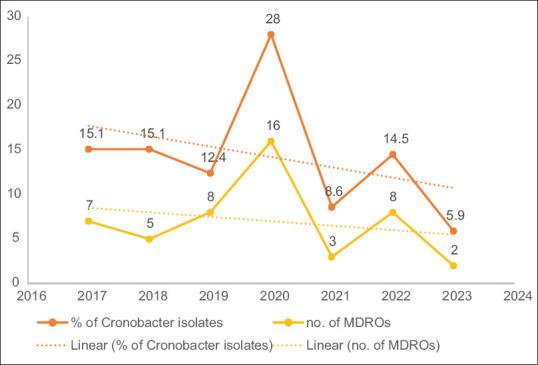
A total of 185 isolates were included, most commonly from patients aged >60 years (42.7%) and <1 year (11.4%). strains had high susceptibility (>80%) to most of the tested antibiotics; however, for beta-lactam antibiotics, it ranged from 0% to 50%. Approximately 26.5% of the strains were multidrug resistant. Independent risk factors for increased frequency of multidrug-resistant strains were urinary catheterization ( = 0.002), surgery ( = 0.021), previous antibiotic therapy ( = 0.047), and critical care unit admission ( = 0.048). About one-fifth of the patients experienced life-threatening infections such as septicemia (15%) and pneumonia (4.7%). All deaths due to septicemia occurred in the >60 years ( = 12) and <1 year ( = 4) age groups.
CONCLUSIONS
isolates from the North Batinah region of Oman were most frequently isolated from elderly and infant patients and had high antibiotic susceptibility; however, the significant resistance against beta-lactams suggests their low effectiveness. The high number of multidrug-resistant strains coupled with the independent risk factors suggests the need for following stricter antibiotic stewardship protocols and infection control practices.
背景
是一种机会致病菌,主要影响免疫系统较弱的新生儿、婴儿和老年人。尚无研究报道阿曼的频率和抗生素敏感性模式,因此开展本研究以填补文献中的这一空白。
材料与方法
本单中心回顾性研究纳入了2017年1月至2023年12月期间在阿曼苏哈尔医院接受治疗的患者不同临床样本中分离出的菌株。根据临床实验室标准协会(CLSI)指南,使用VITEK II自动微生物系统进行细菌鉴定和抗生素敏感性测试。
结果
共纳入185株菌株,最常见于年龄>60岁(42.7%)和<1岁(11.4%)的患者。菌株对大多数测试抗生素具有高敏感性(>80%);然而,对于β-内酰胺类抗生素,敏感性范围为0%至50%。约26.5%的菌株对多种药物耐药。多重耐药菌株频率增加的独立危险因素包括导尿(P = 0.002)、手术(P = 0.021)、既往抗生素治疗(P = 0.047)和入住重症监护病房(P = 0.048)。约五分之一的患者经历了危及生命的感染,如败血症(15%)和肺炎(4.7%)。所有因败血症导致的死亡均发生在>60岁(n = 12)和<1岁(n = 4)年龄组。
结论
阿曼北巴提奈地区分离出的菌株最常来自老年和婴儿患者,且具有较高的抗生素敏感性;然而,对β-内酰胺类药物的显著耐药性表明其疗效较低。大量的多重耐药菌株以及独立危险因素表明需要遵循更严格的抗生素管理方案和感染控制措施。
 Zotero 插件