
老年营养风险指数(GNRI)与胰腺癌患者生存率:一项回顾性研究
Geriatric Nutritional Risk Index (GNRI) and Survival in Pancreatic Cancer: A Retrospective Study.
作者信息
Grinstead Christina, Yoon Saunjoo L
机构信息
Department of Biobehavioral Nursing Science, College of Nursing, University of Florida, 1225 Center Drive, P.O. Box 100187, Gainesville, FL 32610-0187, USA.
出版信息
Nutrients. 2025 Jan 30;17(3):509. doi: 10.3390/nu17030509.
INTRODUCTION
Malnutrition is a major contributor to poor treatment and survival outcomes in pancreatic cancer, yet nutritional assessment is not standardized or consistently implemented in the care of oncology patients. The Geriatric Nutritional Risk Index (GNRI), calculated from serum albumin and body weight, may be useful as a practical tool for identifying patients at risk of poor nutritional status. : To provide a preliminary analysis using a limited selection of variables to examine the association of the GNRI at diagnosis and the GNRI change over time with overall survival in patients with pancreatic cancer.
METHODS
This retrospective study included 314 patients aged ≥18 years with pancreatic cancer. The GNRI was calculated at diagnosis and ≥30 days later. Patients were categorized by the GNRI at diagnosis (no risk >98, any risk ≤98) and change in the GNRI over time (no change/increase, mild decrease, and severe decrease). Additional variables included were demographics and stage. Comparative analysis included -tests, chi-square tests, and ANOVA. Survival was analyzed using Kaplan-Meier curves, log-rank tests, and Cox proportional hazards modeling.
RESULTS
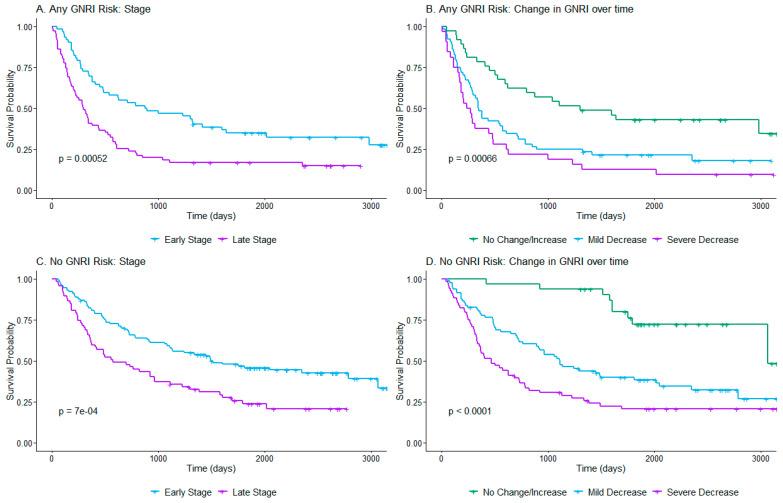
Median survival was significantly decreased in patients in the group compared to the group at diagnosis (442 vs. 1105 days), and those experiencing in the GNRI scores compared and (372.5 vs. 712 vs. 1791 days), respectively. Survival analysis stratified by the GNRI at diagnosis shows that both mild (HR 2.19, 95%, and CI 1.46-3.30) and severe decreases (HR 4.04, 95%, and CI 2.64-6.18) in the GNRI scores were independently associated with decreased survival versus in the GNRI group after controlling for stage. Log-rank tests also show patients with at diagnosis had significantly lower survival than those with ( = 0.00052).
CONCLUSIONS
Lower GNRI scores showing greater nutritional risk at diagnosis and decreasing GNRI scores over time were predictors of decreased survival in pancreatic cancer. Our findings indicate that the GNRI may be valid and effective for the early identification of patients with a high nutritional risk who require nutritional interventions to improve outcomes in pancreatic cancer. However, more research is needed using larger samples and a greater variety of variables to confirm the presence and strength of this relationship, examine the effect of patient factors known to be associated with survival and nutrition, and explore potential influential confounders.
引言
营养不良是导致胰腺癌治疗效果不佳和生存率低下的主要因素,然而在肿瘤患者护理中,营养评估并未标准化或得到持续实施。根据血清白蛋白和体重计算得出的老年营养风险指数(GNRI),可能是识别营养状况不佳风险患者的实用工具。目的:使用有限的变量进行初步分析,以研究胰腺癌患者诊断时的GNRI以及GNRI随时间的变化与总生存期之间的关联。
方法
这项回顾性研究纳入了314例年龄≥18岁的胰腺癌患者。在诊断时及诊断后≥30天计算GNRI。患者根据诊断时的GNRI(无风险>98,有任何风险≤98)以及GNRI随时间的变化(无变化/增加、轻度下降和重度下降)进行分类。纳入的其他变量包括人口统计学和分期。比较分析包括t检验、卡方检验和方差分析。使用Kaplan-Meier曲线、对数秩检验和Cox比例风险模型分析生存率。
结果
诊断时,GNRI处于某组的患者中位生存期显著低于另一组(442天对1105天),而GNRI评分出现某变化的患者相比其他变化的患者,中位生存期分别为(372.5天对712天对1791天)。按诊断时的GNRI分层的生存分析表明,在控制分期后,GNRI评分轻度下降(HR 2.19,95%CI 1.46 - 3.30)和重度下降(HR 4.04,95%CI 2.64 - 6.18)均与生存率降低独立相关,与GNRI无变化/增加组相比。对数秩检验还显示,诊断时处于某GNRI状态的患者生存率显著低于另一GNRI状态的患者(P = 0.00052)。
结论
诊断时较低的GNRI评分表明营养风险更高,且随时间推移GNRI评分下降是胰腺癌患者生存率降低的预测因素。我们的研究结果表明,GNRI可能对早期识别需要营养干预以改善胰腺癌预后的高营养风险患者有效。然而,需要使用更大样本和更多种类的变量进行更多研究,以确认这种关系的存在和强度,研究已知与生存和营养相关的患者因素的影响,并探索潜在的有影响的混杂因素。


 Zotero 插件