
迷走神经与血清素在肠-脑轴中的相互作用。
Interaction of the Vagus Nerve and Serotonin in the Gut-Brain Axis.
作者信息
Hwang Young Keun, Oh Jae Sang
机构信息
Department of Medical Sciences, Graduate School, The Catholic University of Korea, Seoul 06591, Republic of Korea.
Department of Neurosurgery, Uijeongbu St. Mary's Hospital, College of Medicine, The Catholic University of Korea, Seoul 06591, Republic of Korea.
出版信息
Int J Mol Sci. 2025 Jan 29;26(3):1160. doi: 10.3390/ijms26031160.
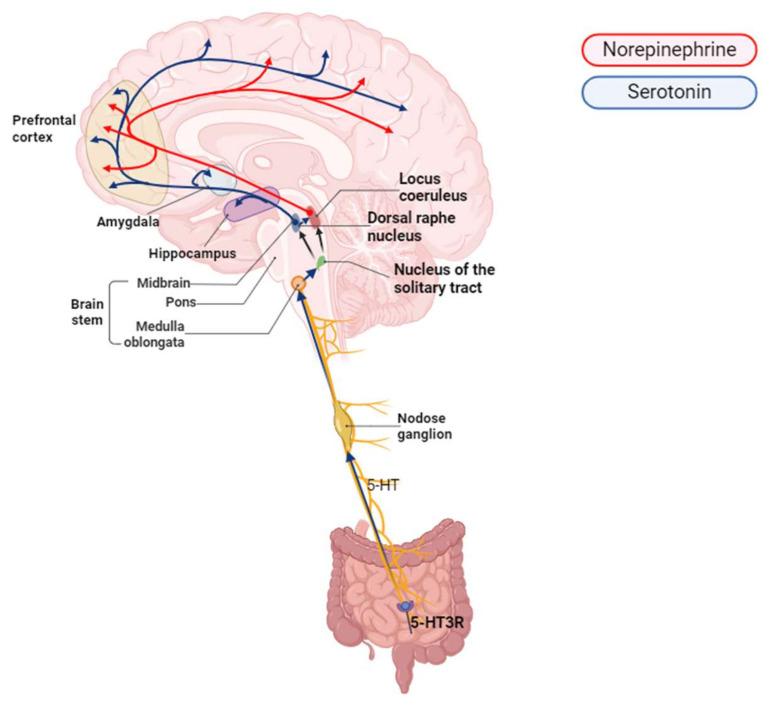
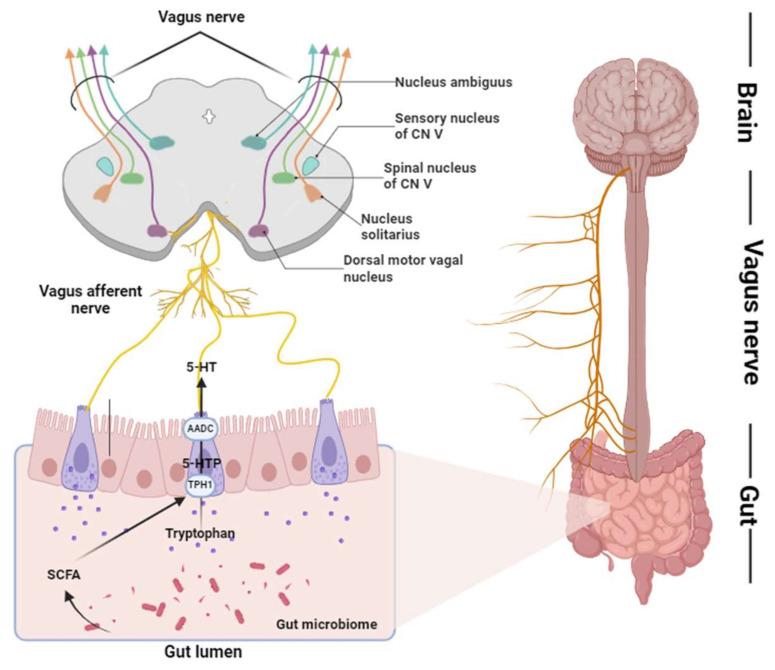
The gut-brain axis represents an important bidirectional communication network, with the vagus nerve acting as a central conduit for peripheral signals from the various gut organs to the central nervous system. Among the molecular mediators involved, serotonin (5-HT), synthesized predominantly by enterochromaffin cells in the gut, plays a pivotal role. Gut-derived serotonin activates vagal afferent fibers, transmitting signals to the nucleus tractus solitarius (NTS) and modulating serotonergic neurons in the dorsal raphe nucleus (DRN) as well as the norepinephrinergic neurons in the locus coeruleus (LC). This interaction influences emotional regulation, stress responses, and immune modulation. Emerging evidence also highlights the role of microbial metabolites, particularly short-chain fatty acids (SCFAs), in enhancing serotonin synthesis and vagal activity, thereby shaping gut-brain communication. This review synthesizes the current knowledge on serotonin signaling, vagal nerve pathways, and central autonomic regulation, with an emphasis on their implications for neuropsychiatric and gastrointestinal disorders. By elucidating these pathways, novel therapeutic strategies targeting the gut-brain axis may be developed to improve mental and physical health outcomes.
肠-脑轴是一个重要的双向通信网络,迷走神经作为从各个肠道器官向中枢神经系统传递外周信号的主要通道。在涉及的分子介质中,主要由肠道嗜铬细胞合成的血清素(5-羟色胺)起着关键作用。肠道产生的血清素激活迷走神经传入纤维,将信号传递到孤束核(NTS),并调节中缝背核(DRN)中的血清素能神经元以及蓝斑核(LC)中的去甲肾上腺素能神经元。这种相互作用影响情绪调节、应激反应和免疫调节。新出现的证据还强调了微生物代谢产物,特别是短链脂肪酸(SCFAs),在增强血清素合成和迷走神经活动方面的作用,从而塑造肠-脑通信。这篇综述综合了关于血清素信号传导、迷走神经通路和中枢自主神经调节的当前知识,重点关注它们对神经精神疾病和胃肠道疾病的影响。通过阐明这些途径,可能会开发出针对肠-脑轴的新型治疗策略,以改善身心健康结果。
 Zotero 插件