
海葵对微塑料和中塑料的消费倾向
Micro- and Mesoplastic Consumption Tendency of Sea Anemones.
作者信息
Kaliszewicz Anita, Czyżewska Agata, Karaban Kamil, Olejniczak Izabella, Boniecki Paweł
机构信息
Institute of Biological Sciences, Cardinal Stefan Wyszynski University in Warsaw, Wóycickiego 1/3, 01-938 Warsaw, Poland.
Faculty of Biology and Environmental Sciences, Cardinal Stefan Wyszynski University in Warsaw, Wóycickiego 1/3, 01-938 Warsaw, Poland.
出版信息
Animals (Basel). 2025 Feb 1;15(3):405. doi: 10.3390/ani15030405.
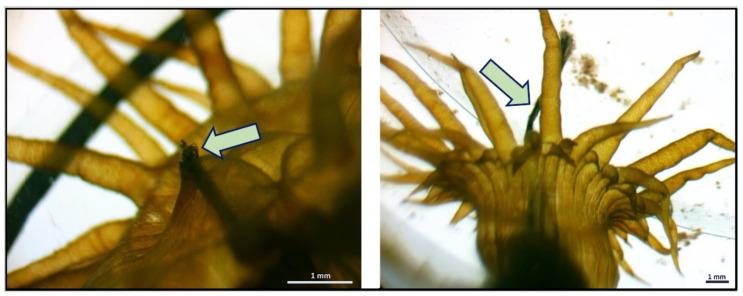
Microplastics are an increasingly common threat to the aquatic environment, and, due to their small size, it is easy for them to spread and enter the seas and oceans. Micro- and mesoplastic particles are often ingested by marine organisms, especially those that have the potential for successful settlement on artificial substrata, including plastic. In laboratory experiments, we tested the tendency of the sea anemone to consume plastic fragments and fibers of various sizes and shapes; these organisms are widely distributed in coastal waters, tide pools, and coral reefs. The plastic fragments and fibers were placed either in natural food or covered with a special food in gel form, which allowed them to retain their original shape. Our studies have shown that plastic in the shape of fibers is less readily consumed than in the form of fragments. The anemones with oral discs of diameter 10-12 mm had difficulty consuming long fibers. A total of 67% of the studied animals were unable to consume fibers of 13 mm length, while those of 3 and 7 mm length were consumed by 100% of the sea anemones. We have also established that microplastics taken with food are harmful to these cnidarians: mechanical injury to the body column was caused by the ingested polypropylene microfragments, and we also observed significantly increased mortality. Injuries, combined with the possible toxicological effects of the polymers, may have been the cause of increased mortality of the .
微塑料对水生环境的威胁日益普遍,并且由于其尺寸小,它们很容易扩散并进入海洋。微塑料和中塑料颗粒经常被海洋生物摄取,特别是那些有可能在包括塑料在内的人工基质上成功定居的生物。在实验室实验中,我们测试了海葵摄取各种尺寸和形状的塑料碎片和纤维的倾向;这些生物广泛分布在沿海水域、潮池和珊瑚礁中。塑料碎片和纤维要么放置在天然食物中,要么用凝胶状的特殊食物覆盖,这样它们就能保持原来的形状。我们的研究表明,纤维状的塑料比碎片状的塑料更不容易被摄取。口盘直径为10 - 12毫米的海葵摄取长纤维有困难。总共67%的被研究动物无法摄取13毫米长的纤维,而3毫米和7毫米长的纤维被100%的海葵摄取。我们还确定,与食物一起摄取的微塑料对这些刺胞动物有害:摄入的聚丙烯微碎片对体柱造成机械损伤,并且我们还观察到死亡率显著增加。损伤加上聚合物可能的毒理学效应,可能是海葵死亡率增加的原因。


 Zotero 插件