
睡眠作为慢性病与抑郁症之间的中介因素:一项美国国家健康与营养检查调查(2005 - 2018年)研究
Sleep as a mediator between chronic diseases and depression: a NHANES study (2005-2018).
作者信息
Tan Ming, Zhao Haihong, Nie Ruya, Deng Pingping, Wang Cuixiao
机构信息
Department of Otolaryngology-Head and Neck Surgery, Jingmen Central Hospital, Jingmen, Hubei, China.
Department of Otolaryngology-Head and Neck Surgery, Jingmen Central Hospital Affiliated to Jingchu University of Technology, Jingmen, Hubei, China.
出版信息
Front Psychol. 2025 Jan 29;16:1522536. doi: 10.3389/fpsyg.2025.1522536. eCollection 2025.
OBJECTIVE
This article investigates the relationship between common chronic diseases and depression among US adults and examines the mediating role of sleep in this relationship, using a cross-sectional study to offer recommendations for depression prevention.
METHODS
This study analyzed data from 10,710 participants collected from the National Health and Nutrition Examination Survey (NHANES) between 2005 and 2018. Logistic regression, subgroup analysis, restricted cubic spline (RCS) analysis, and mediation analysis were employed to explore the relationship between common chronic diseases and depression, and the mediating role of sleep.
RESULTS
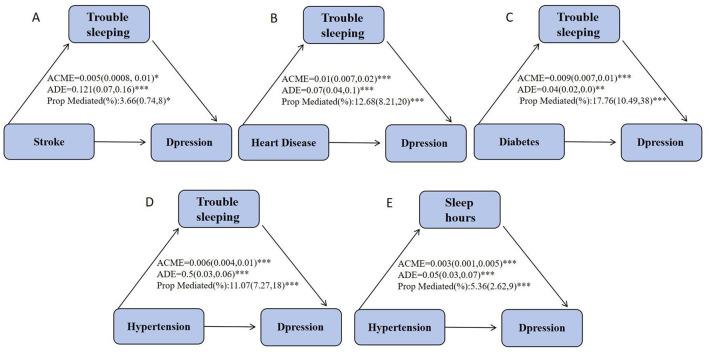
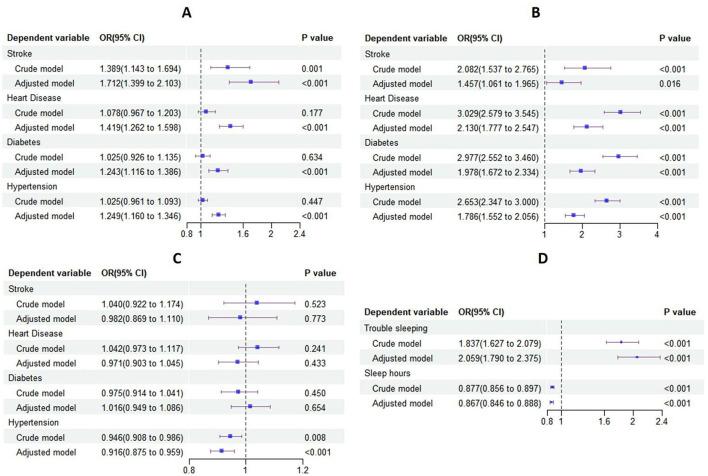
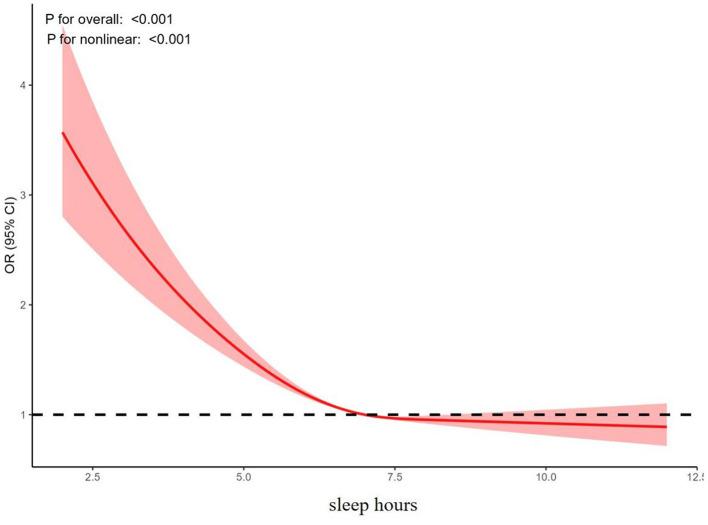
The adjusted model indicated that stroke (OR = 1.712, 95% CI: 1.399, 2.103), heart disease (OR = 1.419, 95% CI: 1.262, 1.598), diabetes (OR = 1.243, 95% CI: 1.116, 1.386), and hypertension (OR = 1.249, 95% CI: 1.160, 1.346) were associated with an increased probability of depression. Additionally, trouble sleeping (OR = 2.059, 95% CI: 1.790, 2.375) was associated with an increased probability of depression, while sleep hours (OR = 0.867, 95% CI: 0.846, 0.888) may decrease this probability. RCS analysis showed a non-linear relationship between sleep hours and the risk of depression. The final mediation analysis showed that trouble sleeping mediated 3.66% of the effect of stroke, 12.68% of heart disease, and 17.76% of diabetes on depression. Furthermore, trouble sleeping mediated 11.07% of the impact of hypertension on depression, while sleep hours mediated 5.36% of this impact.
CONCLUSION
Chronic diseases and sleep problems may increase the likelihood of depression among U.S. adults, with sleep serving as a mediator between chronic diseases and depression.
目的
本文采用横断面研究方法,调查美国成年人常见慢性病与抑郁症之间的关系,并检验睡眠在这种关系中的中介作用,为抑郁症预防提供建议。
方法
本研究分析了2005年至2018年期间从美国国家健康与营养检查调查(NHANES)收集的10710名参与者的数据。采用逻辑回归、亚组分析、受限立方样条(RCS)分析和中介分析,探讨常见慢性病与抑郁症之间的关系以及睡眠的中介作用。
结果
调整后的模型表明,中风(比值比[OR]=1.712,95%置信区间[CI]:1.399,2.103)、心脏病(OR=1.419,95%CI:1.262,1.598)、糖尿病(OR=1.243,95%CI:1.116,1.386)和高血压(OR=1.249,95%CI:1.160,1.346)与抑郁症发生概率增加相关。此外,睡眠困难(OR=2.059,95%CI:1.790,2.375)与抑郁症发生概率增加相关,而睡眠时间(OR=0.867,95%CI:0.846,0.888)可能降低这种概率。RCS分析显示睡眠时间与抑郁症风险之间存在非线性关系。最终的中介分析表明,睡眠困难介导了中风对抑郁症影响的3.66%、心脏病的12.68%和糖尿病的17.76%。此外,睡眠困难介导了高血压对抑郁症影响的11.07%,而睡眠时间介导了这一影响的5.36%。
结论
慢性病和睡眠问题可能会增加美国成年人患抑郁症的可能性,睡眠在慢性病和抑郁症之间起中介作用。
 Zotero 插件