
牛磺酸与咖啡因联合使用对低氧环境下重复冲刺运动表现及认知功能的影响。
Effects of taurine combined with caffeine on repetitive sprint exercise performance and cognition in a hypoxic environment.
作者信息
Liu Jie, Rong Wenchao
机构信息
Department of PE, Xi'an University of Finance and Economics, Xi'an, 710100, China.
Faculty of Education Studies, University Putra Malaysia, Serdang, Malaysia.
出版信息
Sci Rep. 2025 Feb 13;15(1):5386. doi: 10.1038/s41598-025-89680-z.
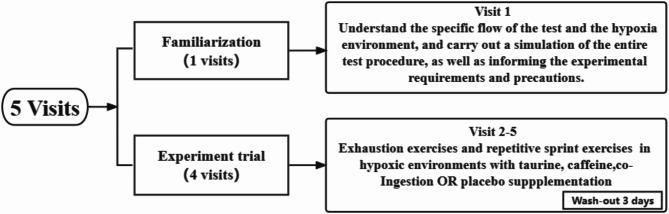
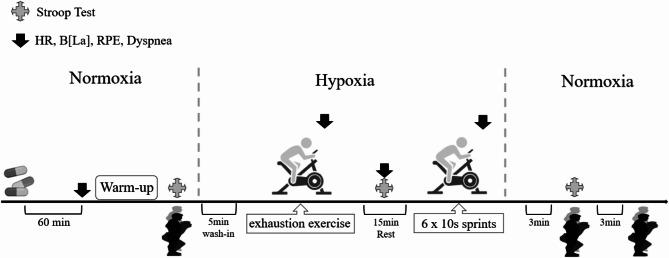
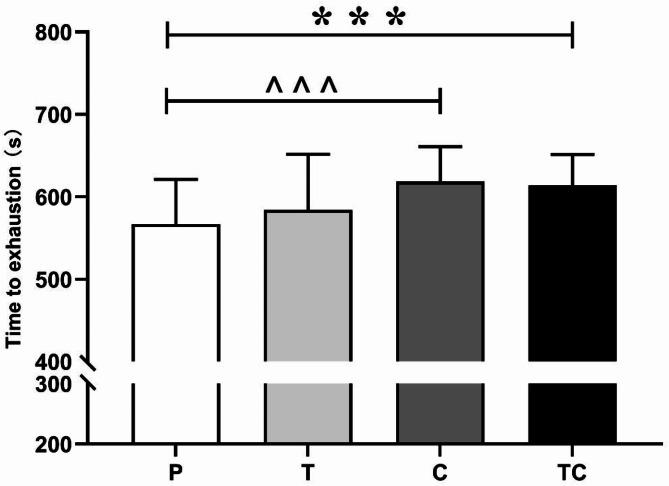
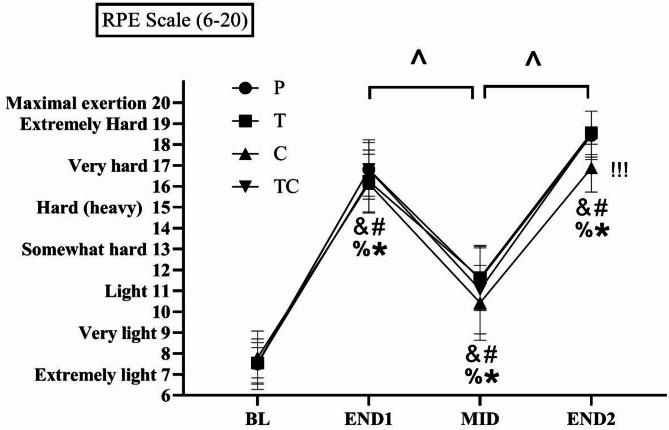
The impact of hypoxic repetitive sprint training on the overall performance of team sports remains controversial due to the specific nature of the exercise capacity required for team sports. While taurine and caffeine are widely utilized as supplements for repetitive sprint exercise in normoxic environments, their efficacy in hypoxic environments remains to be fully understood. Therefore, additional research is needed to explore the role of supplementation in hypoxic conditions. This study was to investigate the effects of caffeine (C), taurine (T), caffeine, and taurine co-ingestion (TC) or placebo (P) on repetitive sprint exercise performance and related physiological responses after exhaustion exercise in team athletes under simulated hypoxic conditions. A double-blind crossover randomized controlled experimental design was employed. 16 male participants (Age:23.69 ± 2.15 years, Body mass: 75.04 ± 7.79 kg, Height:1.78 ± 0.06 m) volunteered to receive four different supplement ingestions to complete the exercise tests: (1) placebo (5 mg/kg maltodextrin), (2) taurine (50 mg/kg), (3) caffeine (5 mg/kg), (4) taurine + caffeine (50 mg/kg + 5 mg/kg). All selected participants were university football players who had undergone rigorous training regimens (85-95% of maximum heart rate, duration of 60 min, with more than five training sessions per week). All participants completed an exhaustion test and subsequent repetitive sprint exercise in a simulated hypoxic environment (A simulation of a soccer game in sports mode). Time to exhaustion (TTE), peak power (PP), and mean power (MP) were recorded at the end of the exhaustion test and during the repetitive sprint exercise, respectively. This study designed an exercise protocol for repetitive sprinting after exhaustion exercise based on the pattern of play in football. The following variables were monitored throughout the experiments: heart rate (HR), blood lactate (B[La]), arterial oxygen saturation (SpO2), dyspnea, and rating of perceived exhaustion (RPE). The Stroop Test was administered at three separate time points: pre-test, mid-test, and post-test, throughout the exercise trial. The countermovement jump test (CMJ) was carried out at three specific time points: before the test, 3 min after the test, and 6 min after the test. The caffeine (C:618.56 + 42.50 s, p = 0.027, d = 0.996) and taurine + caffeine (TC: 613.69 + 37.74 s, p = 0.041, d = 0.902) groups significantly improved time to exhaustion compared to the placebo group. Blood lactate was significantly higher in the taurine + caffeine group than in the placebo group after repetitive sprint exercise (P: 9.87 ± 1.97, TC: 12.31 ± 2.54, p = 0.016). The caffeine group significantly reduced dyspnea, and rating of perceived exhaustion after repetitive sprint exercise (p < 0.05). The taurine (T: 43.42 ± 3.46, p = 0.005), caffeine (C: 44.11 ± 4.72, p < 0.001), and taurine + caffeine (TC: 43.04 ± 3.30, p = 0.011) groups all showed an increase in pre-exercise countermovement jump height. The caffeine group significantly reduced the consistent response time (p = 0.023) and inconsistent response time (p < 0.001) in the Stroop Test compared to the placebo group. Caffeine, along with combined taurine, significantly prolonged the duration of exhaustion exercise in a hypoxic environment; however, it did not affect subsequent repetitive sprint performance. Additionally, caffeine supplementation had a positive impact on cognitive performance during hypoxic training.
由于团队运动所需运动能力的特殊性,低氧重复冲刺训练对团队运动整体表现的影响仍存在争议。虽然牛磺酸和咖啡因在常氧环境中被广泛用作重复冲刺运动的补充剂,但其在低氧环境中的功效仍有待充分了解。因此,需要更多研究来探索补充剂在低氧条件下的作用。本研究旨在调查咖啡因(C)、牛磺酸(T)、咖啡因与牛磺酸联合摄入(TC)或安慰剂(P)对模拟低氧条件下团队运动员力竭运动后重复冲刺运动表现及相关生理反应的影响。采用双盲交叉随机对照实验设计。16名男性参与者(年龄:23.69±2.15岁,体重:75.04±7.79千克,身高:1.78±0.06米)自愿接受四种不同的补充剂摄入以完成运动测试:(1)安慰剂(5毫克/千克麦芽糊精),(2)牛磺酸(50毫克/千克),(3)咖啡因(5毫克/千克),(4)牛磺酸+咖啡因(50毫克/千克+5毫克/千克)。所有入选参与者均为大学足球运动员,他们接受过严格的训练方案(最大心率的85 - 95%,持续60分钟,每周超过五次训练课程)。所有参与者在模拟低氧环境(运动模式下模拟足球比赛)中完成力竭测试及随后的重复冲刺运动。分别在力竭测试结束时和重复冲刺运动期间记录力竭时间(TTE)、峰值功率(PP)和平均功率(MP)。本研究基于足球比赛模式设计了力竭运动后重复冲刺的运动方案。在整个实验过程中监测以下变量:心率(HR)、血乳酸(B[La])、动脉血氧饱和度(SpO2)、呼吸困难和主观疲劳评分(RPE)。在整个运动试验的三个不同时间点进行斯特鲁普测试:测试前、测试中、测试后。在三个特定时间点进行反向运动跳跃测试(CMJ):测试前、测试后3分钟、测试后6分钟。与安慰剂组相比,咖啡因组(C:618.56 + 42.50秒,p = 0.027,d = 0.996)和牛磺酸 + 咖啡因组(TC:613.69 + 37.74秒,p = 0.041,d = 0.902)的力竭时间显著延长。重复冲刺运动后,牛磺酸 + 咖啡因组的血乳酸显著高于安慰剂组(P:9.87±1.97,TC:12.31±2.54,p = 0.016)。咖啡因组在重复冲刺运动后显著减轻了呼吸困难和主观疲劳评分(p < 0.05)。牛磺酸组(T:43.42±3.46,p = 0.005)、咖啡因组(C:44.11±4.72,p < 0.001)和牛磺酸 + 咖啡因组(TC:43.04±3.30,p = 0.011)在运动前反向运动跳跃高度均有所增加。与安慰剂组相比,咖啡因组在斯特鲁普测试中的一致反应时间(p = 0.023)和不一致反应时间(p < 0.001)显著缩短。咖啡因与牛磺酸联合使用显著延长了低氧环境下的力竭运动持续时间;然而,它并未影响随后的重复冲刺表现。此外,补充咖啡因对低氧训练期间的认知表现有积极影响。



 Zotero 插件