
多性状基因组最佳线性无偏预测法(mmGEBLUP):一种通过对主基因、多基因以及基因型与环境互作进行综合分析,用于作物复杂性状遗传改良的先进基因组预测方案。
mmGEBLUP: an advanced genomic prediction scheme for genetic improvement of complex traits in crops through integrative analysis of major genes, polygenes, and genotype-environment interactions.
作者信息
Zhang Qi-Xin, Zhu Tianneng, Lin Feng, Fang Dunhuang, Chen Xuejun, Lou Xiangyang, Tong Zhijun, Xiao Bingguang, Xu Hai-Ming
机构信息
Institute of Crop Science and Institute of Bioinformatics, Zhejiang University, 866 Yuhangtang Road, Xihu District, Hangzhou, Zhejiang 310058, China.
Key Laboratory of Tobacco Biotechnological Breeding, National Tobacco Genetic Engineering Research Center, Yunnan Academy of Tobacco Agricultural Sciences, 33 Yuantong Road, Wuhua Distrct, Kunming, Yunnan 650021, China.
出版信息
Brief Bioinform. 2024 Nov 22;26(1). doi: 10.1093/bib/bbaf058.
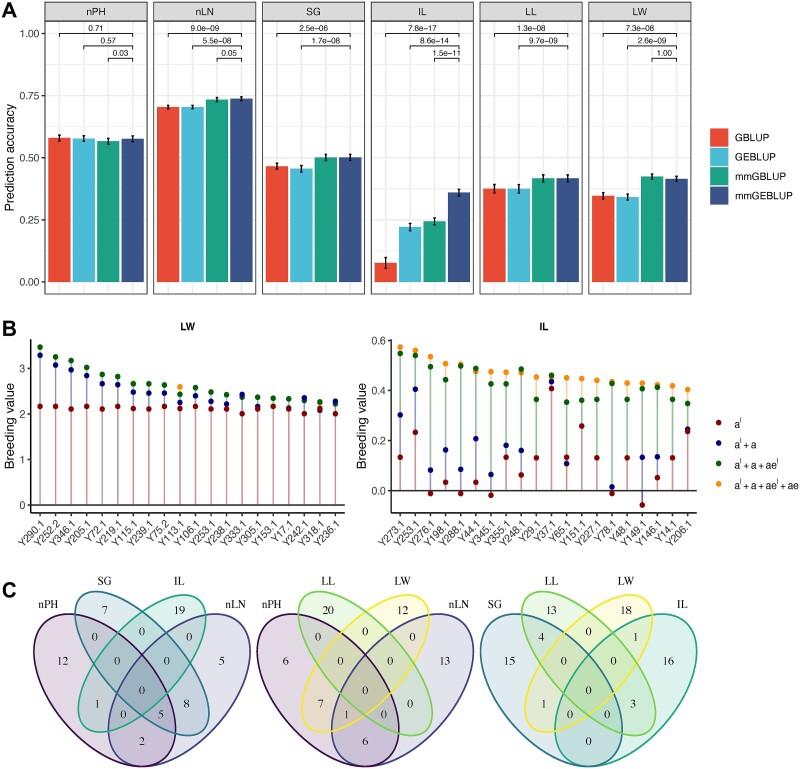
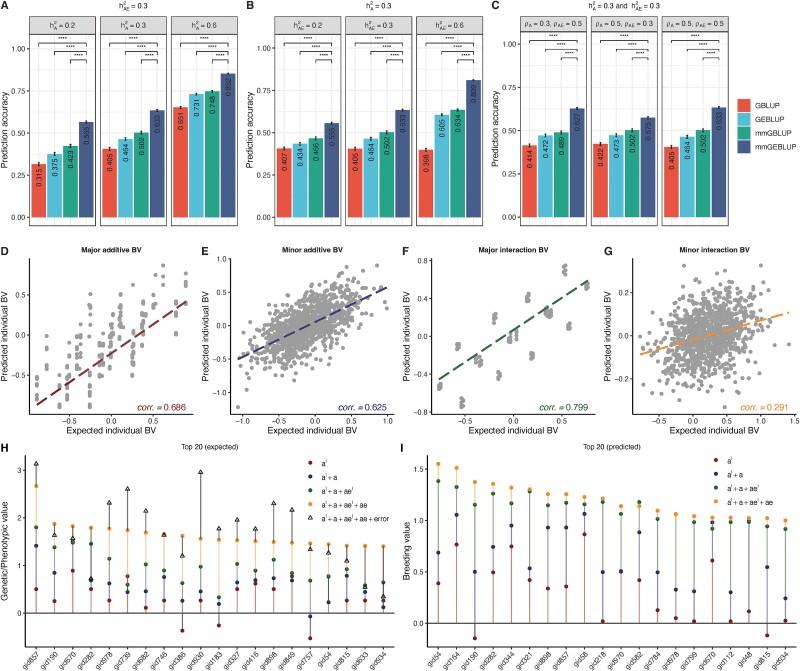
Current genomic prediction (GP) models often fall short of fully capturing the genetic architecture of complex traits and providing practical breeding guidance, particularly under varying environments. Here, we propose the mmGEBLUP, an advanced GP scheme designed to tackle the current limitations in fully exploiting the genetic architecture of complex traits and to predict individual breeding value (BV) with multi-environment trial data. Our approach considers four genetic structural indicators to capture the genetic architectures stepwise across four models: the Genomic Best Linear Unbiased Prediction (GBLUP) model considers only main polygenic effects; the GEBLUP model includes both main and genotype-by-environment (GE) interaction polygenic effects; and the mmGBLUP and mmGEBLUP models further incorporate main and GE interaction effects of major genes. Through systematic simulations and applications to nine traits, three in rice and six in tobacco, we show stepwise increases in prediction accuracy from GBLUP to mmGEBLUP, providing evidence on the scale of heritability and polygenicity of traits. In practical terms, we predict four components of BV: major additive, minor additive, major interaction, and minor interaction. Interestingly, we discover that for traits like natural leaf number in tobacco, the major additive BVs for the top 20 individuals are substantially equal; it is the minor additive BV that causes the difference in the total BV. The relative size of major/minor additive BVs suggests performing either marker-assisted selection or genomic selection or both. Overall, mmGEBLUP is an advanced prediction scheme that enhances the understanding of genetic architectures and facilitate the genetic improvement of complex traits in crops under diverse environments.
当前的基因组预测(GP)模型往往无法充分捕捉复杂性状的遗传结构,也无法提供实际的育种指导,尤其是在不同环境下。在此,我们提出了mmGEBLUP,这是一种先进的GP方案,旨在解决当前在充分利用复杂性状遗传结构方面的局限性,并利用多环境试验数据预测个体育种值(BV)。我们的方法考虑了四个遗传结构指标,通过四个模型逐步捕捉遗传结构:基因组最佳线性无偏预测(GBLUP)模型仅考虑主要多基因效应;GEBLUP模型包括主要和基因型与环境(GE)互作多基因效应;而mmGBLUP和mmGEBLUP模型进一步纳入了主基因的主要和GE互作效应。通过系统模拟以及对九个性状(水稻三个、烟草六个)的应用,我们展示了从GBLUP到mmGEBLUP预测准确性的逐步提高,为性状的遗传力和多基因性规模提供了证据。实际上,我们预测了BV的四个组成部分:主要加性效应、次要加性效应、主要互作效应和次要互作效应。有趣的是,我们发现对于烟草的自然叶片数等性状,前20个个体的主要加性BV基本相等;导致总BV差异的是次要加性BV。主要/次要加性BV的相对大小表明可进行标记辅助选择或基因组选择或两者兼用。总体而言,mmGEBLUP是一种先进的预测方案,可增强对遗传结构的理解,并促进不同环境下作物复杂性状的遗传改良。

 Zotero 插件