
轻度创伤性脑损伤的接纳与承诺疗法(ACTion-mTBI):一项准实验性可行性研究。
Acceptance and commitment therapy for mild traumatic brain injury (ACTion-mTBI): a quasiexperimental feasibility study.
作者信息
Faulkner Josh, Prouty Devin, Devlin Lucy, Appleton Damien, Roche Maree, Below Karen, Moffat John, Snell Deborah, Williams Matt N, Barker-Collo Suzanne, Theadom Alice
机构信息
Te Herenga Waka - Victoria University of Wellington, Wellington, New Zealand
Proactive Rehabilitation, Wellington, New Zealand.
出版信息
BMJ Open. 2025 Feb 16;15(2):e089727. doi: 10.1136/bmjopen-2024-089727.
OBJECTIVES
This study aimed to determine the feasibility of recruiting, implementing and delivering an acceptance and commitment therapy (ACT) intervention for mild traumatic brain injury (mTBI) (ACTion-mTBI) within a multidisciplinary outpatient mTBI rehabilitation services. The study also aimed to conduct a preliminary investigation of group differences between ACTion-mTBI and an equivalent cognitive behavioural therapy (CBT) intervention on various outcome measures and psychological treatment targets.
DESIGN
A two-arm quasiexperimental feasibility study.
SETTING
Five mTBI rehabilitation clinics throughout New Zealand.
INTERVENTION
Psychologists working in mTBI rehabilitation clinics throughout New Zealand were trained to deliver ACTion-mTBI or CBT. Eligible participants were assigned to either of these interventions based on the psychologist available at the clinic they were referred to. ACTion-mTBI is a five sessions intervention that incorporates all six components of the ACT model. The CBT intervention is an equivalent intervention and incorporating all four components of the CBT model. Both interventions are adapted for an mTBI context.
PRIMARY OUTCOME MEASURES
The primary outcomes were related to the feasibility of ACTion-mTBI. This included recruitment, retention and treatment adherence of participants, study procedure and fidelity of treatment delivery.
SECONDARY OUTCOME MEASURES
To explore group differences between ACTion-mTBI and CBT on functional disability, postconcussion symptoms, mental health, valued living and psychological flexibility.
RESULTS
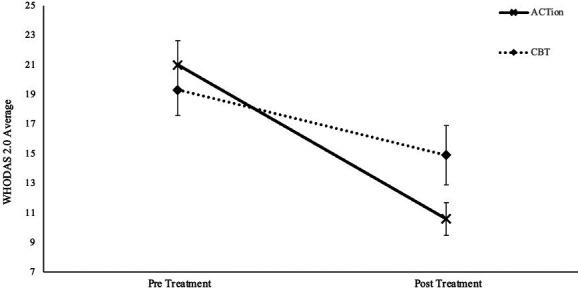
The intervention proved feasible to implement with community-based mTBI rehabilitation services. Attrition rates were comparable between the two psychological interventions and fidelity to the treatments was high. At post-treatment, when covarying pretreatment scores, ACTion-mTBI had a significantly greater improvement in functional disability than CBT (moderate effect). ACTion-mTBI also had a significantly greater reduction in postconcussion symptoms, anxiety and stress. Promisingly, significant improvements in psychological flexibility was also found post-treatment. There were no group differences on depressive symptoms and valued living.
CONCLUSION
We conclude that a full clinical trial of ACTion-mTBI for individuals with mTBI is feasible and warranted.
TRIAL REGISTRATION NUMBER
ACTRN1262100059482.
目的
本研究旨在确定在多学科门诊轻中度创伤性脑损伤(mTBI)康复服务中招募、实施和提供接受与承诺疗法(ACT)干预(ACTion - mTBI)的可行性。该研究还旨在对ACTion - mTBI与等效的认知行为疗法(CBT)干预在各种结局指标和心理治疗目标上的组间差异进行初步调查。
设计
双臂半实验性可行性研究。
地点
新西兰各地的五家mTBI康复诊所。
干预措施
在新西兰各地mTBI康复诊所工作的心理学家接受培训以实施ACTion - mTBI或CBT。符合条件的参与者根据他们被转诊诊所的可用心理学家被分配到这两种干预措施中的一种。ACTion - mTBI是一种包含ACT模型所有六个组成部分的五节干预课程。CBT干预是一种等效干预措施,包含CBT模型的所有四个组成部分。两种干预措施均针对mTBI背景进行了调整。
主要结局指标
主要结局与ACTion - mTBI的可行性相关。这包括参与者的招募、留存率和治疗依从性、研究程序以及治疗实施的保真度。
次要结局指标
探讨ACTion - mTBI与CBT在功能残疾、脑震荡后症状、心理健康、有价值的生活和心理灵活性方面的组间差异。
结果
该干预措施在基于社区的mTBI康复服务中实施被证明是可行的。两种心理干预措施的损耗率相当,且治疗保真度较高。在治疗后,当对治疗前分数进行协变量调整时,ACTion - mTBI在功能残疾方面的改善显著大于CBT(中等效应)。ACTion - mTBI在脑震荡后症状、焦虑和压力方面的减轻也显著更大。有希望的是,治疗后在心理灵活性方面也发现了显著改善。在抑郁症状和有价值的生活方面没有组间差异。
结论
我们得出结论,对mTBI个体进行ACTion - mTBI的全面临床试验是可行的且有必要的。
试验注册号
ACTRN1262100059482。

 Zotero 插件