
接受辅助奥希替尼治疗的 IIIA 期表皮生长因子受体(EGFR)突变非小细胞肺癌切除术后复发为小细胞肺癌转化:一例报告
Recurrence as a small cell lung cancer transformation in a resected stage IIIA EGFR-mutated non-small cell lung cancer treated with adjuvant osimertinib: a case report.
作者信息
Lasvergnas Julie, Monnet Isabelle, Auliac Jean-Bernard, Rousseau-Bussac Gaelle, Chouaid Christos, Assié Jean-Baptiste
机构信息
Department of Pneumology, Centre Hospitalier Intercommunal de Créteil, Créteil, France.
出版信息
Transl Lung Cancer Res. 2025 Jan 24;14(1):287-291. doi: 10.21037/tlcr-24-830. Epub 2025 Jan 16.
BACKGROUND
Based on improvements in recurrence-free and overall survival, osimertinib is now widely used as an adjuvant treatment in stage II-IIIA non-small cell lung cancer (NSCLC) presenting with a common epithelial growth factor receptor (EGFR) mutation. Histological transformation is a well-known resistance mechanism to osimertinib in EGFR-mutated metastatic NSCLC, but we currently have insufficient data on recurrence mechanisms in the adjuvant context. We present here the case of a patient treated with adjuvant osimertinib and presenting a small cell lung cancer (SCLC) transformation as a recurrence.
CASE DESCRIPTION
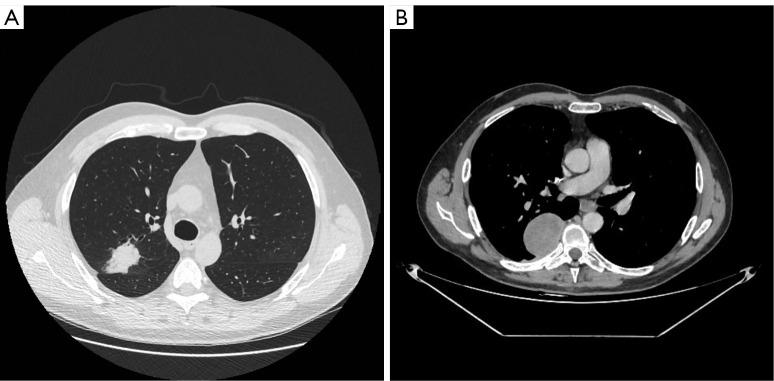
A 54-year-old man, never-smoker and with no previous medical history, underwent right superior lobectomy with lymph node resection for a pT3N1M0 [stage IIIA, tumor-node-metastasis (TNM) 8 edition] adenocarcinoma. Programmed death-ligand 1 (PD-L1) negative with an EGFR exon 19 deletion. The patient received 4 cycles of adjuvant chemotherapy before starting adjuvant osimertinib 80 mg. After 35 months of adjuvant osimertinib the patient had a local recurrence and the re biopsy showed an SCLC transformation, underlining the importance of careful surveillance and biopsy at the time of recurrence in EGFR-mutated NSCLC.
CONCLUSIONS
this case report provides evidence of SCLC transformation while on adjuvant osimertinib, in a pT3N1 EGFR, RB1 and TP53-mutated pulmonary adenocarcinoma. This highlights the importance of biopsy on recurrence and the transformation potential of the EGFR, RB1 and TP53-mutated adenocarcinomas.
背景
基于无复发生存期和总生存期的改善,奥希替尼目前被广泛用作伴有常见表皮生长因子受体(EGFR)突变的II-IIIA期非小细胞肺癌(NSCLC)的辅助治疗。组织学转化是EGFR突变的转移性NSCLC中对奥希替尼的一种众所周知的耐药机制,但我们目前在辅助治疗背景下关于复发机制的数据不足。我们在此报告一例接受奥希替尼辅助治疗并出现小细胞肺癌(SCLC)转化作为复发的患者病例。
病例描述
一名54岁男性,从不吸烟且无既往病史,因pT3N1M0[IIIA期,肿瘤-淋巴结-转移(TNM)第8版]腺癌接受了右上叶切除及淋巴结清扫术。程序性死亡配体1(PD-L1)阴性,伴有EGFR外显子19缺失。患者在开始服用80mg奥希替尼辅助治疗前接受了4个周期的辅助化疗。在接受奥希替尼辅助治疗35个月后,患者出现局部复发,再次活检显示为SCLC转化,强调了在EGFR突变的NSCLC复发时进行仔细监测和活检的重要性。
结论
本病例报告提供了在pT3N1 EGFR、RB1和TP53突变的肺腺癌接受奥希替尼辅助治疗期间发生SCLC转化的证据。这突出了复发时活检的重要性以及EGFR、RB1和TP53突变腺癌的转化潜力。
 Zotero 插件