
纳米材料:用于心肌梗死诊断和治疗的有前景的工具。
Nanomaterials: Promising Tools for the Diagnosis and Treatment of Myocardial Infarction.
作者信息
Ge Yanmin, Wu Lincong, Mei Shuyang, Wu Junduo
机构信息
Department of Cardiology, The Second Hospital of Jilin University, Changchun, Jilin, 130000, People's Republic of China.
出版信息
Int J Nanomedicine. 2025 Feb 11;20:1747-1768. doi: 10.2147/IJN.S500146. eCollection 2025.
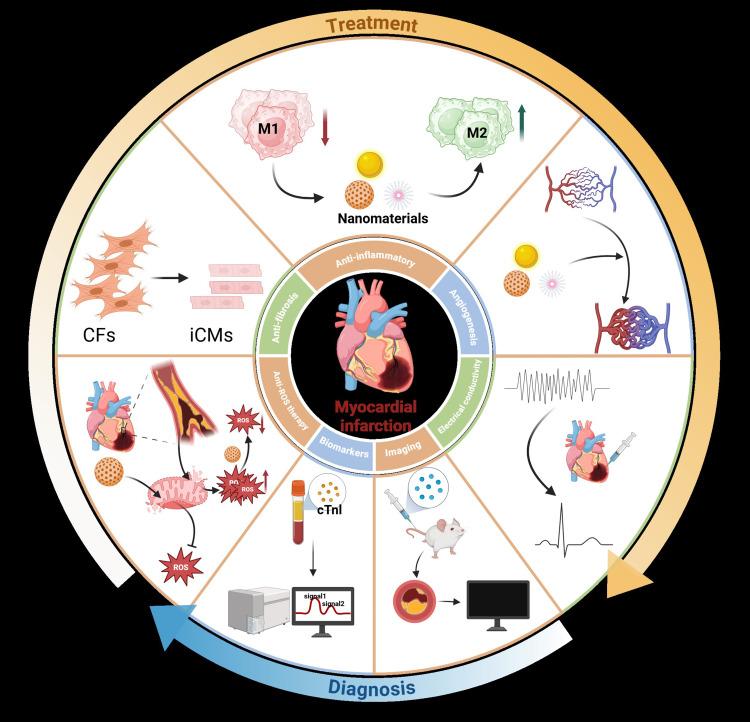
Myocardial infarction (MI) is the leading cause of mortality from cardiovascular diseases. Rapid diagnosis and effective treatment are critical for improving patient prognosis. Although current diagnostic and therapeutic approaches have made significant progress, they still face challenges such as ischemia-reperfusion injury, microcirculatory disorders, adverse cardiac remodeling, and inflammatory responses. These issues highlight the urgent need for innovative solutions. Nanomaterials, with their diverse types, excellent physicochemical properties, biocompatibility, and targeting capabilities, offer promising potential in addressing these challenges. Advances in nanotechnology have increasingly drawn attention to the application of nanomaterials in both diagnosing and treating myocardial infarction. We summarize the pathophysiological mechanisms and staging of myocardial infarction. We systematically review the applications of nanomaterials in MI diagnosis, including the detection of biomarkers and imaging techniques, as well as in MI treatment, encompassing anti-inflammatory effects, antioxidant stress, inhibition of fibrosis, promotion of angiogenesis, and cardiac conduction repair. We analyze the existing challenges and provide insights into future research directions and potential solutions. Specifically, we discuss the need for rigorous safety assessments, long-term efficacy studies, and the development of robust strategies for translating laboratory findings into clinical practice. In conclusion, nanotechnology holds significant promise as a new strategy for diagnosing and treating myocardial infarction. Its potential to enhance clinical outcomes and revolutionize patient care makes it an exciting area of research with practical applications in real-world clinical settings.
心肌梗死(MI)是心血管疾病导致死亡的主要原因。快速诊断和有效治疗对于改善患者预后至关重要。尽管目前的诊断和治疗方法已取得显著进展,但它们仍面临诸如缺血再灌注损伤、微循环障碍、不良心脏重塑和炎症反应等挑战。这些问题凸显了对创新解决方案的迫切需求。纳米材料具有多种类型、优异的物理化学性质、生物相容性和靶向能力,在应对这些挑战方面具有广阔的潜力。纳米技术的进展越来越多地使人们关注纳米材料在心肌梗死诊断和治疗中的应用。我们总结了心肌梗死的病理生理机制和分期。我们系统地综述了纳米材料在心肌梗死诊断中的应用,包括生物标志物检测和成像技术,以及在心肌梗死治疗中的应用,涵盖抗炎作用、抗氧化应激、抑制纤维化、促进血管生成和心脏传导修复。我们分析了现有挑战,并对未来的研究方向和潜在解决方案提供见解。具体而言,我们讨论了进行严格安全性评估、长期疗效研究以及制定将实验室研究结果转化为临床实践的稳健策略的必要性。总之,纳米技术作为一种诊断和治疗心肌梗死的新策略具有巨大潜力。其改善临床结局和变革患者护理的潜力使其成为一个令人兴奋的研究领域,在实际临床环境中具有实际应用价值。
 Zotero 插件