
儿童癌症中的种系变异:基于致癌途径
Germline Variants in Pediatric Cancer : Based on Oncogenic Pathways.
作者信息
Kim Joo Whan
机构信息
Division of Pediatric Neurosurgery, Seoul National University Children's Hospital, Seoul National University College of Medicine, Seoul, Korea.
Department of Genomic Medicine, Seoul National University Hospital, Seoul National University College of Medicine, Seoul, Korea.
出版信息
J Korean Neurosurg Soc. 2025 May;68(3):350-359. doi: 10.3340/jkns.2025.0011. Epub 2025 Feb 17.
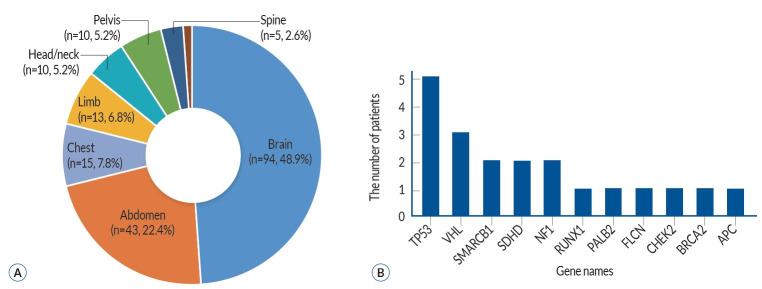
Pathogenic germline variants (PGVs) are increasingly recognized as critical elements in pediatric cancer predisposition. Determining the pathogenicity of germline variants is a dynamic process, with advancements in next-generation sequencing and expanding genome databases reshaping our understanding of cancer genomics. This article reviews the role of PGVs in key oncogenic pathways, including RTK (receptor tyrosine kinase)/RAS/MAPK (mitogen-activated protein kinase), PI3K (phosphatidylinositol 3-kinase)/AKT (v-akt murine thymoma viral oncogene homolog 1), WNT (wingless-type), and Hedgehog signaling, highlighting their associations with specific cancer predisposition syndromes and neurosurgical implications. Most PGVs are inherited in an autosomal dominant pattern and are frequent in tumor suppressor genes, while autosomal recessive conditions like Ataxia-telangiectasia and Fanconi anemia are less common. Germline variants in proto-oncogenes such as PTPN11, KRAS, and HRAS are associated with RASopathies, including Noonan and Costello syndromes, which show variable cancer risks. Similarly, PTEN PGVs, linked to Cowden syndrome, and DICER1 PGVs, responsible for DICER1 syndrome, exemplify the diverse clinical presentations and risks of pediatric cancer predisposition syndromes. Medulloblastoma, a pediatric-specific brain tumor, shows an increasing proportion of PGVs, with approximately 12% of all medulloblastomas harboring PGVs in APC, PTCH1, SUFU, and ELP1 in the WNT-activated and sonic hedgehog-activated subtypes. Emerging evidence suggests that approximately 8.5-20% of pediatric cancer patients harbor PGVs, with a substantial proportion arising de novo. Routine germline screening for pediatric cancer patients is increasingly recommended, as many PGVs lack family history. Programs like STREAM (Solid Tumor REsearch And Magic) in Korea underscore the importance of comprehensive pediatric genome databases for personalized precision medicine. As neurosurgeons are frequently the first to encounter central nervous system tumor manifestations, a robust understanding of genomic medicine is essential. This review emphasizes the need for international collaboration to develop actionable insights into pediatric cancer genomics, ultimately improving diagnostic, therapeutic, and preventive strategies.
致病性种系变异(PGVs)日益被认为是儿童癌症易感性的关键因素。确定种系变异的致病性是一个动态过程,随着下一代测序技术的进步和基因组数据库的不断扩展,我们对癌症基因组学的理解也在不断重塑。本文综述了PGVs在关键致癌途径中的作用,包括RTK(受体酪氨酸激酶)/RAS/MAPK(丝裂原活化蛋白激酶)、PI3K(磷脂酰肌醇3激酶)/AKT(v-akt小鼠胸腺瘤病毒癌基因同源物1)、WNT(无翅型)和Hedgehog信号通路,强调了它们与特定癌症易感性综合征的关联以及神经外科意义。大多数PGVs以常染色体显性模式遗传,在肿瘤抑制基因中较为常见,而像共济失调毛细血管扩张症和范可尼贫血等常染色体隐性疾病则较少见。原癌基因中的种系变异,如PTPN11、KRAS和HRAS,与RASopathies相关,包括努南综合征和科斯特洛综合征,这些综合征表现出不同的癌症风险。同样,与考登综合征相关的PTEN PGVs和导致DICER1综合征的DICER1 PGVs,体现了儿童癌症易感性综合征的多样临床表现和风险。髓母细胞瘤是一种儿童特有的脑肿瘤,PGVs的比例越来越高,在WNT激活型和音猬因子激活型亚型的所有髓母细胞瘤中,约12%在APC、PTCH1、SUFU和ELP1中存在PGVs。新出现的证据表明,约8.5%-20%的儿童癌症患者携带PGVs,其中很大一部分是新发的。由于许多PGVs缺乏家族史,越来越多的人建议对儿童癌症患者进行常规种系筛查。韩国的STREAM(实体瘤研究与魔法)等项目强调了全面的儿童基因组数据库对个性化精准医学的重要性。由于神经外科医生常常是首先遇到中枢神经系统肿瘤表现的人,因此对基因组医学有深入的了解至关重要。本综述强调了开展国际合作以深入了解儿童癌症基因组学从而最终改善诊断、治疗和预防策略的必要性。


 Zotero 插件