
中国西南部农村地区辛辣食物摄入与超重/肥胖:一项横断面研究的结果
Spicy food intake and overweight/obesity in rural Southwest China: findings from a cross-sectional study.
作者信息
Xiong Huali, Zhao Peng, Ma Fengxun, Tang Dayi, Liu Daiqiang
机构信息
Center for Mental Health of Rongchang District, Chongqing, China.
Department of Public Health, Health Commission of Rongchang District, Chongqing, China.
出版信息
Front Nutr. 2025 Feb 3;12:1526775. doi: 10.3389/fnut.2025.1526775. eCollection 2025.
BACKGROUND
Spicy food is an essential part of the culinary culture in rural southwest China, while little is known about the association between spicy food intake and overweight/obesity. This study was undertaken to explore the association between spicy food intake and overweight/obesity by a cross-sectional study.
METHOD
We enrolled 2,995 individuals aged 30-79 years living in Rongchang, Chongqing municipality, southwest China from The China Multi-Ethnic Cohort Study, which was deemed to be the largest cohort study in southwest China. A multivariable-adjusted logistic regression model was applied to estimate the association between spicy food intake and overweight/obesity. Additionally, subgroup and sensitivity analyses were performed to verify the stability of the results.
RESULTS
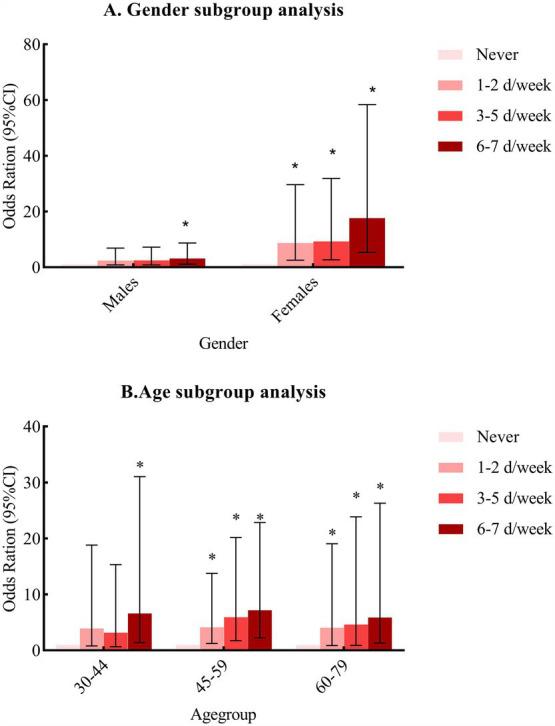
A total of 81.67% of participants had the habit of consuming spicy food. The overall prevalence of overweight/obesity was 57.53%. Spicy food intake ( = 2.913, 95%: 1.319-6.434) and frequency of spicy food intake ( = 1.300, 95%: 1.164-1.452) were positively associated with overweight/obesity. Compared with the participants who never consumed spicy food, after adjusting for confounding factors, the adjusted s (95% s) in frequency of spicy food intake in 1-2 days/week, 3-5 days/week, 6-7 days/week subgroups were 3.985 (1.855-8.560), 4.381 (2.011-9.543), 6.515 (3.101-13.686), respectively. Subgroup analyses stratified by gender and age group, as well as sensitivity analyses, have consistently revealed a similar association between spicy food intake/the frequency of spicy food intake and overweight/obesity.
CONCLUSION
This study could provide additional evidence for overweight and the obesity epidemic among rural adults in southwest China. Reducing spicy food intake might benefit from weight management.
背景
辛辣食物是中国西南部农村饮食文化的重要组成部分,然而关于辛辣食物摄入量与超重/肥胖之间的关联却知之甚少。本研究通过横断面研究来探讨辛辣食物摄入量与超重/肥胖之间的关联。
方法
我们从中国多民族队列研究中纳入了2995名年龄在30 - 79岁之间、居住在中国西南部重庆市荣昌区的个体,该研究被认为是中国西南部最大的队列研究。应用多变量调整的逻辑回归模型来估计辛辣食物摄入量与超重/肥胖之间的关联。此外,进行了亚组分析和敏感性分析以验证结果的稳定性。
结果
共有81.67%的参与者有食用辛辣食物的习惯。超重/肥胖的总体患病率为57.53%。辛辣食物摄入量(β = 2.913,95%置信区间:1.319 - 6.434)和辛辣食物摄入频率(β = 1.300,95%置信区间:1.164 - 1.452)与超重/肥胖呈正相关。与从不食用辛辣食物的参与者相比,在调整混杂因素后,每周1 - 2天、每周3 - 5天、每周6 - 7天亚组中辛辣食物摄入频率的调整后β值(95%置信区间)分别为3.985(1.855 - 8.560)、4.381(2.011 - 9.543)、6.515(3.101 - 13.686)。按性别和年龄组分层的亚组分析以及敏感性分析一致显示辛辣食物摄入量/辛辣食物摄入频率与超重/肥胖之间存在类似的关联。
结论
本研究可为中国西南部农村成年人超重和肥胖流行提供更多证据。减少辛辣食物摄入量可能有助于体重管理。
 Zotero 插件