
2000 - 2019年美国城市层面社会人口与健康因素与耐抗菌药物淋病患病率之间的关联:一项时空建模研究
Association between city-level sociodemographic and health factors and the prevalence of antimicrobial-resistant gonorrhea in the US, 2000-2019: a spatial-temporal modeling study.
作者信息
Li Jingwen, Murray-Watson Rachel E, St Cyr Sancta B, Grad Yonatan H, Warren Joshua L, Yaesoubi Reza
机构信息
Department of Health Policy and Management, Yale School of Public Health, New Haven, CT, USA.
Public Health Modeling Unit, Yale School of Public Health, New Haven, CT, USA.
出版信息
Lancet Reg Health Am. 2025 Jan 31;43:101006. doi: 10.1016/j.lana.2025.101006. eCollection 2025 Mar.
BACKGROUND
Evidence from the surveillance systems of antimicrobial-resistant (AMR) gonorrhea suggests substantial variation in the prevalence of AMR gonorrhea across populations. However, little is known about the extent to which the population-level demographic, socioeconomic, and health factors (e.g., population density, poverty level, or the prevalence of other sexually-transmitted diseases) are associated with the burden of AMR gonorrhea. We developed a hierarchical Bayesian spatial-temporal logistic regression model to investigate the association between multiple spatially- and temporally-varying predictors and the proportion of isolates with resistance to each one of ciprofloxacin, penicillin, and tetracycline between 2000 and 2019 in the United States (US).
METHODS
The model was informed by data from the Gonococcal Isolate Surveillance Project (GISP), a sentinel surveillance system to monitor trends in the AMR gonorrhea in the US. During our study period, GISP included 112,487 isolates from the first 25 symptomatic men who have been diagnosed with urethral gonorrhea each month after attending participating sexually-transmitted disease clinics in one of about 30 select cities.
FINDINGS
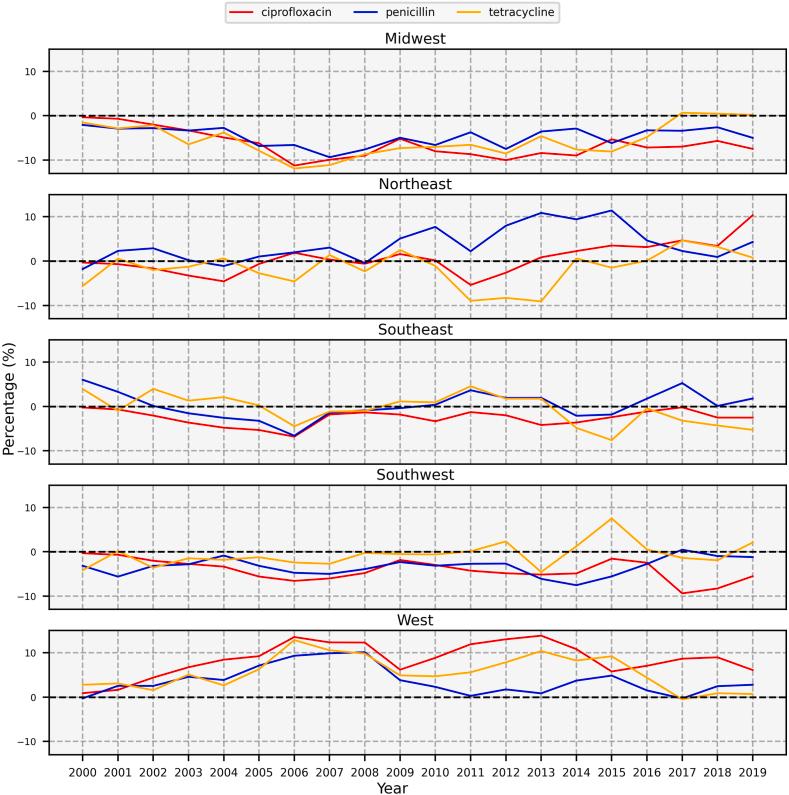
Among 112,487 isolates collected between 2000 and 2019, 16.5%, 13.7%, and 22.2% were resistance to ciprofloxacin, penicillin, and tetracycline. Denser populations were associated with higher prevalence of ciprofloxacin and penicillin resistance (odd ratio (OR): 1.5, 95% with credible interval: [1.29, 1.74] and 1.36 [1.22, 1.52], respectively); West was associated with higher prevalence of ciprofloxacin resistance (OR with respect to Midwest: 14.42 [2.02, 59.27]) and Southeast was associated with higher prevalence of ciprofloxacin and penicillin resistance (OR with respect to Midwest: 6.66 [1.59, 18.20] and 7.59 [2.3, 22.94]); higher prevalence of HIV was associated with higher prevalence of ciprofloxacin and tetracycline resistance (OR: 1.18 [1.01, 1.37] and 1.14 [1.02, 1.28]); and higher incidence of gonorrhea was associated with higher prevalence of tetracycline resistance (OR: 1.08 [1.05, 1.11]).
INTERPRETATION
Geographic location and certain population-level characteristics including population density and HIV prevalence could provide insight about the population-level risk of AMR gonorrhea at a county-level. These results could guide the expansion of AMR surveillance systems or access to drug susceptibility testing in areas with characteristics associated with increased prevalence of AMR gonorrhea.
FUNDING
US National Institutes of Health.
背景
抗菌药物耐药(AMR)淋病监测系统的证据表明,不同人群中AMR淋病的患病率存在显著差异。然而,对于人群层面的人口统计学、社会经济和健康因素(如人口密度、贫困水平或其他性传播疾病的患病率)与AMR淋病负担之间的关联程度,我们知之甚少。我们开发了一种分层贝叶斯时空逻辑回归模型,以研究2000年至2019年美国多个时空变化预测因素与对环丙沙星、青霉素和四环素耐药的分离株比例之间的关联。
方法
该模型依据淋病分离株监测项目(GISP)的数据构建,GISP是一个用于监测美国AMR淋病趋势的哨点监测系统。在我们的研究期间,GISP纳入了来自约30个选定城市中参与性传播疾病诊所的每月首批25名被诊断为尿道淋病的有症状男性的112,487株分离株。
研究结果
在2000年至2019年收集的112,487株分离株中,对环丙沙星、青霉素和四环素耐药的分别占16.5%、13.7%和22.2%。人口密度较高与环丙沙星和青霉素耐药的较高患病率相关(优势比(OR):分别为1.5,95%可信区间:[1.29, 1.74]和1.36 [1.22, 1.52]);西部地区与环丙沙星耐药的较高患病率相关(相对于中西部地区的OR:14.42 [2.02, 59.27]),东南部地区与环丙沙星和青霉素耐药的较高患病率相关(相对于中西部地区的OR:6.66 [1.59, 18.20]和7.59 [2.3, 22.94]);较高的HIV患病率与环丙沙星和四环素耐药的较高患病率相关(OR:1.18 [1.01, 1.37]和1.14 [1.02, 1.28]);较高的淋病发病率与四环素耐药的较高患病率相关(OR:1.08 [1.05, 1.11])。
解读
地理位置以及包括人口密度和HIV患病率在内的某些人群层面特征,可以为县级AMR淋病的人群层面风险提供见解。这些结果可以指导在与AMR淋病患病率增加相关特征的地区扩大AMR监测系统或提供药敏试验。
资金来源
美国国立卫生研究院。

 Zotero 插件