
美国人群中身体形态指数与结直肠癌之间的关联:一项基于美国国家健康与营养检查调查(NHANES)的横断面研究
Association between a body shape index and colorectal cancer in US population: a cross-sectional study based on NHANES.
作者信息
Liu Hui, Kang Jialu, Liu Wei, Shen Yongqing
机构信息
Department of Internal Medicine Nursing, Faculty of Nursing, Hebei University of Chinese Medicine, Shijiazhuang, Hebei, China.
Faculty of Nursing, Hebei University of Chinese Medicine, Shijiazhuang, Hebei, China.
出版信息
Front Nutr. 2025 Jan 31;12:1535655. doi: 10.3389/fnut.2025.1535655. eCollection 2025.
BACKGROUND
Colorectal cancer (CRC) is linked to obesity, particularly visceral fat. A more accurate measure of visceral fat accumulation is offered by a body shape index (ABSI). Currently, the direct application of the ABSI to populations with varying ethnic backgrounds might be restricted. Moreover, there is less evidence about the correlation between ABSI and CRC among individuals from different ethnical backgrounds.
METHODS
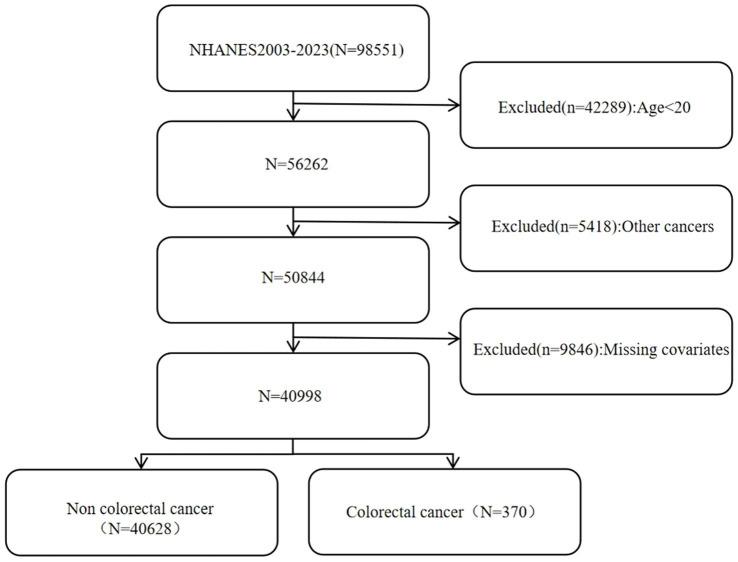
A total of 40,998 individuals who took part in the National Health and Nutrition Examination Survey (NHANES) spanning from 2003 to 2023 were subjected to analysis. Logistic regression was utilized to examine the associations between the ABSI and the risk of CRC. In addition, restricted cubic spline curves (RCS) were utilized, and subgroup analyses along with interaction tests were also carried out. The receiver operating characteristic curve (ROC) was employed to predict the risk of CRC relying on various anthropometric indicators.
RESULTS
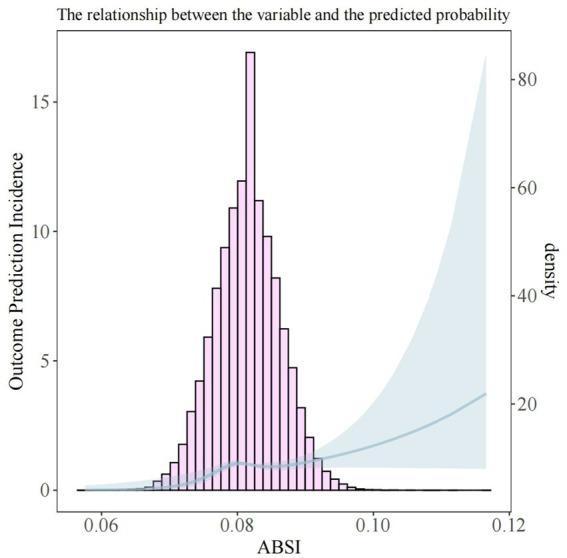
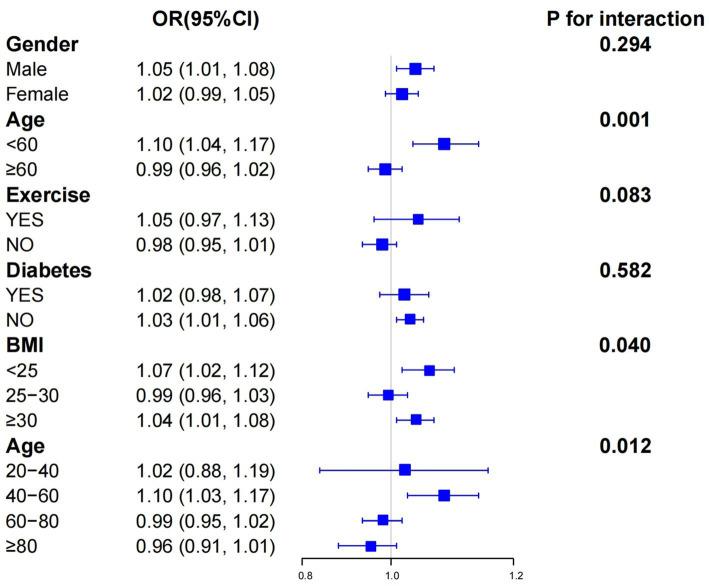
After adjusting for covariates, ABSI demonstrated a positive association with the incidence of CRC (OR = 1.03 [95% CI: 1.01-1.05], = 0.018). Individuals in the upper quartile of ABSI exhibited a greater prevalence of CRC than those in the lower quartile (OR = 1.88 [95% CI: 1.19-2.96], = 0.006). RCS analysis indicated a nonlinear correlation between ABSI and CRC ( for nonlinear = 0.030). Subgroup analysis indicated a notable interaction between age and BMI subgroups (interaction < 0.05), and ROC curves indicated that the ABSI was effective in predicting CRC risk (AUC = 0.658), demonstrating good sensitivity, particularly in individuals under 60 years of age.
CONCLUSION
A positive correlation exists between ABSI levels and the increased incidence of CRC among U.S. adults. This is especially true for people under 60 years of age (40-60 years), with a BMI below 25 kg/m, and those with a BMI of 30 kg/m or beyond. ABSI can be used as a simple anthropometric predictor of CRC.
背景
结直肠癌(CRC)与肥胖有关,尤其是内脏脂肪。体型指数(ABSI)能更准确地衡量内脏脂肪堆积情况。目前,ABSI在不同种族背景人群中的直接应用可能受到限制。此外,关于不同种族背景个体中ABSI与CRC之间的相关性证据较少。
方法
对2003年至2023年参加美国国家健康与营养检查调查(NHANES)的40998名个体进行分析。采用逻辑回归分析ABSI与CRC风险之间的关联。此外,使用受限立方样条曲线(RCS),并进行亚组分析和交互作用检验。采用受试者工作特征曲线(ROC),依靠各种人体测量指标预测CRC风险。
结果
调整协变量后,ABSI与CRC发病率呈正相关(OR = 1.03 [95% CI:1.01 - 1.05],P = 0.018)。ABSI上四分位数的个体CRC患病率高于下四分位数的个体(OR = 1.88 [95% CI:1.19 - 2.96],P = 0.006)。RCS分析表明ABSI与CRC之间存在非线性相关性(非线性P = 0.030)。亚组分析表明年龄和BMI亚组之间存在显著交互作用(交互作用P < 0.05),ROC曲线表明ABSI可有效预测CRC风险(AUC = 0.658),具有良好的敏感性,尤其是在60岁以下个体中。
结论
美国成年人中,ABSI水平与CRC发病率增加之间存在正相关。对于60岁以下(40 - 60岁)、BMI低于25kg/m²以及BMI为30kg/m²及以上的人群尤其如此。ABSI可用作CRC的简单人体测量预测指标。

 Zotero 插件