
按年龄和抗生素类别划分的、归因于呼吸道合胞病毒的全科医疗抗生素处方:对英国人群的一项生态学分析
General practice antibiotic prescriptions attributable to respiratory syncytial virus by age and antibiotic class: an ecological analysis of the English population.
作者信息
Miller Lucy, Beaney Thomas, Hope Russell, Cunningham Mark, Robotham Julie V, Pouwels Koen B, Costelloe Cèire E
机构信息
Global Digital Health Unit, School of Public Health, Imperial College London, London W12 0BZ, UK.
Healthcare Associated Infection, Fungal, Antimicrobial Resistance, Antimicrobial Usage and Sepsis Division, UK Health Security Agency, London NW9 5EQ, UK.
出版信息
J Antimicrob Chemother. 2025 Apr 2;80(4):1116-1126. doi: 10.1093/jac/dkaf043.
BACKGROUND
Respiratory syncytial virus (RSV) may contribute to a substantial volume of antibiotic prescriptions in primary care. However, data on the type of antibiotics prescribed for such infections are only available for children <5 years in the UK. Understanding the contribution of RSV to antibiotic prescribing would facilitate predicting the impact of RSV preventative measures on antibiotic use and resistance. The objective of this study was to estimate the proportion of antibiotic prescriptions in English general practice attributable to RSV by age and antibiotic class.
METHODS
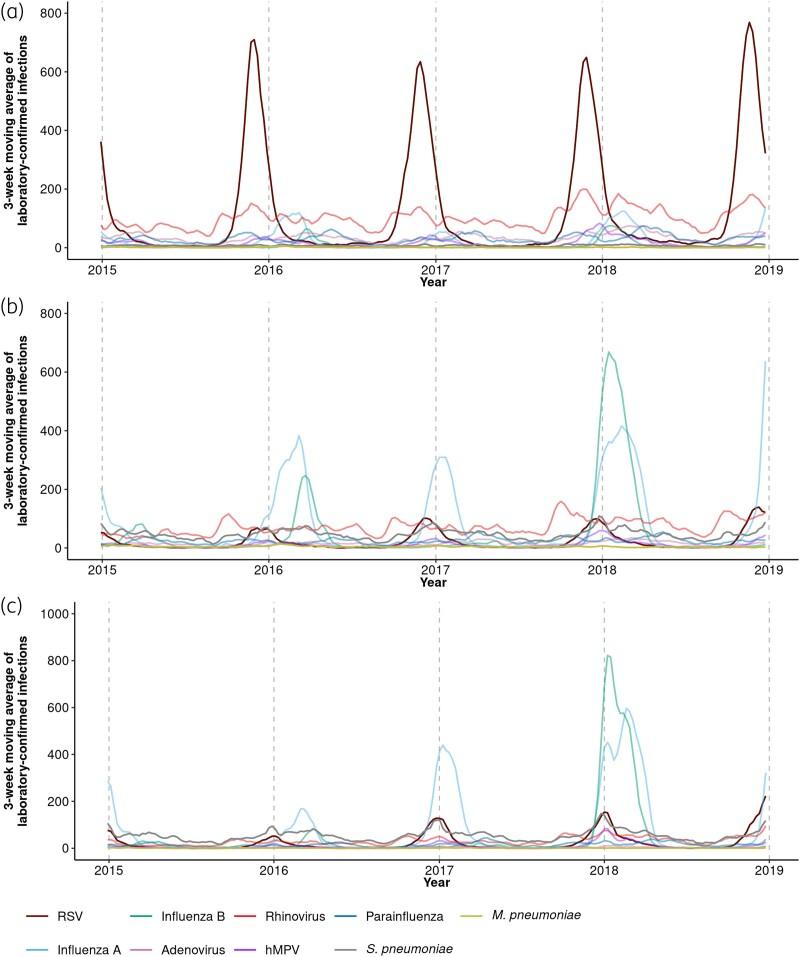
Generalized additive models examined associations between weekly counts of general practice antibiotic prescriptions and laboratory-confirmed respiratory infections from 2015 to 2018, adjusting for temperature, practice holidays and remaining seasonal confounders. We used general practice records from the Clinical Practice Research Datalink and microbiology tests for RSV, influenza, rhinovirus, adenovirus, parainfluenza, human metapneumovirus, Mycoplasma pneumoniae and Streptococcus pneumoniae from England's Second Generation Surveillance System.
RESULTS
An estimated 2.1% of antibiotics were attributable to RSV, equating to an average of 640 000 prescriptions annually. Of these, adults ≥75 years contributed to the greatest volume, with an annual average of 149 078 (95% credible interval: 93 733-206 045). Infants 6-23 months had the highest average annual rate at 6580 prescriptions per 100 000 individuals (95% credible interval: 4522-8651). Most RSV-attributable antibiotic prescriptions were penicillins, macrolides or tetracyclines. Adults ≥65 years had a wider range of antibiotic classes associated with RSV compared with younger age groups.
CONCLUSIONS
Interventions to reduce the burden of RSV, particularly in older adults, could complement current strategies to reduce antibiotic use in England.
背景
呼吸道合胞病毒(RSV)可能导致基层医疗中大量抗生素处方的开具。然而,关于此类感染所开具抗生素类型的数据仅在英国5岁以下儿童中可得。了解RSV对抗生素处方的影响将有助于预测RSV预防措施对抗生素使用和耐药性的影响。本研究的目的是按年龄和抗生素类别估计英格兰全科医疗中RSV所致抗生素处方的比例。
方法
采用广义相加模型研究2015年至2018年全科医疗抗生素处方周计数与实验室确诊的呼吸道感染之间的关联,并对温度、医疗机构假期及其他季节性混杂因素进行调整。我们使用了临床实践研究数据链中的全科医疗记录以及来自英格兰第二代监测系统的RSV、流感、鼻病毒、腺病毒、副流感病毒、人偏肺病毒、肺炎支原体和肺炎链球菌的微生物检测数据。
结果
估计2.1%的抗生素处方归因于RSV,相当于每年平均640000张处方。其中,75岁及以上成年人的处方量最大,年均149078张(95%可信区间:93733 - 206045)。6至23个月大的婴儿年均发病率最高,每100000人中有6580张处方(95%可信区间:452 - 8651)。大多数归因于RSV的抗生素处方为青霉素类、大环内酯类或四环素类。与较年轻年龄组相比,65岁及以上成年人与RSV相关的抗生素类别范围更广。
结论
减轻RSV负担的干预措施,尤其是针对老年人的措施,可补充英国目前减少抗生素使用的策略。


 Zotero 插件