
肾功能对阿尔茨海默病血液生物标志物的影响:对预测淀粉样蛋白-β阳性的意义。
The impact of kidney function on Alzheimer's disease blood biomarkers: implications for predicting amyloid-β positivity.
作者信息
Arslan Burak, Brum Wagner S, Pola Ilaria, Therriault Joseph, Rahmouni Nesrine, Stevenson Jenna, Servaes Stijn, Tan Kübra, Vitali Paolo, Montembeault Maxime, Klostranec Jesse, Macedo Arthur C, Tissot Cecile, Gauthier Serge, Lantero-Rodriguez Juan, Zimmer Eduardo R, Blennow Kaj, Zetterberg Henrik, Rosa-Neto Pedro, Benedet Andrea L, Ashton Nicholas J
机构信息
Department of Psychiatry and Neurochemistry, Institute of Neuroscience & Physiology, the Sahlgrenska Academy at the University of Gothenburg, Mölndal, Sweden.
Clinical Neurochemistry Laboratory, Sahlgrenska University Hospital, Gothenburg, Sweden.
出版信息
Alzheimers Res Ther. 2025 Feb 19;17(1):48. doi: 10.1186/s13195-025-01692-z.
BACKGROUND
Impaired kidney function has a potential confounding effect on blood biomarker levels, including biomarkers for Alzheimer's disease (AD). Given the imminent use of certain blood biomarkers in the routine diagnostic work-up of patients with suspected AD, knowledge on the potential impact of comorbidities on the utility of blood biomarkers is important. We aimed to evaluate the association between kidney function, assessed through estimated glomerular filtration rate (eGFR) calculated from plasma creatinine and AD blood biomarkers, as well as their influence over predicting Aβ-positivity.
METHODS
We included 242 participants from the Translational Biomarkers in Aging and Dementia (TRIAD) cohort, comprising cognitively unimpaired individuals (CU; n = 124), mild cognitive impairment (MCI; n = 58), AD dementia (n = 34), and non-AD dementia (n = 26) patients all characterized by [F] AZD-4694. Plasma samples were analyzed for Aβ42, Aβ40, glial fibrillary acidic protein (GFAP), neurofilament light chain (NfL), tau phosphorylated at threonine 181 (p-tau181), 217 (p-tau217), 231 (p-tau231) and N-terminal containing tau fragments (NTA-tau) using Simoa technology. Kidney function was assessed by eGFR in mL/min/1.73 m, based on plasma creatinine levels, age, and sex. Participants were also stratified according to their eGFR-indexed stages of chronic kidney disease (CKD). We evaluated the association between eGFR and blood biomarker levels with linear models and assessed whether eGFR provided added predictive value to determine Aβ-positivity with logistic regression models.
RESULTS
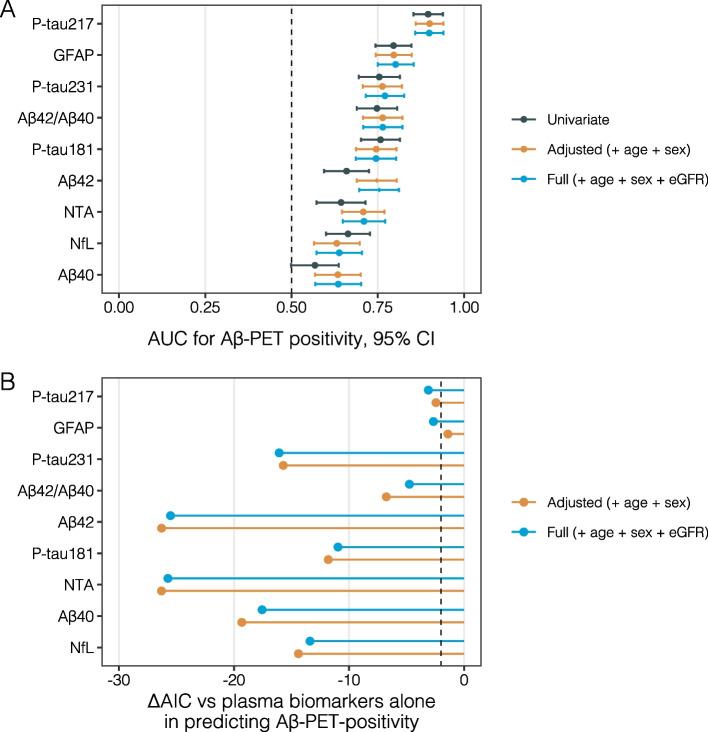
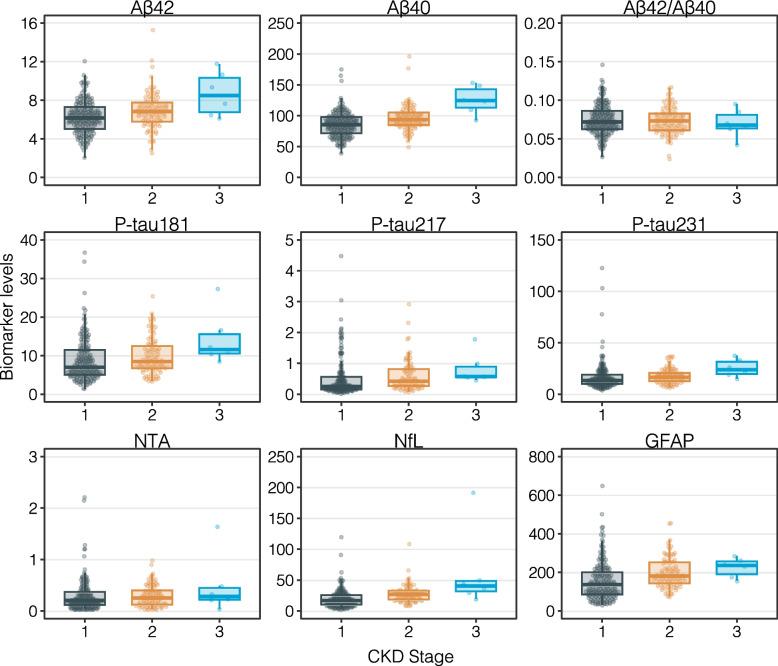
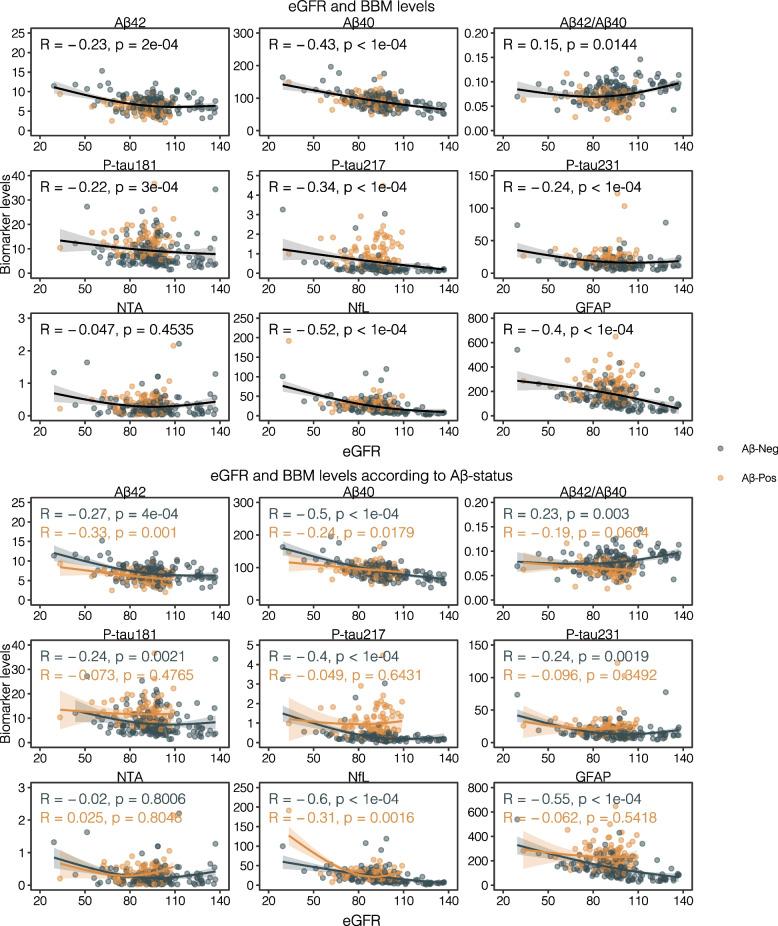
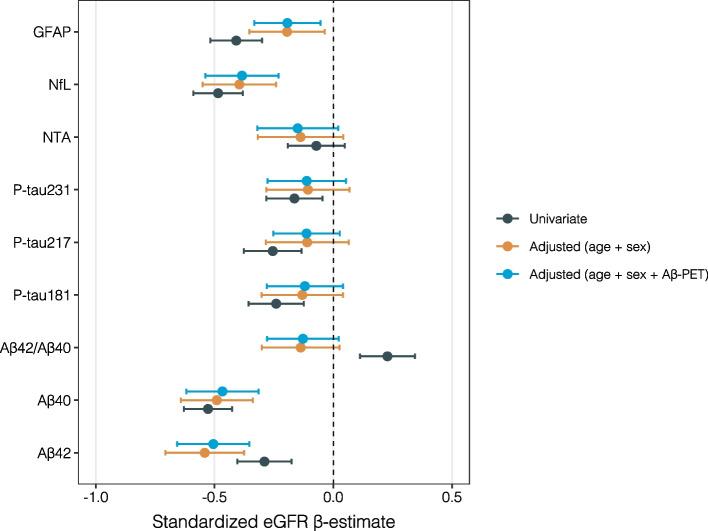
Biomarker concentrations were highest in individuals with CKD stage 3, followed by stages 2 and 1, but differences were only significant for NfL, Aβ42, and Aβ40 (not Aβ42/Aβ40). All investigated biomarkers showed significant associations with eGFR except plasma NTA-tau, with stronger relationships observed for Aβ40 and NfL. However, after adjusting for either age, sex or Aβ-PET SUVr, the association with eGFR was no longer significant for all biomarkers except Aβ40, Aβ42, NfL, and GFAP. When evaluating whether accounting for kidney function could lead to improved prediction of Aβ-positivity, we observed no improvements in model fit (Akaike Information Criterion, AIC) or in discriminative performance (AUC) by adding eGFR to a base model including each plasma biomarker, age, and sex. While covariates like age and sex improved model fit, eGFR contributed minimally, and there were no significant differences in clinical discrimination based on AUC values.
CONCLUSIONS
We found that kidney function seems to be associated with AD blood biomarker concentrations. However, these associations did not remain significant after adjusting for age and sex, except for Aβ40, Aβ42, NfL, and GFAP. While covariates such as age and sex improved prediction of Aβ-positivity, including eGFR in the models did not lead to improved prediction for any biomarker. Our findings indicate that renal function, within the normal to mild impairment range, does not seem to have a clinically relevant impact when using highly accurate blood biomarkers, such as p-tau217, in a biomarker-supported diagnosis.
背景
肾功能受损对血液生物标志物水平具有潜在的混杂影响,包括阿尔茨海默病(AD)的生物标志物。鉴于某些血液生物标志物即将用于疑似AD患者的常规诊断检查,了解合并症对血液生物标志物效用的潜在影响非常重要。我们旨在评估通过血浆肌酐计算的估计肾小球滤过率(eGFR)评估的肾功能与AD血液生物标志物之间的关联,以及它们对预测Aβ阳性的影响。
方法
我们纳入了来自衰老与痴呆转化生物标志物(TRIAD)队列的242名参与者,包括认知未受损个体(CU;n = 124)、轻度认知障碍(MCI;n = 58)、AD痴呆(n = 34)和非AD痴呆(n = 26)患者,所有患者均以[F]AZD - 4694为特征。使用Simoa技术分析血浆样本中的Aβ42、Aβ40、胶质纤维酸性蛋白(GFAP)、神经丝轻链(NfL)、苏氨酸181磷酸化的tau(p - tau181)、217(p - tau217)、231(p - tau231)以及含N端的tau片段(NTA - tau)。根据血浆肌酐水平、年龄和性别,通过eGFR(以mL/min/1.73 m为单位)评估肾功能。参与者还根据其eGFR索引的慢性肾脏病(CKD)阶段进行分层。我们使用线性模型评估eGFR与血液生物标志物水平之间的关联,并使用逻辑回归模型评估eGFR是否为确定Aβ阳性提供额外的预测价值。
结果
CKD 3期个体的生物标志物浓度最高,其次是2期和1期,但差异仅在NfL、Aβ42和Aβ40(而非Aβ42/Aβ40)方面显著。除血浆NTA - tau外,所有研究的生物标志物均显示与eGFR有显著关联,Aβ40和NfL的关联更强。然而,在调整年龄、性别或Aβ - PET SUVr后,除Aβ40、Aβ42、NfL和GFAP外,所有生物标志物与eGFR的关联不再显著。在评估考虑肾功能是否能改善对Aβ阳性的预测时,我们发现通过将eGFR添加到包括每种血浆生物标志物、年龄和性别的基础模型中,模型拟合度(赤池信息准则,AIC)或判别性能(AUC)均未得到改善。虽然年龄和性别等协变量改善了模型拟合度,但eGFR的贡献最小,基于AUC值的临床判别无显著差异。
结论
我们发现肾功能似乎与AD血液生物标志物浓度相关。然而,在调整年龄和性别后,除Aβ40、Aβ42、NfL和GFAP外,这些关联不再显著。虽然年龄和性别等协变量改善了对Aβ阳性的预测,但在模型中纳入eGFR并未导致对任何生物标志物的预测得到改善。我们的研究结果表明,在使用高度准确的血液生物标志物(如p - tau217)进行生物标志物支持的诊断时,正常至轻度受损范围内的肾功能似乎没有临床相关影响。
 Zotero 插件