
感染自我采样和自我检测的可接受性:关于公众用户观点的快速系统评价
Acceptability of self-sampling and self-testing for infections: a rapid systematic review on public users' views.
作者信息
Borek Aleksandra J, Roleston Caity, Lazzarino Runa, Cooray Mineli, Hayward Gail, Roberts Nia, Blandford Edward, Fowler Tom, Tonkin-Crine Sarah
机构信息
Nuffield Department of Primary Care Health Sciences, University of Oxford, Oxford, UK.
National Institute for Health and Care Research (NIHR) Health Protection Research Unit in Healthcare Associated Infections and Antimicrobial Resistance, University of Oxford, Oxford, UK.
出版信息
BMC Public Health. 2025 Feb 20;25(1):695. doi: 10.1186/s12889-025-21773-w.
BACKGROUND
Self-sampling and self-testing have been increasingly used for sexually transmitted infections (STIs) and quickly became widespread during the COVID-19 pandemic. User acceptability, preferences, and experiences are important factors affecting self-sampling/self-testing uptake. Understanding these factors is key to managing infections and planning responses to health emergencies. This review aimed to identify user views and experiences related to the acceptability, usability, motivations and preferences for self-sampling/self-testing for infections.
METHODS
We conducted a rapid systematic review. We searched Medline, EMBASE, PsycINFO, CINAHL, and Web of Science, limiting records to those published in English between 2014 and 2023. We also searched manually for additional peer-reviewed and grey literature. We included reports of public users' views on self-sampling/self-testing for any symptomatic and asymptomatic infections (except human papillomavirus) with qualitative, mixed-methods or survey data relevant to the review aim. Data were extracted into tables and qualitative findings were coded in NVivo. We synthesised data narratively.
RESULTS
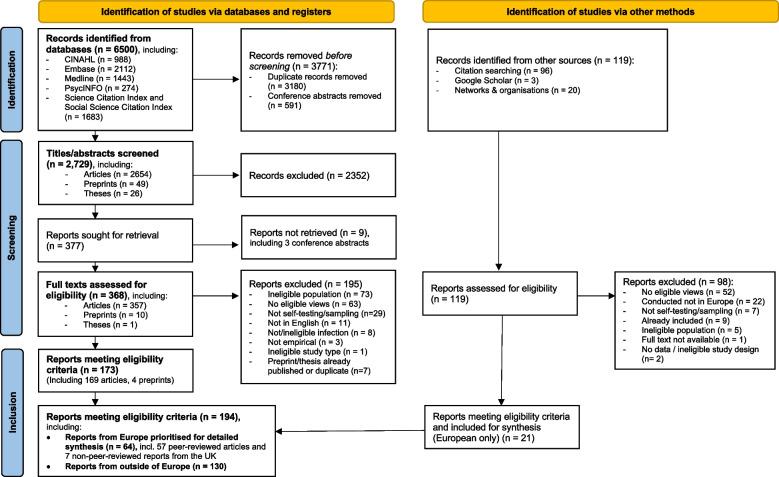
We identified 194 eligible reports, including 64 from Europe (which we prioritised for detailed synthesis) and 130 from outside of Europe. In Europe, the studied infections were respiratory (n = 42, including 37 for COVID-19), STIs/HIV/genital infections (n = 20), and hepatitis C (n = 2). Findings indicate that users found self-sampling/self-testing acceptable across infection/sampling types, populations, settings, and countries. Users wanted self-sampling/self-testing to help determine infection status and protect others. The main benefits were privacy and convenience, helping reduce the potential stigma of STIs/HIV/genital infections, and (for COVID-19) informing behaviour (e.g., socialising, self-isolating) and contributing to research. Easier to perform and less invasive sampling approaches were more acceptable. However, some participants reported challenges to self-sampling/self-testing, such as not understanding instructions, pain/discomfort in collecting samples, and lack of confidence in interpreting results.
CONCLUSIONS
This review synthesised evidence on the acceptability of SS/ST and factors affecting it across different infections, sampling approaches, settings, and populations. Evidence shows that most people with experience of self-sampling/self-testing found it acceptable and were willing to accept some discomfort in favour of several perceived benefits. This amenability to self-sampling/self-testing could be leveraged for diagnosing infections and preventing transmission. It can be used to support the viability of new models of clinical care and pandemic preparedness.
TRIAL REGISTRATION
The review was pre-registered on PROSPERO (ref. CRD42024507656 ).
背景
自我采样和自我检测在性传播感染(STIs)检测中使用得越来越多,并在新冠疫情期间迅速普及。用户的可接受性、偏好和体验是影响自我采样/自我检测采用率的重要因素。了解这些因素是控制感染和规划应对突发卫生事件的关键。本综述旨在确定用户对感染自我采样/自我检测的可接受性、可用性、动机和偏好的相关观点和体验。
方法
我们进行了一项快速系统综述。我们检索了Medline、EMBASE、PsycINFO、CINAHL和Web of Science,将记录限制为2014年至2023年期间发表的英文文献。我们还手动搜索了其他同行评审文献和灰色文献。我们纳入了关于公众用户对任何有症状和无症状感染(人乳头瘤病毒除外)进行自我采样/自我检测的观点报告,以及与综述目标相关的定性、混合方法或调查数据。数据被提取到表格中,定性结果在NVivo中进行编码。我们对数据进行了叙述性综合分析。
结果
我们确定了194篇符合条件的报告,其中64篇来自欧洲(我们将其作为详细综合分析的重点),130篇来自欧洲以外地区。在欧洲,所研究的感染包括呼吸道感染(n = 42,其中37例为新冠病毒感染)、性传播感染/艾滋病毒/生殖器感染(n = 20)和丙型肝炎(n = 2)。研究结果表明,用户认为自我采样/自我检测在各种感染/采样类型、人群、环境和国家中都是可以接受的。用户希望通过自我采样/自我检测来确定感染状况并保护他人。主要好处包括隐私和便利,有助于减少性传播感染/艾滋病毒/生殖器感染的潜在污名,以及(对于新冠病毒感染)为行为提供信息(如社交、自我隔离)并有助于研究。更容易操作且侵入性较小的采样方法更易被接受。然而,一些参与者报告了自我采样/自我检测面临的挑战,如不理解说明、采集样本时的疼痛/不适以及对解读结果缺乏信心。
结论
本综述综合了关于自我采样/自我检测的可接受性以及影响其在不同感染、采样方法、环境和人群中可接受性的因素的证据。证据表明,大多数有自我采样/自我检测经验的人认为其可以接受,并且愿意为了一些感知到的好处而忍受一些不适。这种对自我采样/自我检测的接受度可用于诊断感染和预防传播。它可用于支持新的临床护理模式和大流行防范的可行性。
试验注册
该综述已在PROSPERO上进行预注册(参考文献CRD42024507656)。
 Zotero 插件