
用于具有图案化和局部生化信号的功能梯度组织工程构建体的新型杂交打印机-SAM的开发。
Development of a Novel Hybprinter-SAM for Functionally Graded Tissue Engineering Constructs with Patterned and Localized Biochemical Signals.
作者信息
Li Jiannan, Kim Carolyn, Alizadeh Hossein V, Garg Shreya, Bruyas Arnaud, Zhao Peng, Passos Isadora S D, Pan Chi-Chun, Pérez Andrea S Flores, Skylar-Scott Mark A, Kim Sungwoo, Yang Yunzhi P
机构信息
Department of Orthopaedic Surgery, School of Medicine, Stanford University, Stanford, CA 94305, USA.
Department of Mechanical Engineering, School of Engineering, Stanford University, Stanford, CA 94305, USA.
出版信息
Res Sq. 2025 Feb 7:rs.3.rs-5898561. doi: 10.21203/rs.3.rs-5898561/v1.
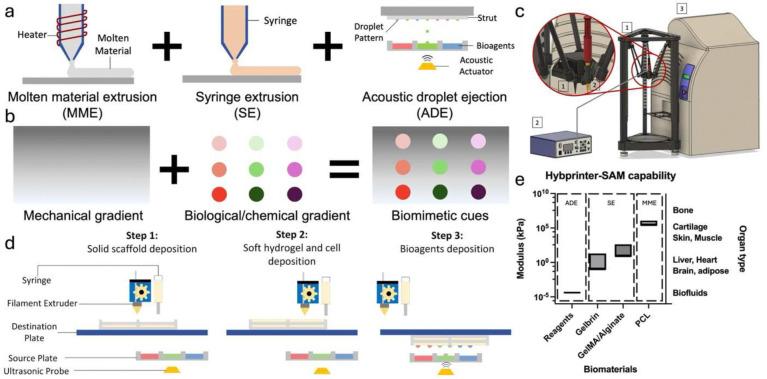
Engineering native-mimetic tissue constructs is challenging due to their intricate biological and structural gradients. To address this, Hybprinter-SAM was developed by integrating three bioprinting technologies: syringe extrusion (SE), acoustic droplet ejection (ADE) and molten material extrusion (MME). This system not only enables the creation of mechanical gradients by integrating soft and rigid materials spanning 7 order magnitude of stiffness but also facilitates precise patterning and controlled localization of biochemical signals within printed scaffolds. This capability is beneficial in replicating the complexity of native tissues to enhance functionality. Both the printing process and biomaterials were optimized to balance printability, mechanical integrity, and biocompatibility. As a proof of concept, Hybprinter-SAM was used in a bone-tendon regeneration study to engineer a multi-material construct with patterned fibroblast growth factor 2 (FGF-2), resulting in markers indicative of fibrocartilage development. These findings highlight the potential of Hybprinter-SAM as a versatile platform for diverse tissue engineering applications that require complex, functionally graded tissue constructs.
构建仿生组织工程支架具有挑战性,因为它们具有复杂的生物学和结构梯度。为了解决这个问题,通过整合三种生物打印技术开发了Hybprinter-SAM:注射器挤出(SE)、声滴喷射(ADE)和熔融材料挤出(MME)。该系统不仅能够通过整合跨越7个数量级刚度的软质和硬质材料来创建机械梯度,还能促进生化信号在打印支架内的精确图案化和可控定位。这种能力有助于复制天然组织的复杂性,以增强其功能。打印过程和生物材料都经过了优化,以平衡可打印性、机械完整性和生物相容性。作为概念验证,Hybprinter-SAM被用于一项骨-肌腱再生研究,以构建一种带有图案化成纤维细胞生长因子2(FGF-2)的多材料支架,从而产生了表明纤维软骨发育的标志物。这些发现突出了Hybprinter-SAM作为一个通用平台在各种组织工程应用中的潜力,这些应用需要复杂的、功能梯度的组织构建体。




 Zotero 插件