
精准无创脑刺激:用于个性化控制脑动力学的流程
Precision non-invasive brain stimulation: anpipeline for personalized control of brain dynamics.
作者信息
Karimi Fariba, Steiner Melanie, Newton Taylor, Lloyd Bryn A, Cassara Antonino M, de Fontenay Paul, Farcito Silvia, Paul Triebkorn Jan, Beanato Elena, Wang Huifang, Iavarone Elisabetta, Hummel Friedhelm C, Kuster Niels, Jirsa Viktor, Neufeld Esra
机构信息
Foundation for Research on Information Technologies in Society (IT'IS), Zurich, Switzerland.
Department of Information Technology and Electrical Engineering, Swiss Federal Institute of Technology (ETH), Zurich, Switzerland.
出版信息
J Neural Eng. 2025 Apr 22;22(2):026061. doi: 10.1088/1741-2552/adb88f.
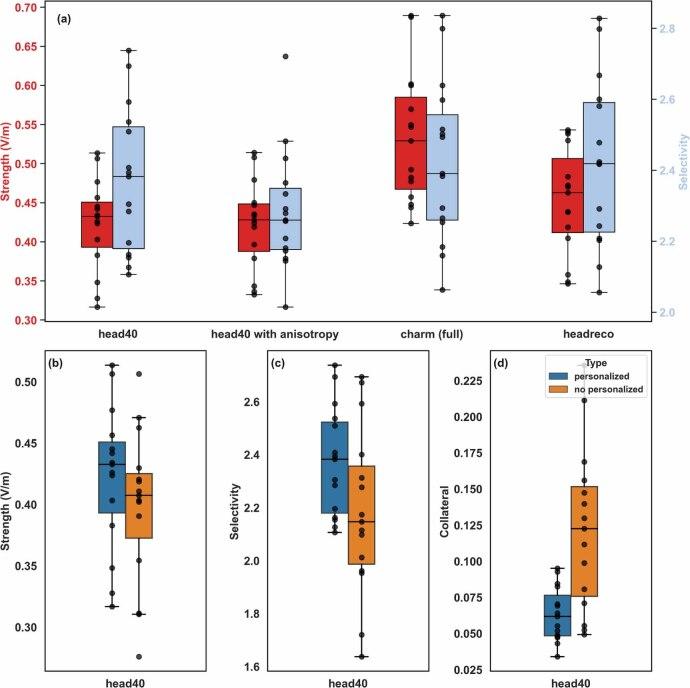
Non-invasive brain stimulation (NIBS) offers therapeutic benefits for various brain disorders. Personalization may enhance these benefits by optimizing stimulation parameters for individual subjects.We present a computational pipeline for simulating and assessing the effects of NIBS using personalized, large-scale brain network activity models. Using structural MRI and diffusion-weighted imaging data, the pipeline leverages a convolutional neural network-based segmentation algorithm to generate subject-specific head models with up to 40 tissue types and personalized dielectric properties. We integrate electromagnetic simulations of NIBS exposure with whole-brain network models to predict NIBS-dependent perturbations in brain dynamics, simulate the resulting EEG traces, and quantify metrics of brain dynamics.The pipeline is implemented on oSPARC, an open, cloud-based infrastructure designed for collaborative and reproducible computational life science. Furthermore, a dedicated planning tool provides guidance for optimizing electrode placements for transcranial temporal interference stimulation. In two proof-of-concept applications, we demonstrate that: (i) transcranial alternating current stimulation produces expected shifts in the EEG spectral response, and (ii) simulated baseline network activity exhibits physiologically plausible fluctuations in inter-hemispheric synchronization.This pipeline facilitates a shift from exposure-based to response-driven optimization of NIBS, supporting new stimulation paradigms that steer brain dynamics towards desired activity patterns in a controlled manner.
非侵入性脑刺激(NIBS)对各种脑部疾病具有治疗益处。个性化可通过为个体受试者优化刺激参数来增强这些益处。我们提出了一种计算流程,用于使用个性化的大规模脑网络活动模型模拟和评估NIBS的效果。利用结构磁共振成像(MRI)和扩散加权成像数据,该流程利用基于卷积神经网络的分割算法生成具有多达40种组织类型和个性化介电特性的个体特异性头部模型。我们将NIBS暴露的电磁模拟与全脑网络模型相结合,以预测NIBS依赖的脑动力学扰动,模拟由此产生的脑电图(EEG)轨迹,并量化脑动力学指标。该流程在oSPARC上实现,oSPARC是一个开放的、基于云的基础设施,专为协作和可重复的计算生命科学而设计。此外,一个专门的规划工具为优化经颅颞部干扰刺激的电极放置提供指导。在两个概念验证应用中,我们证明:(i)经颅交流电刺激在EEG频谱响应中产生预期的变化,以及(ii)模拟的基线网络活动在半球间同步中表现出生理上合理的波动。这个流程有助于从基于暴露的NIBS优化转向基于反应的优化,支持新的刺激范式,以可控的方式将脑动力学引导至期望的活动模式。




 Zotero 插件