
影响接受体外膜肺氧合治疗的急性心肌梗死合并心源性休克患者预后的危险因素。
Risk factors influencing the prognosis of patients with acute myocardial infarction and cardiogenic shock undergoing extracorporeal membrane oxygenation therapy.
作者信息
Zheng Guoying, Xu Zhuoqian, Yao Shuwen, Liu Xiao, Wang Shuxiang, Huang Haitian, Li Yuanyuan
机构信息
Department of Critical Care Medicine, Huadu District People's Hospital of Guangzhou, 48 Xinhua Road, Huadu District, Guangzhou, 510800, Guangdong Province, China.
出版信息
J Cardiothorac Surg. 2025 Feb 20;20(1):138. doi: 10.1186/s13019-025-03348-3.
BACKGROUND
Patients with acute myocardial infarction (AMI) complicated by cardiogenic shock (CS) face high mortality rates. Extracorporeal Membrane Oxygenation (ECMO) therapy offers critical support in these cases, yet identifying factors that influence patient outcomes is crucial for improving survival rates.
METHODS
This retrospective study included 63 patients with AMI and CS who underwent ECMO therapy at our institution from January 2020 to December 2023. Patients were categorized into survivors (n = 33) and non-survivors (n = 30) based on 30-day outcomes. Data collected included demographics, clinical history, hemodynamic and biomarker parameters, and treatment details such as time from symptom onset to percutaneous coronary intervention (PCI) and the use of intra-aortic balloon pump (IABP). Logistic regression models and ROC curve analysis were used to evaluate the predictive value of various factors.
RESULTS
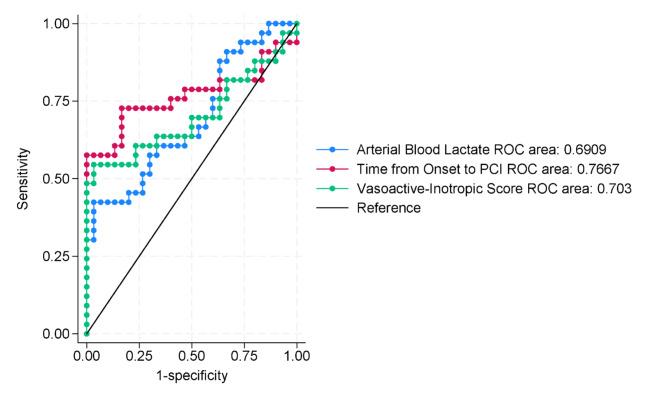
Non-survivors had significantly higher arterial blood lactate levels (8.0 [6.2, 11.0] mmol/L vs. 4.8 [3.0, 8.5] mmol/L, p = 0.015) and required more intensive vasoactive support, as indicated by higher Vasoactive-Inotropic Scores (VIS) (130 [IQR: 105, 175] vs. 100 [IQR: 60, 115], p = 0.016). They also experienced longer delays from symptom onset to PCI (15.5 [IQR: 11.0, 20.5] hours vs. 9.5 [IQR: 7.0, 12.0] hours, p = 0.001). The prevalence of left main coronary artery disease (33.3% vs. 12.1%, p = 0.013) and triple vessel disease (36.7% vs. 9.1%, p = 0.002) was higher in non-survivors. ROC analysis identified arterial blood lactate (AUC = 0.6909), time from onset to PCI (AUC = 0.7667), and VIS (AUC = 0.703) as significant predictors of prognosis. Logistic regression showed that arterial blood lactate (OR = 1.884, p = 0.039), VIS (OR = 1.122, p = 0.033), and time from onset to PCI (OR = 108.271, p = 0.039) were significantly associated with worse outcomes.
CONCLUSIONS
Elevated arterial blood lactate, prolonged time to PCI, and higher VIS could be important predictors of poor outcomes in AMI-CS patients undergoing ECMO therapy. Timely intervention, including rapid revascularization and effective management of metabolic disturbances, might be key to improving survival.
背景
急性心肌梗死(AMI)合并心源性休克(CS)的患者面临着较高的死亡率。体外膜肺氧合(ECMO)治疗在这些病例中提供了关键支持,然而识别影响患者预后的因素对于提高生存率至关重要。
方法
这项回顾性研究纳入了2020年1月至2023年12月在我院接受ECMO治疗的63例AMI合并CS患者。根据30天的预后情况,将患者分为幸存者(n = 33)和非幸存者(n = 30)。收集的数据包括人口统计学、临床病史、血流动力学和生物标志物参数,以及从症状发作到经皮冠状动脉介入治疗(PCI)的时间和主动脉内球囊泵(IABP)的使用等治疗细节。使用逻辑回归模型和ROC曲线分析来评估各种因素的预测价值。
结果
非幸存者的动脉血乳酸水平显著更高(8.0 [6.2, 11.0] mmol/L对4.8 [3.0, 8.5] mmol/L,p = 0.015),并且需要更强化的血管活性支持,血管活性-正性肌力评分(VIS)更高表明了这一点(130 [四分位间距:105, 175]对100 [四分位间距:60, 115],p = 0.016)。他们从症状发作到PCI的延迟时间也更长(15.5 [四分位间距:11.0, 20.5]小时对9.5 [四分位间距:7.0, 12.0]小时,p = 0.001)。非幸存者中左主干冠状动脉疾病(33.3%对12.1%,p = 0.013)和三支血管疾病(36.7%对9.1%,p = 0.002)的患病率更高。ROC分析确定动脉血乳酸(AUC = 0.6909)、从发作到PCI的时间(AUC = 总0.7667)和VIS(AUC = 0.703)是预后的重要预测指标。逻辑回归显示动脉血乳酸(OR = 1.884,p = 0.039)、VIS(OR = 1.122,p = 0.033)和从发作到PCI的时间(OR = 108.271,p = 0.039)与更差的预后显著相关。
结论
动脉血乳酸升高、PCI时间延长和VIS升高可能是接受ECMO治疗的AMI-CS患者预后不良的重要预测指标。及时干预,包括快速血管重建和有效管理代谢紊乱,可能是提高生存率的关键。
 Zotero 插件