
佐剂亚单位鼻内疫苗可降低仓鼠体内严重急性呼吸综合征冠状病毒2(SARS-CoV-2)的传播。
Adjuvanted subunit intranasal vaccine reduces SARS-CoV-2 onward transmission in hamsters.
作者信息
Sui Yongjun, Kar Swagata, Chawla Bhavna, Hoang Tanya, Yu YuanKai, Wallace Shannon M, Andersen Hanne, Berzofsky Jay A
机构信息
Vaccine Branch, National Cancer Institute, National Institutes of Health, Bethesda, MD, United States.
Bioqual Inc., Rockville, MD, United States.
出版信息
Front Immunol. 2025 Feb 7;16:1514845. doi: 10.3389/fimmu.2025.1514845. eCollection 2025.
INTRODUCTION
Most COVID-19 vaccine trials have focused on recipient protection, not protection of their contacts, a critical need. As a subunit intranasal COVID-19 vaccine reduced nasopharyngeal virus more than did an intramuscular (IM) vaccine, we hypothesized that this vaccine might reduce onward transmission to others.
METHODS
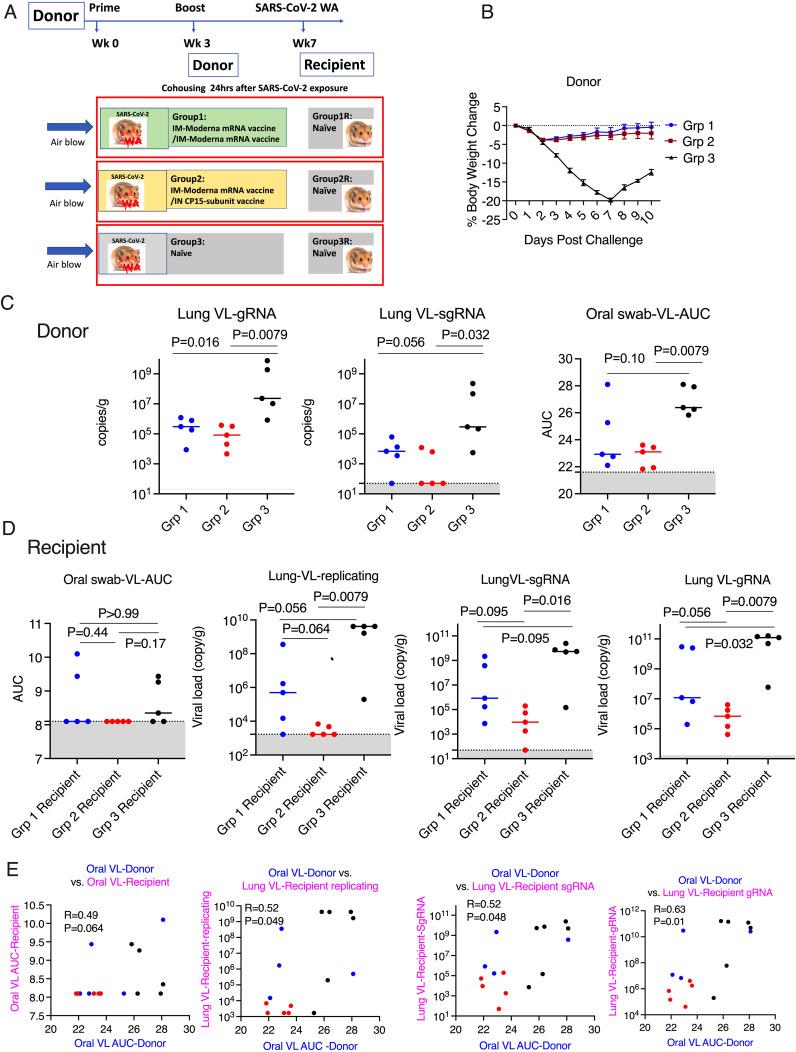
We vaccinated hamsters with either the IM-administrated licensed mRNA vaccine twice or one dose of mRNA IM followed by adjuvanted subunit intranasal vaccine. 24 hours after SARS-CoV-2 challenge, these animals were housed with naïve recipients in a contactless chamber that allows airborne transmission.
RESULTS
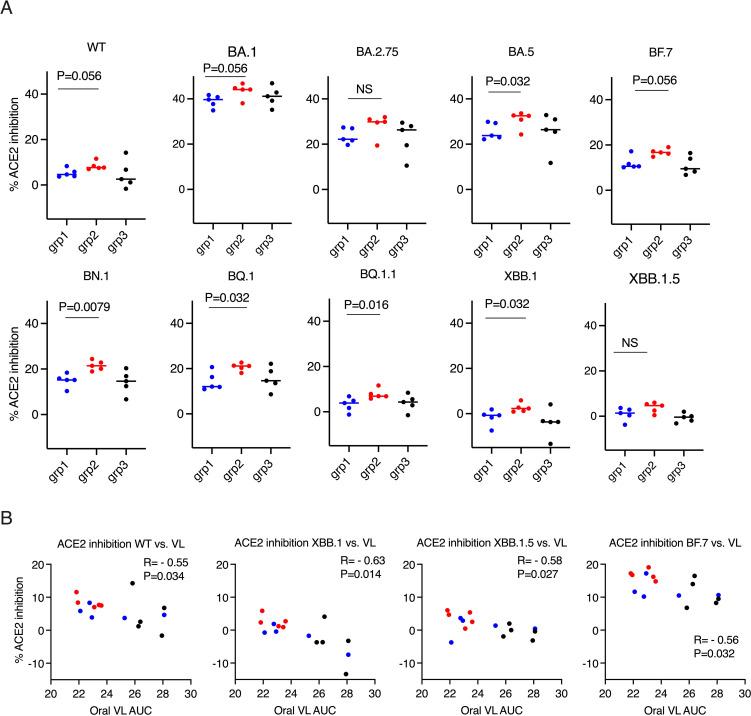
Onward airborne transmission was profoundly blocked: the donor and recipients of the intranasal vaccine-boosted group had lower oral and lung viral loads (VL), which correlated with mucosal ACE2 inhibition activity. Notably, in this head-to-head comparison of COVID-19 booster vaccines on SARS-CoV-2 onward transmission, we found that statistically significant viral reduction in the lung tissues and oral swabs was observed only in the intranasal S1 nanoparticle vaccine-boosted group, but not in the systemic mRNA vaccine-boosted group, suggesting the superior protection of this intranasal vaccine, which could act as an attractive vaccine booster candidate to complement the current licensed systemic vaccines.
DISCUSSION
Overall, our study strongly supports the use of the intranasal vaccine as a boost to protect not only the vaccinated person, but also people exposed to the vaccinated person, a key public health goal.
引言
大多数新冠疫苗试验都集中在受种者的保护上,而非对其接触者的保护,而这是一项迫切需求。由于一种亚单位鼻内新冠疫苗比肌内注射(IM)疫苗更能减少鼻咽部病毒,我们推测这种疫苗可能会减少向他人的传播。
方法
我们用已获许可的肌内注射mRNA疫苗对仓鼠进行两次接种,或先接种一剂肌内注射mRNA疫苗,随后接种佐剂亚单位鼻内疫苗。在感染新冠病毒24小时后,将这些动物与未接种疫苗的受体置于一个允许空气传播的无接触舱内饲养。
结果
空气传播被显著阻断:鼻内疫苗加强组的供体和受体的口腔和肺部病毒载量(VL)较低,这与粘膜血管紧张素转换酶2抑制活性相关。值得注意的是,在这次关于新冠加强疫苗对新冠病毒传播影响的直接比较中,我们发现仅在鼻内S1纳米颗粒疫苗加强组的肺组织和口腔拭子中观察到病毒载量有统计学意义的降低,而在全身mRNA疫苗加强组中未观察到,这表明这种鼻内疫苗具有更好的保护作用,它可能是一种有吸引力的疫苗加强候选物,可作为对当前已获许可的全身疫苗的补充。
讨论
总体而言,我们的研究有力支持使用鼻内疫苗作为加强针,不仅保护接种者本人,还能保护接触接种者的人,这是一个关键的公共卫生目标。

 Zotero 插件