
抑郁症生物学相互作用途径中的下丘脑-垂体-肾上腺轴和肠-脑轴
Hypothalamus-pituitary-adrenal and gut-brain axes in biological interaction pathway of the depression.
作者信息
Bertollo Amanda Gollo, Santos Camila Ferreira, Bagatini Margarete Dulce, Ignácio Zuleide Maria
机构信息
Laboratory of Physiology Pharmacology and Psychopathology, Graduate Program in Biomedical Sciences, Federal University of Fronteira Sul, Chapecó, Brazil.
出版信息
Front Neurosci. 2025 Feb 6;19:1541075. doi: 10.3389/fnins.2025.1541075. eCollection 2025.
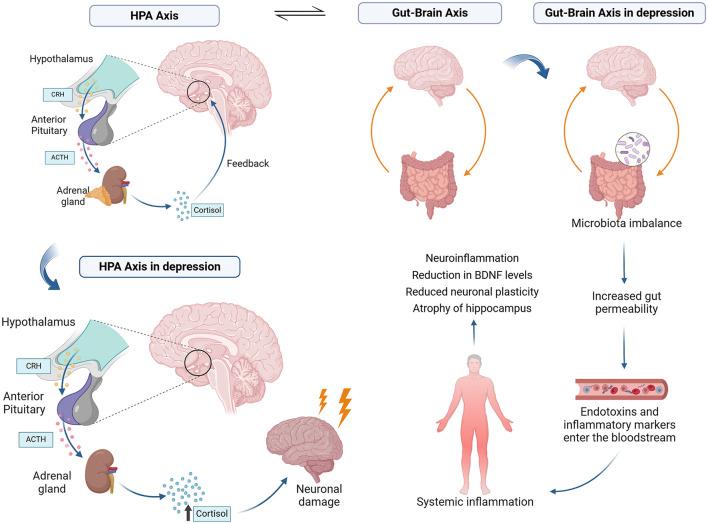
The hypothalamus-pituitary-adrenal (HPA) and gut-brain axes are vital biological pathways in depression. The HPA axis regulates the body's stress response, and chronic stress can lead to overactivation of the HPA axis, resulting in elevated cortisol levels that contribute to neuronal damage, particularly in regions such as the hippocampus and prefrontal cortex, both of which are involved in mood regulation and mental disorders. In parallel, the gut-brain axis, a bidirectional communication network between the gut microbiota and the central nervous system, influences emotional and cognitive functions. Imbalances in gut microbiota can affect the HPA axis, promoting inflammation and increasing gut permeability. This allows endotoxins to enter the bloodstream, contributing to neuroinflammation and altering neurotransmitter production, including serotonin. Since the majority of serotonin is produced in the gut, disruptions in this pathway may be linked to depressive symptoms. This review explores the interplay between the HPA axis and the gut-brain axis in the context of depression.
下丘脑-垂体-肾上腺(HPA)轴和肠-脑轴是抑郁症中至关重要的生物学途径。HPA轴调节身体的应激反应,慢性应激可导致HPA轴过度激活,导致皮质醇水平升高,这会导致神经元损伤,尤其是在海马体和前额叶皮质等区域,这两个区域都参与情绪调节和精神障碍。与此同时,肠-脑轴是肠道微生物群与中枢神经系统之间的双向通信网络,影响情绪和认知功能。肠道微生物群的失衡会影响HPA轴,促进炎症并增加肠道通透性。这使得内毒素进入血液,导致神经炎症并改变神经递质的产生,包括血清素。由于大多数血清素是在肠道中产生的,这条途径的破坏可能与抑郁症状有关。这篇综述探讨了抑郁症背景下HPA轴和肠-脑轴之间的相互作用。


 Zotero 插件