
重新审视糖尿病酮症酸中毒(DKA)的液体管理:是否应使用生理盐水?
Revisiting Diabetic Ketoacidosis (DKA) Fluid Management: Should Normal Saline Be Used?
作者信息
Messina Noelle, Anderson Zackary, Saravis Lauren, Jimenez Glendy, Plowman Keegan, Harrington Doug
机构信息
Graduate Medical Education Internal Medicine Residency, Naples Comprehensive Health (NCH) Healthcare System, Naples, USA.
Graduate Medical Education Pulmonary and Critical Care Residency, Naples Comprehensive Health (NCH) Healthcare System, Naples, USA.
出版信息
Cureus. 2025 Jan 20;17(1):e77739. doi: 10.7759/cureus.77739. eCollection 2025 Jan.
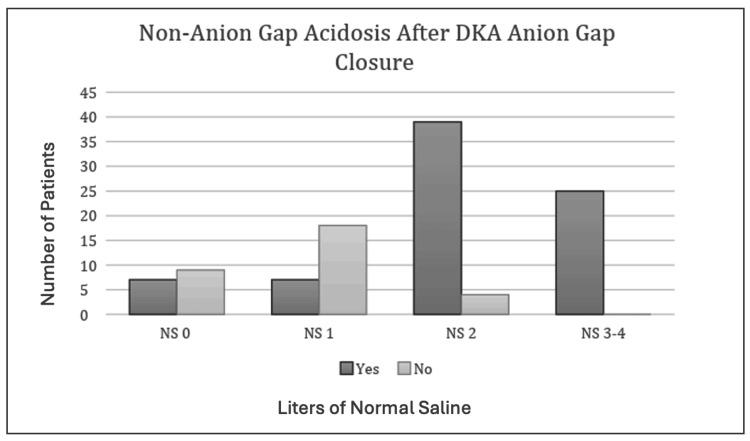
Background Diabetic ketoacidosis (DKA) is a common and serious complication of diabetes, often requiring hospitalization and intensive care. Fluid resuscitation is a cornerstone of DKA management, with traditional guidelines recommending isotonic normal saline (NS) for initial volume replacement. Recent studies, however, suggest that large volumes of NS may lead to undesirable outcomes such as hyperchloremic metabolic acidosis. This study investigates the effects of large-volume NS resuscitation on clinical outcomes in DKA management, comparing it to other fluids, such as lactated Ringers (LR). Objective To evaluate whether large-volume resuscitation with isotonic normal saline (NS) is associated with prolonged ICU length of stay (LOS), increased time on insulin infusion, and higher rates of non-anion gap metabolic acidosis in patients with DKA. Materials and methods This was a single-center, retrospective, observational study conducted at Naples Comprehensive Healthcare System. We reviewed electronic medical records of patients diagnosed with DKA, defined by pH <7.3, bicarbonate <18, and anion gap >12. The primary outcome was ICU LOS, and secondary outcomes included overall length of stay, insulin infusion duration after DKA resolution, and incidence of non-anion gap metabolic acidosis after DKA resolution. Patients were grouped by the amount of NS received during resuscitation: 0L, 1L, 2L, and ≥3L. Statistical analyses included analysis of variance (ANOVA), t-tests, and chi-square tests to compare outcomes between groups. Results A total of 109 patients were included in the study. The mean age was 51.34 years, and the cohort consisted of 43.1% females and 56.9% males. There was no significant difference in ICU LOS between patients who received 0L and 1L of NS. However, patients who received 2L (p=0.0249) and ≥3L (p=0.00065) had significantly longer ICU LOS compared to those who received 0L of NS. No significant difference in overall LOS was also observed across all groups (p=0.894). Patients who received ≥3L of NS had a significantly longer duration of insulin infusion compared to those who received 0L (p=0.0101) after DKA anion gap closure while a significant increase in the incidence of non-anion gap acidosis after DKA resolution was observed in patients receiving ≥2L of NS (p=0.0000). Conclusion This study suggests that large-volume resuscitation with isotonic NS in DKA patients is associated with increased ICU length of stay, prolonged insulin infusion, and a higher incidence of non-anion gap metabolic acidosis. These findings support the use of balanced crystalloids, such as lactated Ringers, for initial resuscitation in DKA patients, as they may reduce the risk of complications related to hyperchloremia and improve clinical outcomes. Further prospective studies are needed to confirm these findings and guide fluid management protocols in DKA.
背景
糖尿病酮症酸中毒(DKA)是糖尿病常见且严重的并发症,常需住院及重症监护。液体复苏是DKA治疗的基石,传统指南推荐使用等渗生理盐水(NS)进行初始容量补充。然而,近期研究表明大量使用NS可能导致诸如高氯性代谢性酸中毒等不良后果。本研究调查大量NS复苏对DKA治疗临床结局的影响,并将其与其他液体(如乳酸林格液(LR))进行比较。
目的
评估等渗生理盐水(NS)大量复苏是否与DKA患者延长的重症监护病房(ICU)住院时间(LOS)、胰岛素输注时间增加以及非阴离子间隙代谢性酸中毒发生率升高相关。
材料与方法
这是一项在那不勒斯综合医疗保健系统进行的单中心、回顾性、观察性研究。我们回顾了诊断为DKA(定义为pH <7.3、碳酸氢盐<18且阴离子间隙>12)患者的电子病历。主要结局是ICU LOS,次要结局包括总住院时间、DKA缓解后胰岛素输注持续时间以及DKA缓解后非阴离子间隙代谢性酸中毒的发生率。患者根据复苏期间接受的NS量分组:0L、1L、2L和≥3L。统计分析包括方差分析(ANOVA)、t检验和卡方检验,以比较组间结局。
结果
本研究共纳入109例患者。平均年龄为51.34岁,队列中女性占43.1%,男性占56.9%。接受0L和1L NS的患者在ICU LOS方面无显著差异。然而,接受2L(p = 0.0249)和≥3L(p = 0.00065)NS的患者与接受0L NS的患者相比,ICU LOS显著更长。所有组在总住院时间方面也未观察到显著差异(p = 0.894)。DKA阴离子间隙闭合后,接受≥3L NS的患者与接受0L NS的患者相比,胰岛素输注持续时间显著更长(p = 0.0101),而接受≥2L NS的患者在DKA缓解后非阴离子间隙酸中毒的发生率显著增加(p = 0.0000)。
结论
本研究表明,DKA患者使用等渗NS大量复苏与ICU住院时间增加、胰岛素输注时间延长以及非阴离子间隙代谢性酸中毒发生率升高相关。这些发现支持使用平衡晶体液(如乳酸林格液)对DKA患者进行初始复苏,因为它们可能降低与高氯血症相关的并发症风险并改善临床结局。需要进一步的前瞻性研究来证实这些发现并指导DKA的液体管理方案。


 Zotero 插件