
两种遗传改良养殖尼罗罗非鱼(尼罗罗非鱼)鱼片和鱼皮的特性分析
Characterization of fillets and skins from two varieties of genetically improved farmed Nile tilapia (Oreochromis niloticus).
作者信息
Campos Vinicius José, Gasparino Eliane, Lima Júnior José Wellington Rodrigues, Khatlab Angélica de Souza, Bastos Marisa Silva, Santana Thais Pacheco, Almeida Fernanda Losi Alves, de Souza Maria Luiza Rodrigues, Matiucci Marcos Antonio, Oliveira Gislaine Gonçalves, Oliveira Carlos Antonio Lopes de, Ribeiro Ricardo Pereira, Schlotefeldt Carolina, Oliveira Isis Regina Santos de, Oliveira Julia Gasparino de, Del Vesco Ana Paula
机构信息
Department of Animal Science, Federal University of Sergipe, São Cristóvão, Sergipe, Brazil.
Department of Animal Science, State University of Maringá, Maringá, Paraná, Brazil.
出版信息
PLoS One. 2025 Feb 21;20(2):e0314928. doi: 10.1371/journal.pone.0314928. eCollection 2025.
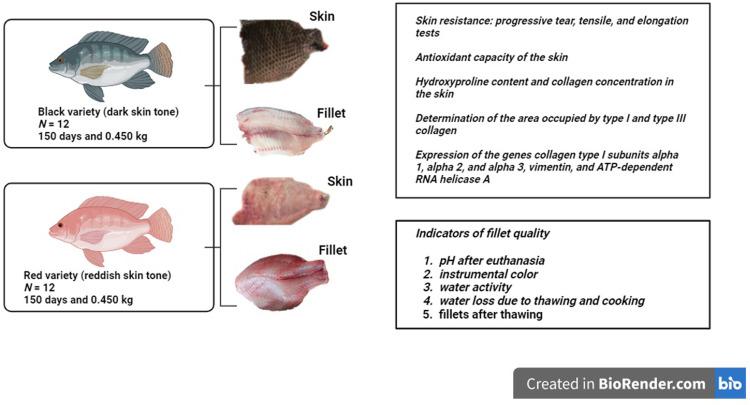
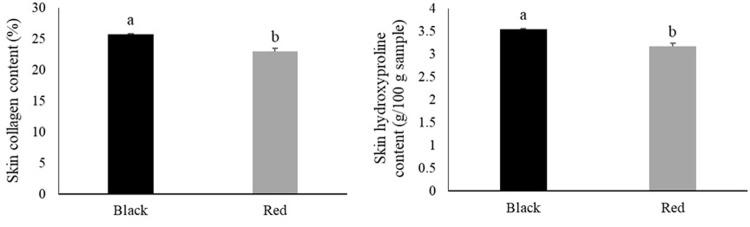
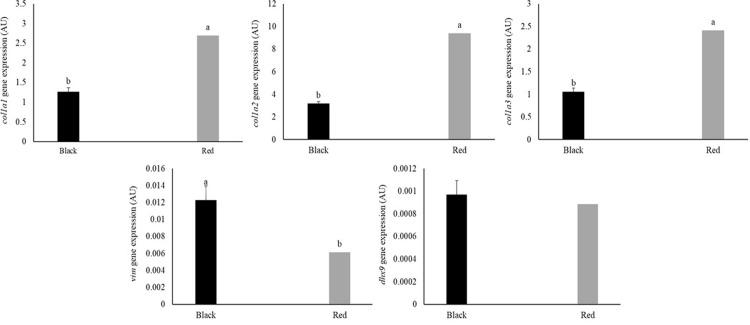
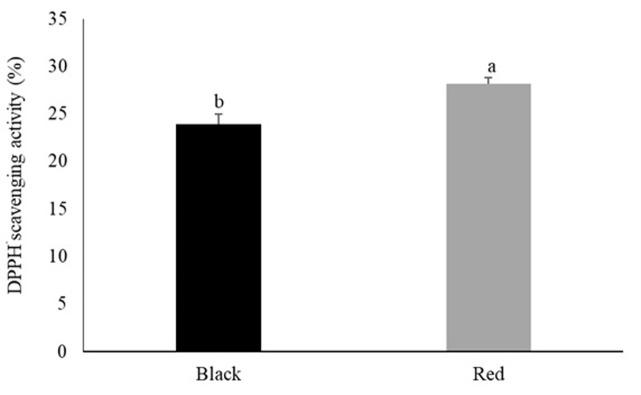
Genetically improved farmed tilapia (GIFT) is a strain of Nile tilapia (Oreochromis niloticus) developed for improved production and commercial parameters. Skin color, one of the characteristics distinguishing tilapia varieties, is an important phenotypic trait associated with qualitative and productive performance. This study aimed to assess fillet and skin characteristics in GIFT Nile tilapia with black and red skin phenotypes. For this, 24 GIFT Nile tilapia from the same spawning stock were divided into two groups based on skin color, namely a black variety (dark skin) and a red variety (reddish skin). There were no significant differences in biometric parameters between varieties. Fish of the red variety had higher 2 h post-slaughter pH and muscle antioxidant capacity and lower yellow-blue axis value (b*), luminosity (L*), thawing loss, cooking loss, and conjugated diene content (P < 0.05). The skin of black tilapia exhibited higher force in the progressive tear test tear, and higher strength, tensile strength, deformation, and elongation in the traction and stretching test than that of red tilapia. Black tilapia skin had higher collagen and hydroxyproline contents. The skin of the red variety exhibited higher expression levels of alpha 1, 2, and 3 type I collagen genes, lower expression levels of the vimentin gene, and higher antioxidant capacity. The results suggest that skin color phenotype may be linked to important metabolic pathways influencing fish fillet and skin traits. These findings can support future research aimed at identifying optimal varieties of Nile tilapia for specific purposes and optimizing the utilization of filleting waste.
遗传改良养殖罗非鱼(GIFT)是尼罗罗非鱼(Oreochromis niloticus)的一个品系,旨在提高生产性能和商业参数。皮肤颜色是区分罗非鱼品种的特征之一,是与品质和生产性能相关的重要表型性状。本研究旨在评估具有黑色和红色皮肤表型的GIFT尼罗罗非鱼的鱼片和皮肤特征。为此,将来自同一产卵群体的24条GIFT尼罗罗非鱼根据皮肤颜色分为两组,即黑色品种(深色皮肤)和红色品种(微红皮肤)。不同品种之间的生物测量参数没有显著差异。红色品种的鱼在屠宰后2小时的pH值和肌肉抗氧化能力较高,黄蓝轴值(b*)、亮度(L*)、解冻损失、烹饪损失和共轭二烯含量较低(P<0.05)。黑色罗非鱼的皮肤在渐进撕裂试验中的撕裂力更高,在拉伸试验中的强度、抗张强度、变形和伸长率均高于红色罗非鱼。黑色罗非鱼皮肤的胶原蛋白和羟脯氨酸含量更高。红色品种的皮肤表现出更高的I型α1、2和3型胶原蛋白基因表达水平,更低的波形蛋白基因表达水平和更高的抗氧化能力。结果表明,皮肤颜色表型可能与影响鱼片和皮肤性状的重要代谢途径有关。这些发现可为未来旨在确定特定用途尼罗罗非鱼最佳品种以及优化鱼片加工废弃物利用的研究提供支持。




 Zotero 插件