
胰高血糖素样肽-1受体激动剂与2型糖尿病肾移植受者心血管及肾脏结局的关联
Association of glucagon-like peptide-1 receptor agonists with cardiovascular and kidney outcomes in type 2 diabetic kidney transplant recipients.
作者信息
Lin Li-Chun, Chen Jui-Yi, Huang Thomas Tao-Min, Wu Vin-Cent
机构信息
Division of Nephrology, Department of Internal Medicine, National Taiwan University Hospital, Taipei, Taiwan.
Division of Nephrology, Department of Internal Medicine, Chi-Mei Medical Center, Tainan, Taiwan.
出版信息
Cardiovasc Diabetol. 2025 Feb 21;24(1):87. doi: 10.1186/s12933-025-02649-0.
BACKGROUND
Cardiovascular disease is a leading cause of post-transplant mortality in kidney transplant recipients (KTRs), especially those with diabetes. Although glucagon-like peptide-1 receptor agonists (GLP-1 RAs) have demonstrated cardiovascular and kidney benefits in the general population with type 2 diabetes mellitus (T2DM), evidence regarding their effects in diabetic KTRs is limited.
METHODS
This retrospective cohort study utilized data from the Global Collaborative Network in TriNetX, spanning January 1, 2006, to June 1, 2023. Propensity score matching (PSM) with 1:1 ratio was employed to create balanced cohorts. Adult KTRs with T2DM who received GLP-1 RAs within 3 months post-transplant were compared to a matched cohort of KTRs who did not. The primary outcome was all-cause mortality, with secondary outcomes including major adverse cardiovascular events (MACEs) and major adverse kidney events (MAKEs).
RESULTS
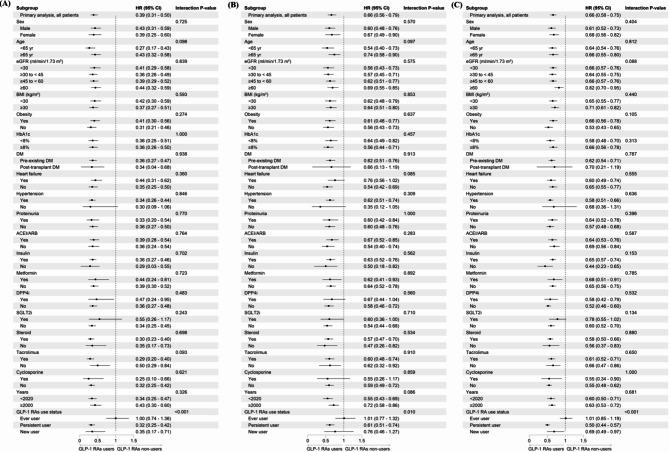
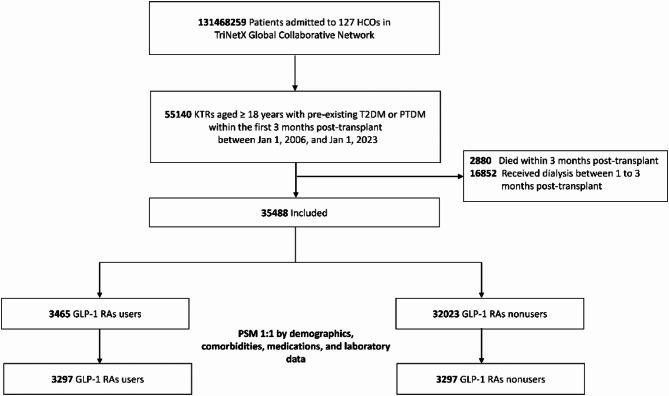
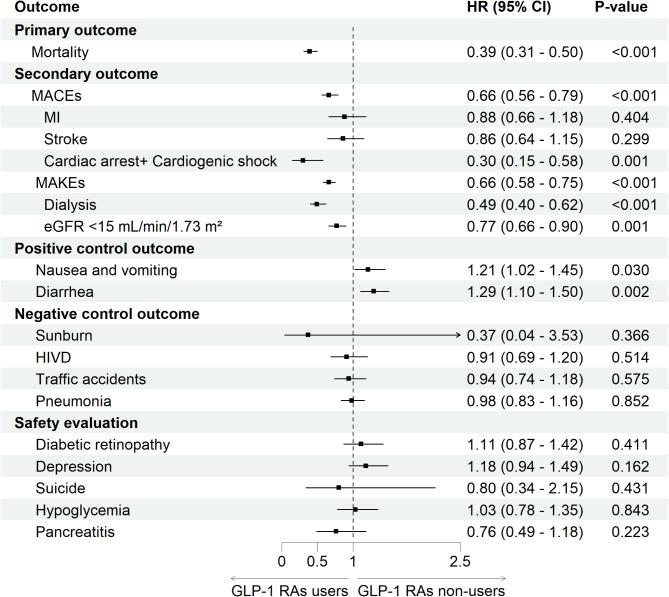
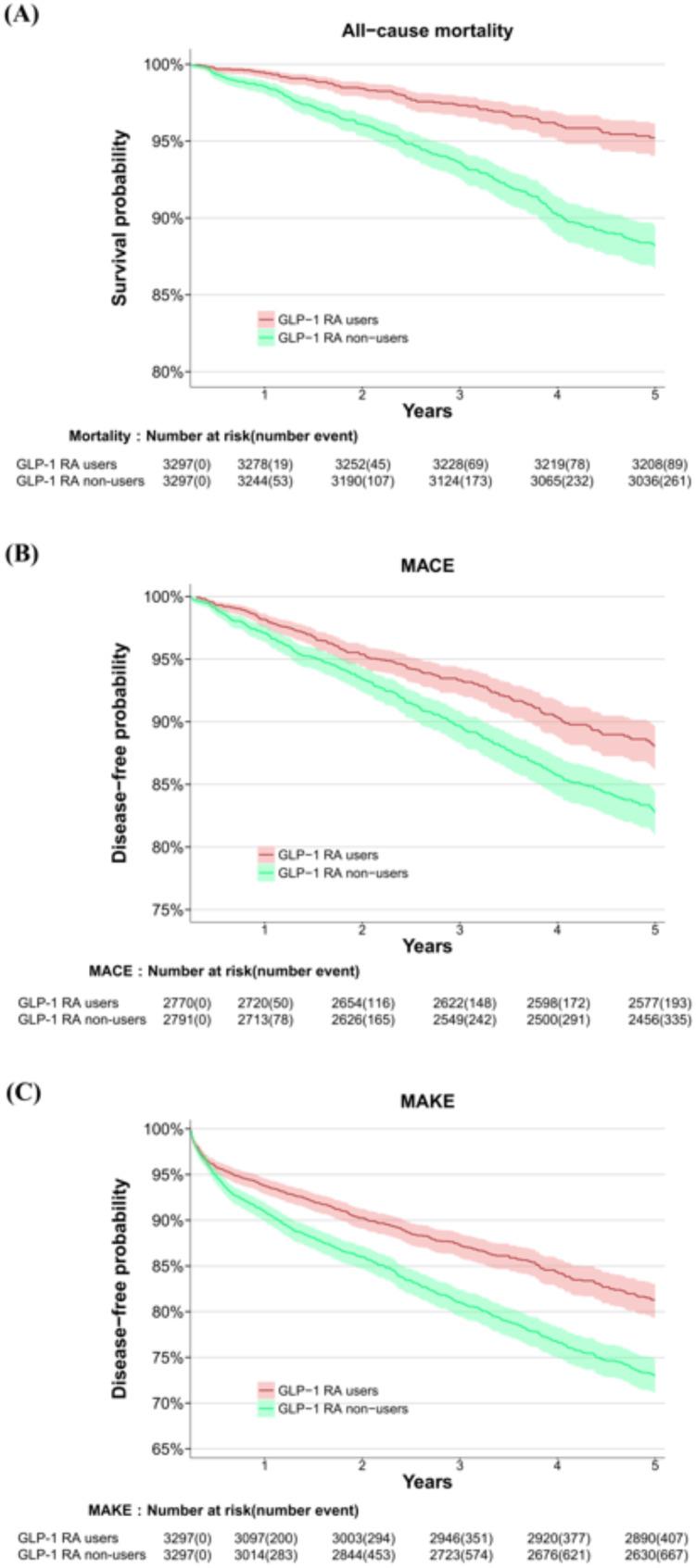
A total of 35,488 adult KTRs with T2DM (mean [SD] age, 57.7 [12.2] years; 57.7% men) were identified and 9.8% patients used GLP-1 RAs among 3 months post-transplant. Following PSM, 3564 GLP-1 RAs users were matched with an equal number of nonusers. After a median follow-up of 2.5 years, GLP-1 RAs users had lower risks of mortality (adjusted hazard ratio (aHR), 0.39; 95% CI 0.31-0.50), MACEs (aHR 0.66; 95% CI 0.56-0.79), and MAKEs (aHR 0.66; 95% CI 0.58-0.75). Adverse effects included higher risks of nausea, vomiting and diarrhea, while risks of suicide, hypoglycemia, retinopathy, and pancreatitis were not increased.
CONCLUSIONS
In KTRs with T2DM, GLP-1 RAs use was associated with substantial reductions in all-cause mortality, MAKEs, and MACEs compared to nonuse without increasing complications. However, the underutilization of GLP-1 RAs represents a significant opportunity to improve post-transplant outcomes in this high-risk population.
背景
心血管疾病是肾移植受者(KTRs)移植后死亡的主要原因,尤其是糖尿病患者。尽管胰高血糖素样肽-1受体激动剂(GLP-1 RAs)已在2型糖尿病(T2DM)普通人群中显示出心血管和肾脏益处,但关于其对糖尿病KTRs影响的证据有限。
方法
这项回顾性队列研究利用了TriNetX全球合作网络从2006年1月1日至2023年6月1日的数据。采用1:1比例的倾向评分匹配(PSM)来创建平衡队列。将移植后3个月内接受GLP-1 RAs的成年糖尿病KTRs与未接受的匹配队列进行比较。主要结局是全因死亡率,次要结局包括主要不良心血管事件(MACEs)和主要不良肾脏事件(MAKEs)。
结果
共识别出35488例成年糖尿病KTRs(平均[标准差]年龄,57.7[12.2]岁;57.7%为男性),9.8%的患者在移植后3个月内使用GLP-1 RAs。PSM后,3564例GLP-1 RAs使用者与同等数量的未使用者匹配。中位随访2.5年后,GLP-1 RAs使用者的死亡风险(调整后风险比[aHR],0.39;95%置信区间0.31-0.50)、MACEs(aHR 0.66;95%置信区间0.56-0.79)和MAKEs(aHR 0.66;95%置信区间0.58-0.75)较低。不良反应包括恶心、呕吐和腹泻风险较高,而自杀、低血糖、视网膜病变和胰腺炎风险未增加。
结论
在糖尿病KTRs中,与未使用GLP-1 RAs相比,使用GLP-1 RAs可显著降低全因死亡率、MAKEs和MACEs,且不增加并发症。然而,GLP-1 RAs的使用不足代表了改善这一高危人群移植后结局的重要机会。
 Zotero 插件